Freeze-Dried Pet Food Production: Equipment and Scale-Up Guide
A practical pet food freeze dryer guide covering product preparation, tray loading, condenser sizing, sanitation, packaging, and scale-up from H series to FFD.
Industrial Food Freeze Dryer
Watch the process
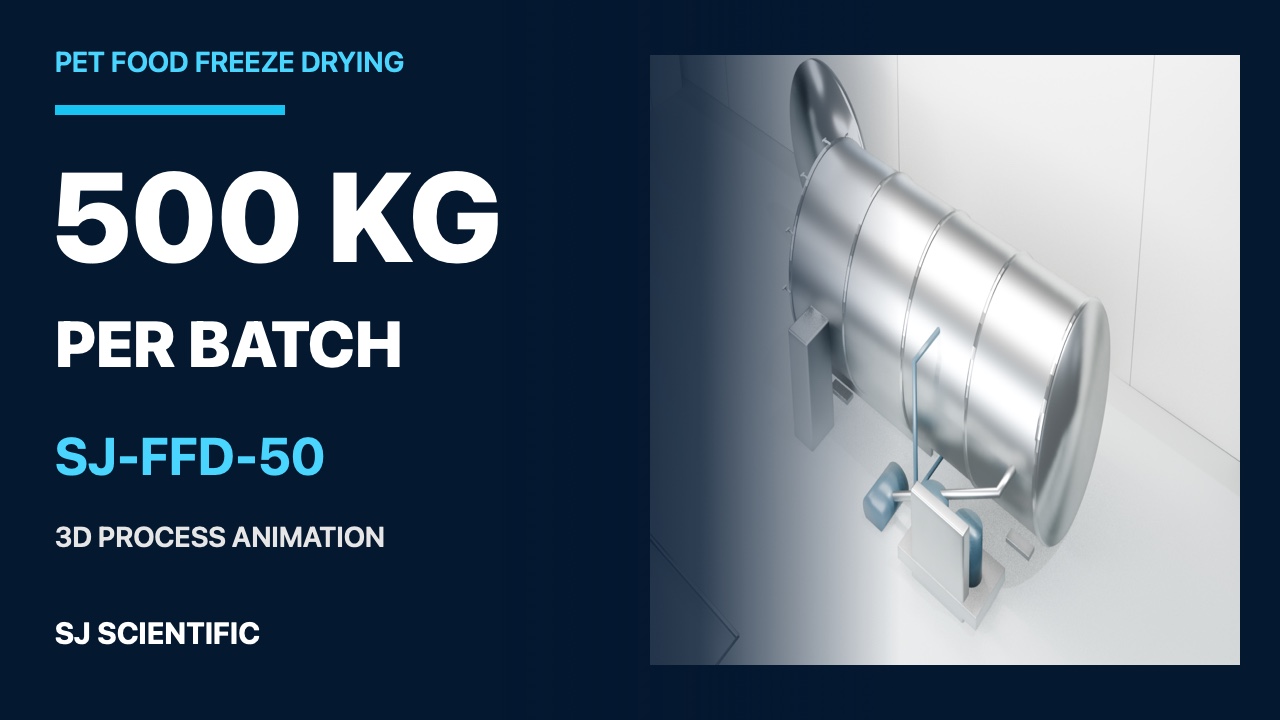
SJ-FFD-50 Pet Food Freeze-Drying Line: 3D Process Animation
Follow meat preparation, tray loading, pre-freezing and rack transfer to SJ FFD drying. Review fresh load, ice load and packing requirements separately.
3D concept. The 500 kg shown is reference fresh load, not guaranteed output.
Original 3D process concept, not customer-site footage or a validated production recipe. Loading, equipment configuration and process settings require project review.
Open video & English captionsQuick answer: A pet food freeze dryer should be selected from the real recipe and water load, not from fresh kilograms alone. Meat, organ, fish, poultry, toppers, training treats, and complete formulations can differ sharply in moisture, fat, piece size, tray depth, freezing behavior, drying time, cleaning, and packaging requirements.
Meat-cube freeze drying: follow the material through the line
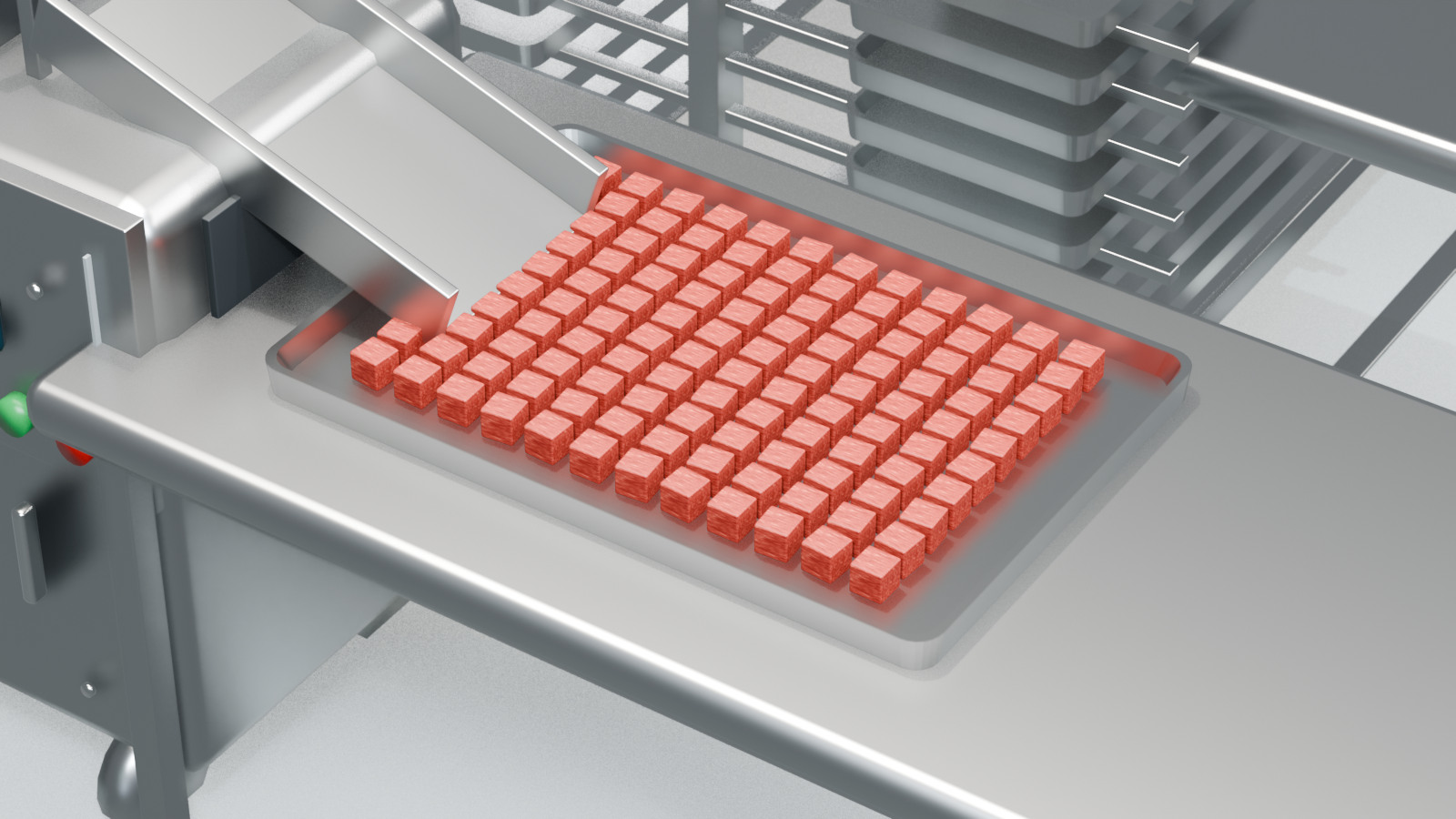
SJ Scientific process study, September 2026. The English animation follows diced meat from preparation to protected packing, using an SJ-FFD-50 reference arrangement. It is a 3D process concept, not customer-site footage, a delivered installation or a validated food-safety process.
Watch the 100-second process animation Choose an English model PDF
What changes at each step?
| Stage and equipment | Product state and practical check |
|---|---|
| Preparation and meat dicing | Record the recipe, raw or cooked condition, fat content and cube dimensions. The feed, cutting grid and cross-cut action in the animation explain size preparation; guarding and equipment selection need a separate review. |
| Tray and upper-rack loading | Spread the cubes in a repeatable shallow layer. Weigh a filled tray and record fill depth. A full rack fitting through the door does not prove that its water load fits the dryer. |
| Pre-freezing and frozen storage | Freeze the actual loaded trays, confirm the product-center condition, and maintain the frozen state. Distinguish freezing throughput from storage space. |
| Pre-cooling and rail transfer | Prepare the dryer before removing the load from cold storage. Dock the lower trolley; roll only the upper rack and product trays onto the chamber rails. |
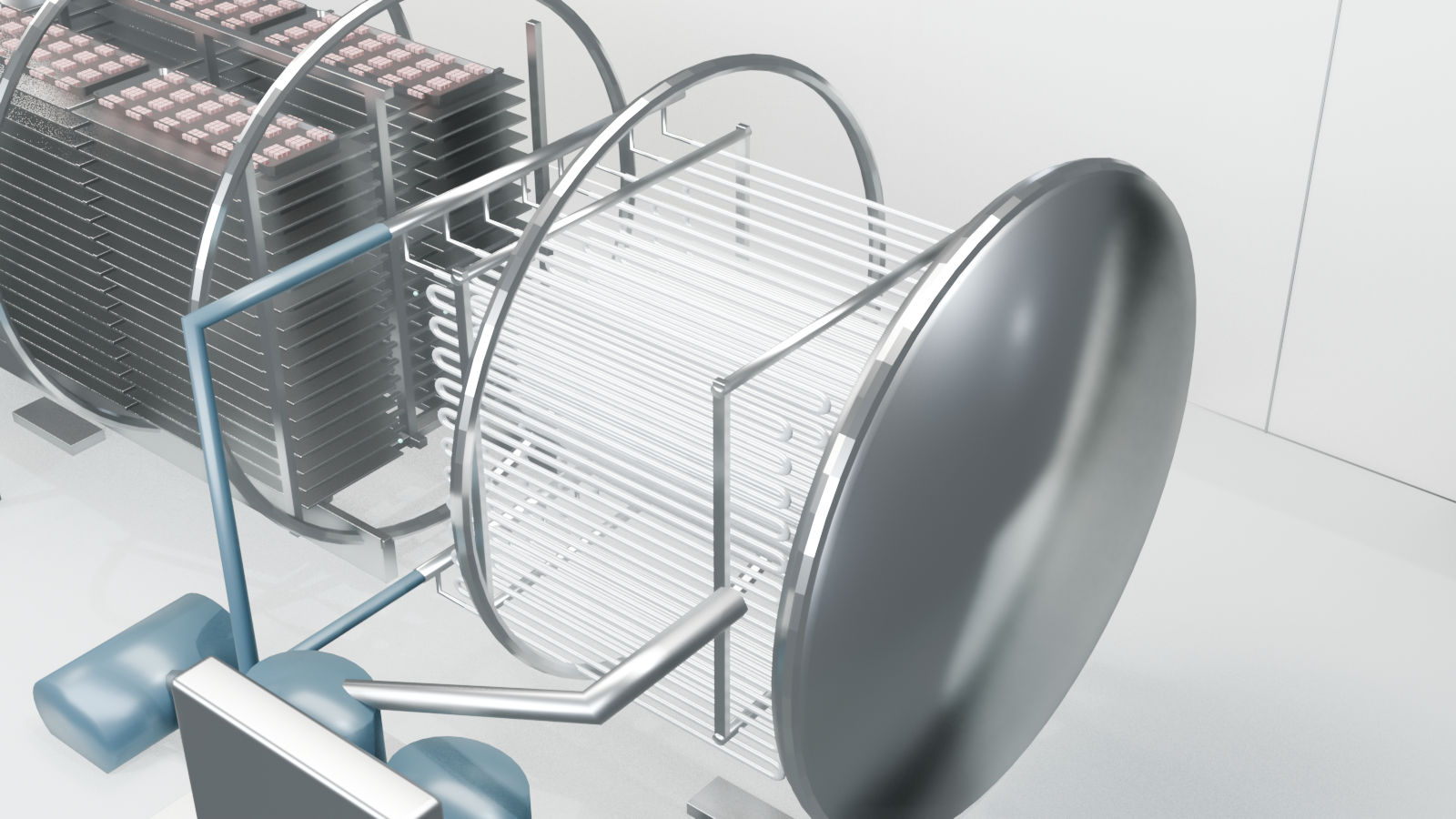
| Vacuum drying and vapor capture | Develop the shelf and pressure program for the product. Ice sublimes from the cubes; the rear refrigerated coil bank collects the vapor as ice. |
| Unloading and packing | After the defined endpoint and controlled repressurization, return the upper rack to the trolley. Inspect, test and protect the dried product promptly with the selected moisture-barrier package. |
The upper rack enters; the transfer trolley stays outside
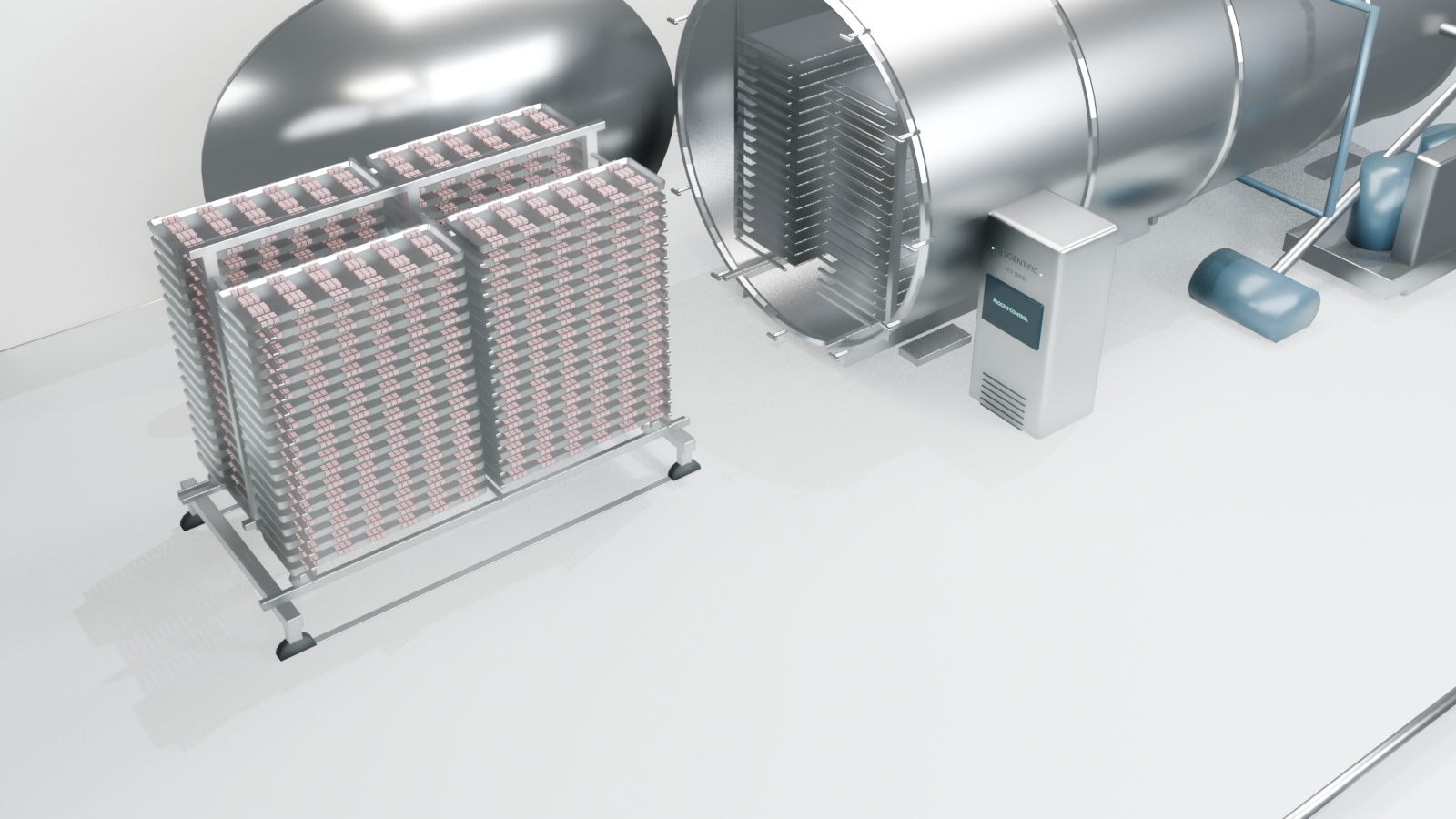
This distinction matters when planning the room. Agree the docking height, rail spacing, loaded rack weight, door clearance and trolley turning space before ordering upstream handling equipment. The twin shelf-bank illustration is one concept, not a dimensional drawing for every FFD model. The FFD-150 uses a project-defined modular arrangement; other models require their own approved loading drawing.
Do not confuse inventory, batch load and daily output
The FFD-50 video uses approximately 500 kg of prepared fresh material per batch as a planning reference. Its 5,000 kg frozen-storage label represents ten reference batches of inventory. Neither number describes finished dry weight, a freezer's freezing rate, or guaranteed kg/day. A cold room may hold ten batches yet be unable to freeze incoming material quickly enough to supply the line.
The illustrated shelf pre-cooling of -15 to -25 degrees C and cold-trap condition of -45 degrees C concern loading preparation only. They are not universal primary- or secondary-drying settings. Product trials must establish the temperature limits, loading pattern and drying endpoint.
Model-specific English process guides
| Model | Shelf area | Reference fresh load | English PDF |
|---|---|---|---|
| SJ-FFD-50 | 50 m2 | 500 kg/batch | FFD-50 PDF |
| SJ-FFD-100 | 100 m2 | 1000 kg/batch | FFD-100 PDF |
| SJ-FFD-150 | 150 m2 | 1500 kg/batch | FFD-150 PDF |
| SJ-FFD-200 | 200 m2 | 2000 kg/batch | FFD-200 PDF |
| SJ-FFD-250 | 250 m2 | 2500 kg/batch | FFD-250 PDF |
Each PDF contains three pages of process illustrations and model planning information. Shared pictures do not specify the exact rack or coil arrangement, and ten-batch cold storage is a planning example rather than standard supplied equipment. Compare the full SJ FFD series after checking recipe, removable water, tray loading and batch turnaround.
Make the next conversation specific
Send a product photograph, cube dimensions, kilograms and depth per tray, initial moisture, fat content, required fresh input and dry output, pre-freezing method, target endpoint, packaging and site utilities. Ask for energy on an agreed measurement basis: installed kW is not measured kWh per batch, and dryer-only energy excludes upstream freezing and other line equipment. Freeze drying does not replace the producer's food-safety and sanitation controls.
Discuss a pet-food FFD project. For a different material state and preparation route, see the coffee-extract and frozen-granule process study.
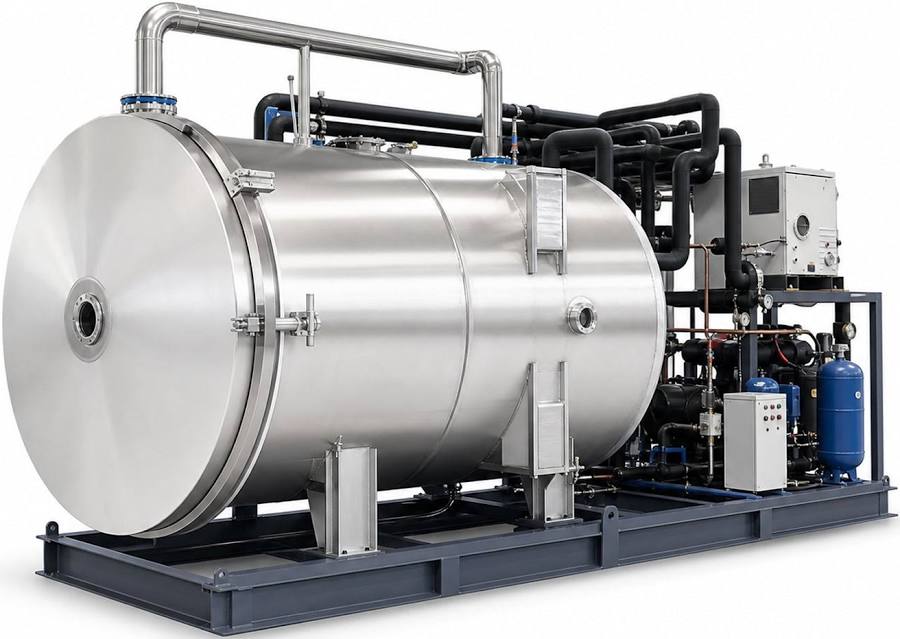
Pet food products that can be evaluated for freeze drying
- Single-ingredient treats: diced meat, poultry, fish, organ, and selected seafood products.
- Toppers and inclusions: flakes, crumbs, cubes, and high-value ingredients added to another food format.
- Formulated products: patties, nuggets, bites, or complete recipes whose handling and process have been developed for the intended market.
- Product-development batches: recipe comparison, piece-size trials, packaging studies, and scale-up data collection.
The freeze dryer is not the whole pet-food line. Receiving, cold storage, preparation, forming, hygienic controls, pre-freezing, loading, unloading, endpoint testing, metal or foreign-material control where required, and packaging must be defined around it.
Start with recipe, geometry, and water load
Two projects with the same fresh kilograms can require different shelf area and condenser duty. A thin diced lean-meat layer behaves differently from a thick, fatty formulation. Record each ingredient, incoming temperature, moisture, fat, salt or binder where relevant, piece dimensions, kilograms per tray, layer depth, number of trays, and water to be removed.
Use the prepared product load for equipment discussions. Marketing capacity such as “kilograms per batch” is only a reference until the actual recipe, tray pattern, pre-freezing, cycle, and endpoint are confirmed.
Recommended freeze-dried pet food workflow
- Define the product and controls: establish the recipe, supplier controls, intended market, process authority or qualified review where applicable, and release specifications.
- Prepare repeatably: control trimming, mixing, forming, piece size, and time-temperature handling according to the validated plan.
- Load the trays: record kilograms per tray, bed depth, spacing, and the exact loading map.
- Pre-freeze consistently: verify product-center temperature for the real loading pattern rather than checking air temperature alone.
- Develop primary drying: balance shelf temperature, chamber pressure, product temperature, vapor flow, and condenser margin.
- Develop secondary drying: continue to the defined product endpoint without assuming that a dry surface means a dry center.
- Unload and test: control exposure to room humidity and use the defined moisture, water-activity, and other release checks.
- Package promptly: use a moisture barrier and evaluate oxygen and light protection for the real formulation and shelf-life target.
Condenser duty, fat content, and cycle time
The condenser must handle the vapor released during the demanding part of the cycle with operating margin. Estimate removable water from the actual recipe, then confirm the design with trials and process data. More shelf area or deeper loading without matching condenser, refrigeration, vacuum, and heat-transfer performance can extend the cycle or narrow the operating window.
Fat does not sublimate like water. High-fat meat, organ, fish, and formulated products can change heat transfer, surface behavior, cleaning, oxidation control, and packaging. A pet food freeze dryer quotation should therefore request composition and product photographs, not only batch weight.
Data needed to size a pet food freeze dryer
| Input | Why it changes equipment selection |
|---|---|
| Recipe and ingredient percentages | Defines moisture, fat, structure, cleaning, and oxidation considerations. |
| Fresh kilograms per batch and day | Defines tray area, cycles, labor, pre-freezing, and packaging rhythm. |
| Incoming and target moisture | Estimates removable water and required condenser margin. |
| Piece size and product format | Changes freezing time, vapor path, handling, and cycle development. |
| Kilograms and depth per tray | Connects the product load to usable shelf area and drying time. |
| Pre-freezing method | Changes chamber occupancy, cart flow, and refrigeration planning. |
| Sanitation and changeover plan | Defines materials, drainage, cleaning access, zoning, and records. |
| Package and shelf-life target | Defines moisture-barrier, oxygen-control, and handling requirements. |
Commercial H or industrial FFD?
Use a Commercial H freeze dryer machine for food for product development, market validation, smaller premium batches, or cycle and packaging studies. SJ-30H, SJ-35H, and SJ-50H have approximately 30-70 kg reference fresh-food loads, but actual pet-food capacity must be confirmed from the recipe, loading, and cycle.
Move to an FFD industrial food freeze dryer when daily input, carts, separate pre-freezing, hygiene zones, condenser duty, utilities, unloading, and packaging need to operate as a factory workflow. FFD-50 to FFD-250 cover 50-250 m2 of shelf area and approximately 500-2500 kg reference fresh-food loads; the project basis still comes from actual product data.
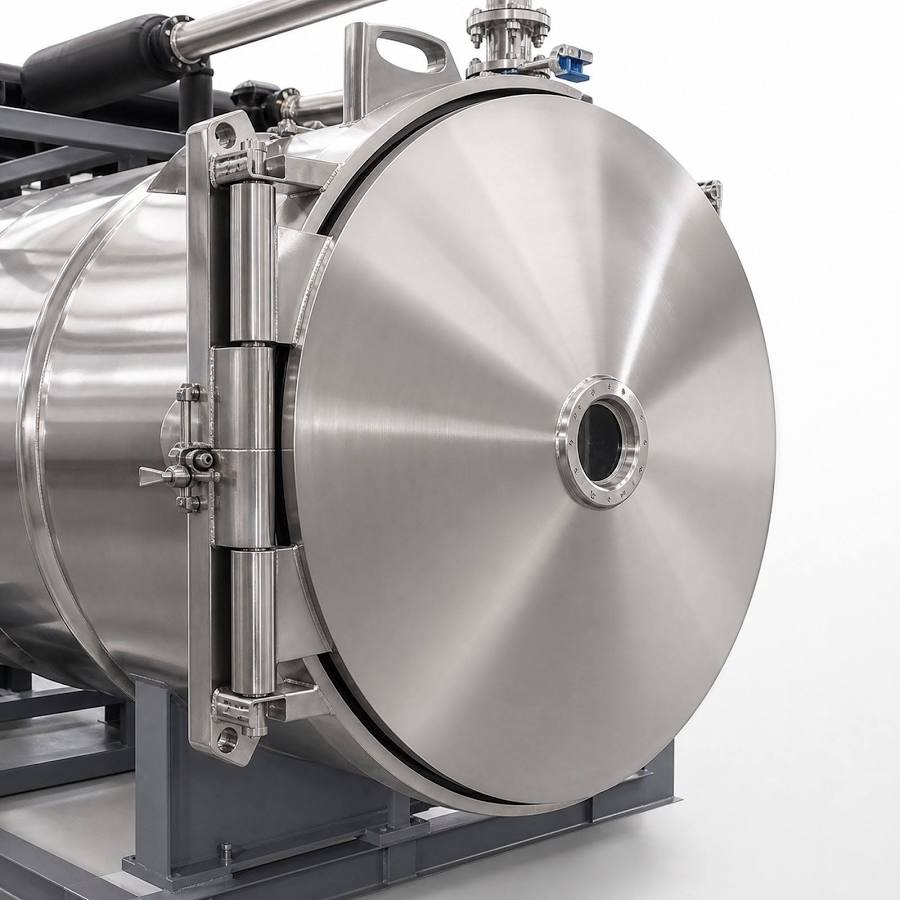
Specialty proteins and search terminology
Some pet-food buyers also search for black soldier fly farm equipment or insect-protein drying equipment when evaluating alternative protein treats. If an insect ingredient is part of the recipe, provide its exact prepared form, moisture, fat, piece size, tray loading, sanitation, and packaging requirements. SJ Scientific's scope on this page is the freeze-drying stage, not a complete insect-rearing or farm-equipment line.
This terminology should not replace the core engineering description. The same selection rule applies to meat, fish, organ, poultry, or insect ingredients: choose the freeze dryer from verified product data and the required production workflow.
What to include in a pet food equipment RFQ
Send product photographs, recipe and ingredient percentages, fresh kilograms per batch and day, moisture and fat data, piece dimensions, kilograms and depth per tray, pre-freezing method, target moisture or water activity, required cycles per day, sanitation and changeover requirements, packaging, site voltage, cooling water, room dimensions, and target launch volume.
For a first engineering review, compare the SJ-FFD-50, read the food freeze-drying process guide and industrial FFD operation guide, or send the pet-food process inputs.
Frequently asked questions
What pet food products can be freeze dried?
Meat, organ, fish, poultry, toppers, training treats, and developed formulations can be evaluated. Suitability and process requirements depend on the recipe, geometry, food-safety plan, endpoint, and package.
How is pet food freeze dryer capacity calculated?
Start with recipe, fresh load, moisture, removable water, fat, piece size, kilograms and depth per tray, pre-freezing, cycle target, and condenser margin. A generic fresh-kilogram rating is only a reference.
Does a pet food freeze dryer make raw product automatically safe?
No. Freeze drying is not a substitute for a validated food-safety program. The producer must define supplier, preparation, process, sanitation, testing, release, packaging, and regulatory controls for the intended market.
Which SJ freeze dryer is suitable for pet food trials?
H and Commercial H models support development and smaller production. FFD systems are considered when the project requires factory-scale input, carts, separate pre-freezing, utilities, hygienic workflow, and industrial packaging.
What data is needed for pet food freeze dryer sizing?
Provide photographs, recipe, batch and daily load, moisture, fat, piece size, tray load and depth, pre-freezing, target endpoint, cycle target, sanitation, packaging, and site utilities.
Does the lower transfer trolley enter the FFD chamber?
In the illustrated concept, only the upper rack and product trays enter; the lower trolley stays outside. Docking height, rails, load and clearances must follow the selected model and approved project drawing.
Does the 5,000 kg freezer example mean 5,000 kg of freeze-dried product per day?
No. It illustrates frozen inventory for ten reference FFD-50 batches. Freezing rate, dryer batch load, daily throughput and final dry weight are separate quantities.