Freeze Dryer for Candy: Small-Business Machine Selection and Batch Planning
A practical guide to testing candy, calculating tray capacity, choosing an H-series food freeze dryer, and planning a repeatable small commercial process.
Food Freeze Dryer
Short answer: a freeze dryer for candy should be selected from real candy trials, not from a generic fresh-food kilogram rating. Record the formula, piece dimensions, loading pattern, expansion, sticking, cycle time, finished texture, package response, and pieces or kilograms per usable tray. Then choose enough tray area, vertical clearance, vacuum and shelf-heat control, cleaning access, and weekly throughput for the intended business.
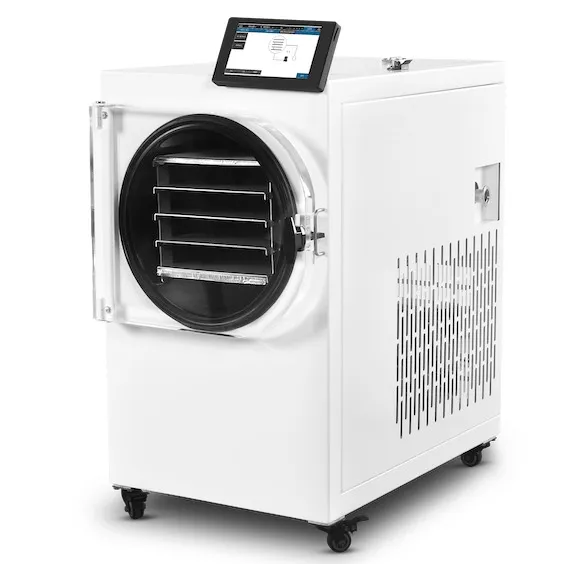
This guide covers searches such as freeze dryer for candy, candy freeze dryer machine, freeze dryer for sweets, and freeze dryer for small business. It links to the existing small H-series food freeze dryers and commercial H-series machines without changing those indexed product pages.
Candy is not one universal freeze-drying process
Fruit, cooked meals, confectionery, and pharmaceutical vials do not behave alike. A fruit process normally freezes water in the product and removes that ice by sublimation. In confectionery, product behavior may also be dominated by dissolved sugar, gas, gelatin, starch, fat, coatings, inclusions, and expansion under reduced pressure. Some products expand readily; others soften, foam, stick, collapse, or show little useful change.
Do not copy one candy recipe to another formula merely because the pieces look similar. Confirm whether the proposed route uses pre-freezing, conditioning or preheating, controlled vacuum exposure, shelf heating, or a combination. The machine can provide a controlled environment, but it does not make every candy suitable.
Run a structured test before selecting machine size
A useful trial report is more valuable than a list of successful candy names. For every test, record:
- product name, supplier, lot, ingredient list, coating, filling, and known allergens;
- piece length, width, height, mass, and starting condition;
- tray type, liner, spacing, pieces per tray, kilograms per tray, and unused edge area;
- pre-freezing or conditioning method, shelf program, pressure behavior, and elapsed time;
- maximum expansion, contact between pieces, sticking, breakage, color, texture, and center condition;
- finished mass, moisture or water-activity result where applicable, package type, and quality after storage.
Test at least several representative lots. A formula or supplier change can alter expansion and drying behavior. Preserve the test records as the basis for recipes, loading instructions, cost calculations, and future scale-up.
Calculate capacity from usable tray area and spacing
A candy machine should be sized from the qualified loading pattern. The same tray may carry many small hard pieces or far fewer large gummies and marshmallows. Expansion space can limit capacity before kilograms do.
| Capacity input | How to establish it | Why it matters |
|---|---|---|
| Pieces per tray | Count a non-contact loading pattern after allowing for expansion | Supports order and package planning |
| Qualified kg per tray | Weigh the repeatable loading pattern | Converts tray results into batch mass |
| Usable trays per batch | Confirm tray dimensions and shelf clearance | Defines practical batch capacity |
| Good finished yield | Exclude broken, fused, underprocessed, or rejected product | Prevents overstating saleable output |
| Door-to-door time | Include loading, recipe, unloading, defrost, cleaning, and checks | Determines realistic batches per week |
Planning batch mass can be expressed as qualified kilograms per tray multiplied by the number of usable trays. Weekly saleable output should then apply the observed good-yield percentage and realistic number of completed batches. This method is safer than multiplying a catalog fresh-food rating by an assumed candy factor.
Machine features that matter for candy
- Tray area and geometry: compare usable dimensions, number of trays, edge clearance, and loading ergonomics.
- Vertical clearance: leave room for the tallest starting piece and its tested expansion without touching the next tray.
- Vacuum behavior: the pump, valves, sensor, and controller should reach and hold the process range without uncontrolled pressure swings.
- Shelf heating: controlled, repeatable heat input is more useful than an unverified maximum temperature.
- Recipe and data functions: named programs, trends, alarms, and batch records help repeat a qualified route.
- Condenser and defrost: candy can contain less removable water than fruit, but vapor still needs capture and each batch needs a practical turnaround.
- Cleaning: sugar dust, fragments, melted coatings, fats, colors, and allergens must be accessible for removal.
- Utilities and environment: confirm voltage, current, ventilation, pump exhaust, noise, drainage, working space, and room temperature.
Match H-series size to the business stage
| Business stage | Useful starting range | Selection logic |
|---|---|---|
| Recipe tests and market samples | SJ-05H or SJ-08H | Prove formula, loading, packaging, and customer acceptance with limited capital exposure |
| Micro-production and regular online orders | SJ-10H, SJ-15H, or SJ-20H | Increase tray area after one qualified product and package have demonstrated repeat demand |
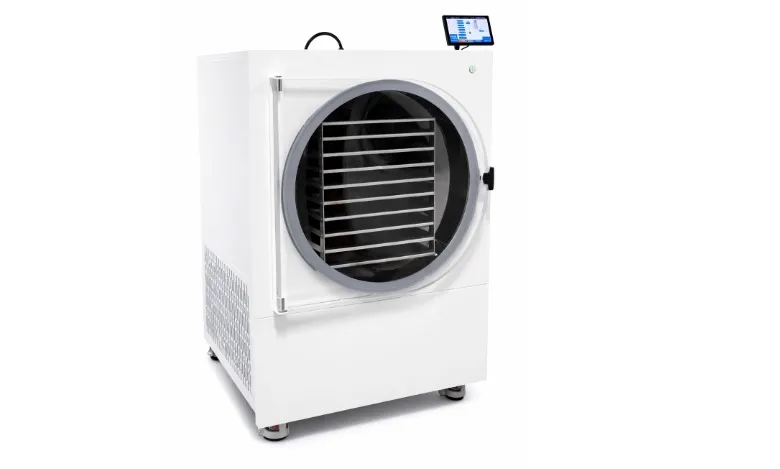
| Dedicated commercial room | SJ-30H, SJ-35H, or SJ-50H | Plan greater tray handling, packaging, utilities, sanitation, spares, and operating schedule |
These fresh-food model references are not guaranteed candy loads. Final selection should use the trial-derived pieces per tray, qualified kilograms per tray, good yield, and door-to-door batch time.
Plan the complete small-business workflow
The freeze dryer is only one station. Map ingredient receiving, lot identification, storage, preparation, tray staging, processing, unloading, inspection, weighing, packaging, labeling, finished-goods storage, rejected product, cleaning, and record retention. Avoid crossing raw ingredients, open finished product, packaging waste, and cleaned trays through the same congested path.
Freeze drying is not a kill step and vacuum packaging is not a safety step. Apply appropriate food-handling, sanitation, allergen-control, and regulatory requirements for the product and sales location. In the United States, commercial operators should review applicable FDA, state, and local requirements, including facility registration where required, 21 CFR Part 117, labeling, and allergen controls.
Packaging is part of the qualified process
Expanded candy can be fragile and moisture-sensitive. Select package dimensions from the finished product, not the starting pieces. Validate seal integrity, moisture and oxygen barrier as needed, headspace, breakage in shipment, label fit, and product quality throughout the intended storage period. Do not publish a shelf-life claim based only on the machine cycle.
Build the real cost per saleable package
Include ingredients, rejects, machine depreciation or finance, vacuum-pump service, electricity, labor, packaging, labels, testing, sanitation, rent, permits, freight, marketplace fees, and warranty or spare parts. Divide by saleable packages, not by theoretical tray capacity. A larger machine can reduce labor per kilogram only when sales, preparation, packaging, and utilities can keep it loaded.
Information for a candy freeze dryer quotation
Send candy photos and ingredient information, piece dimensions and mass, trial route, pieces and kilograms per tray, expansion allowance, target batches per week, package size, electrical supply, room conditions, installation country, and required data functions. Use the food freeze dryer inquiry form for a configuration review.
Technical and regulatory references
Frequently asked questions
What size freeze dryer is best for a candy business?
Start from qualified pieces or kilograms per tray, usable trays, good yield, door-to-door batch time, weekly demand, and available utilities. Small H-series units suit testing and micro-production; 30H-50H models suit dedicated commercial rooms.
Can every candy be freeze dried?
No. Formula, sugar system, gelatin or starch, fat, coatings, fillings, gas structure, and process route affect whether a product expands, sticks, collapses, or develops a useful texture.
How many candy pieces fit in one batch?
Count a tested non-contact loading pattern after allowing for expansion. Multiply qualified pieces per tray by usable trays, then apply the observed good-yield percentage.
Does candy need to be frozen before the vacuum cycle?
That depends on the formulation and validated process route. Do not assume that a fruit freeze-drying recipe or another candy recipe applies; test the specific product and document the method.
What costs should a freeze-dried candy business include?
Include ingredients, rejects, equipment, finance, pump maintenance, electricity, labor, packaging, labels, testing, sanitation, premises, permits, freight, marketplace fees, spares, and warranty support.