H Series Freeze Dryer Loading Capacity Guide
Weigh a sample to estimate tray and batch wet load for eight SJ H Series food freeze dryers, with illustrated steps and clearly stated area assumptions.
Food Freeze Dryer Loading
Weigh a sample to estimate tray and batch capacity. This guide helps you relate your own food product to the tray area of an SJ H Series freeze dryer before purchasing or planning a trial. It estimates wet material before drying, not finished-product yield or guaranteed throughput within a particular cycle.
SJ-05H · SJ-08H · SJ-10H Smart · SJ-15H Smart · SJ-20H Smart · SJ-30H · SJ-35H · SJ-50H
Start with one small sample
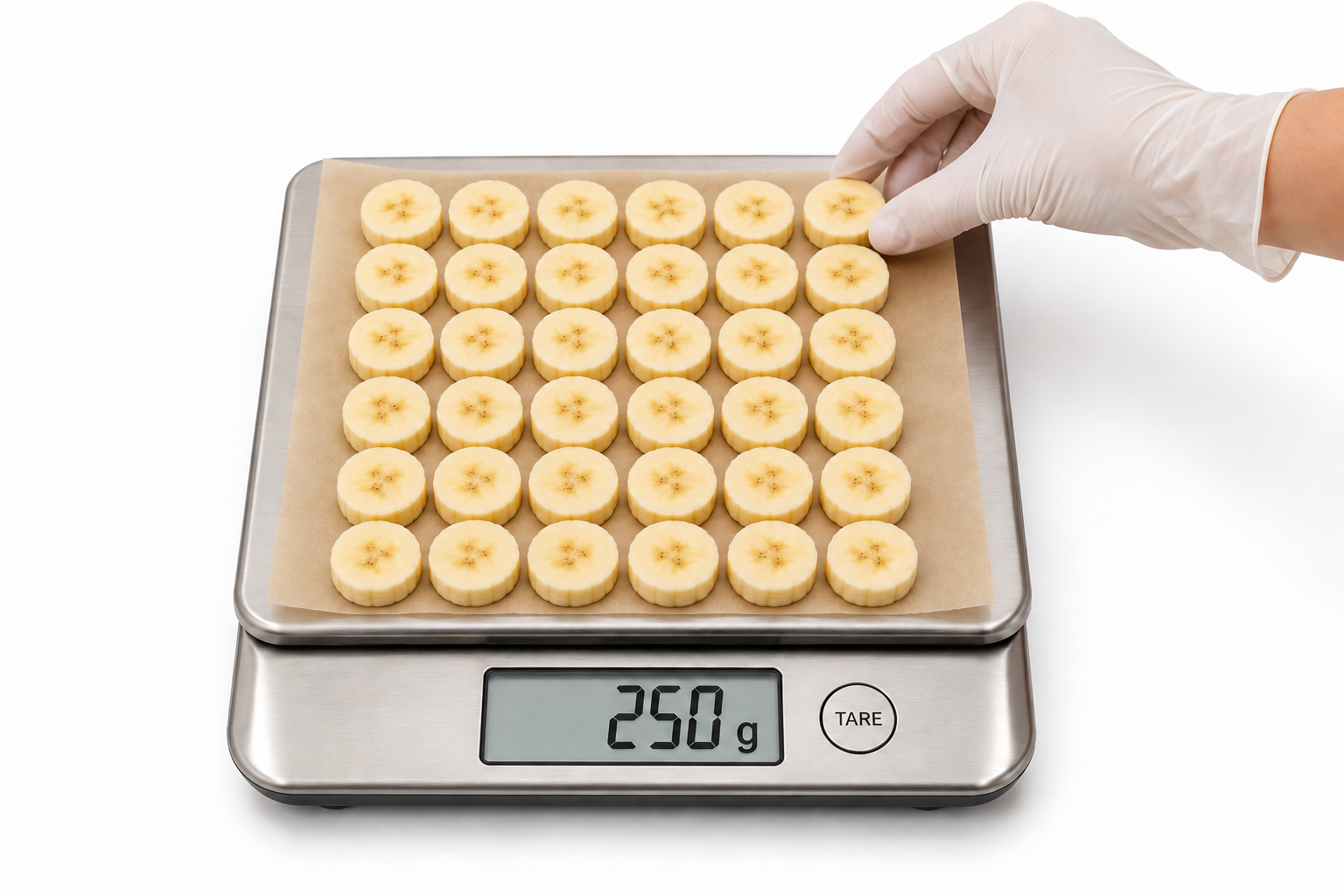
Suppose banana slices occupy a single-layer 20 × 20 cm footprint and weigh 250 g net. An SJ-05H nominal tray area of 1210 cm² gives 1210 ÷ 400 = 3.025. The estimate is 250 × 3.025 = 756.25 g per tray, or 3.025 kg across 4 trays (about 3.03 kg). This is an arithmetic example, not a measured banana batch.
← 20 cm →
↑
20 cm
↓
20 × 20 = 400 cm²
The dimension box represents the assumed occupied sample footprint; the photograph is not a scaled measurement. Measure the entire occupied rectangle, including normal gaps between pieces.
Four steps to estimate a load
- Prepare representative pieces. Use the same thickness and arrangement as the intended batch. Keep fruit slices in one layer without overlap; meat pieces may be placed closely.
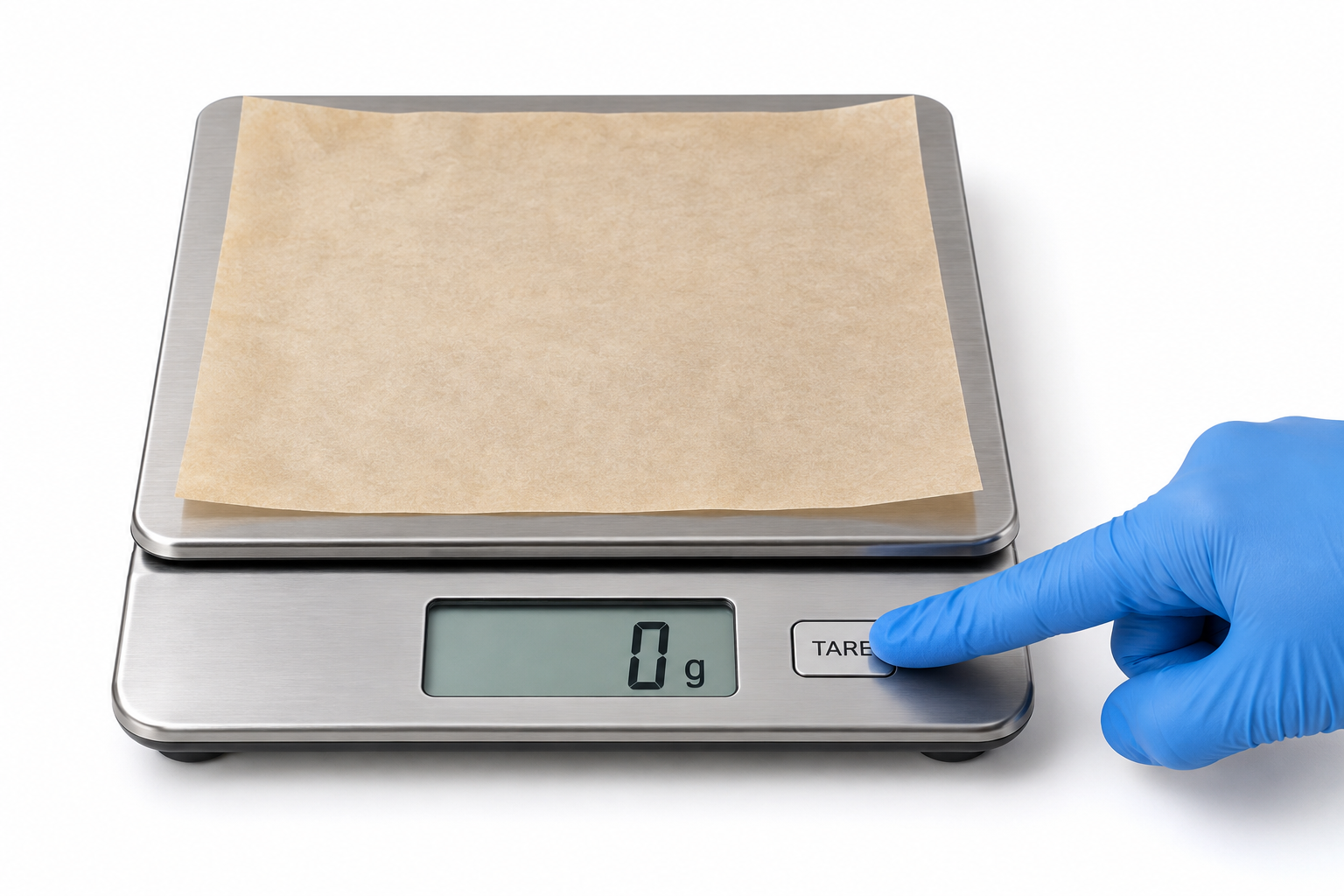
- Tare, then weigh net food. Place food-contact baking paper and any required container on the scale, then tare to zero. Add the food, release your hands and read the stable net weight.
- Measure the occupied rectangle. Record length and width, including normal gaps. The 20 × 20 cm footprint is only a convenient example; your sample does not need to be exactly 400 cm².
- Scale by area. Divide measured usable tray area by sample area, then multiply by sample net weight. Multiply by the number of trays actually used for the batch; calculate different tray sizes separately.
Area multiplier = usable tray area ÷ occupied sample area
Wet load per tray = sample net weight × area multiplier
Wet batch load = wet load per tray × trays used
Example cuts and assumed weights
| Food | Example cut / arrangement | Assumed net weight / 400 cm² |
|---|---|---|
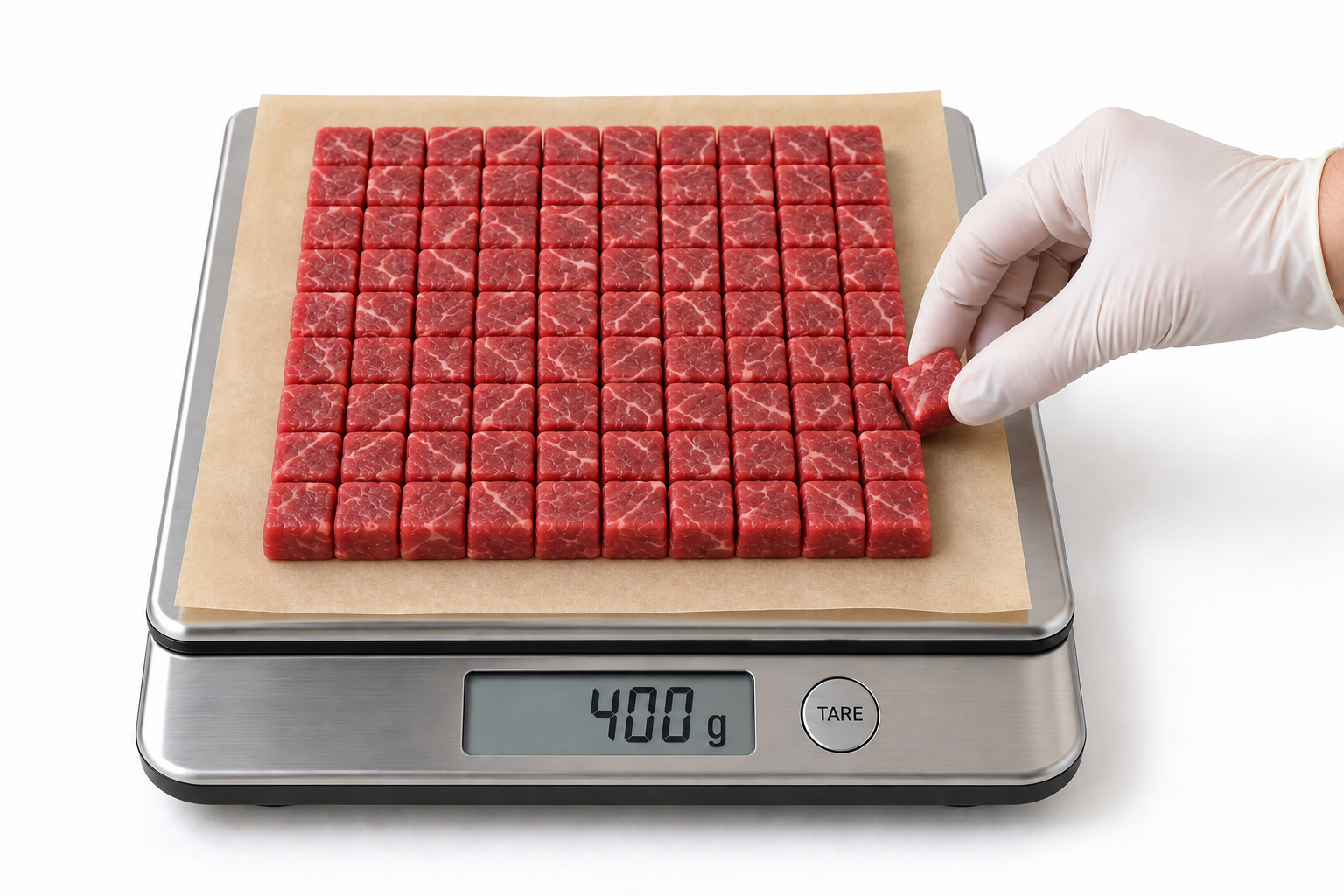
| Beef | 20 × 20 × 10 mm; smaller pieces may fill edges | 400 g |
| Chicken | Consistent thickness; weigh your own material | 390 g |
| Strawberry | About 40 × 30 mm, 8–10 mm thick; whole slices | 270 g |
| Banana | About 30 mm diameter, 8–10 mm thick; whole slices | 250 g |
Choose a model and check the area basis
The first seven models use approximate catalog nominal dimensions before wall/rim allowance. The 50H solid and liquid examples use different area bases, explained in its section. Results are calculated from unrounded values and rounded only for display.
SJ-05H: loading estimate
View product: SJ-05H · 4 trays
Tray footprint proportions: 550 × 220 mm
↕ 220 mm
Approximation from catalog nominal dimensions 550 × 220 mm, before wall/rim allowance: 1210 cm² per tray. This is not a measured usable inner base.
Area multiplier: 1210 ÷ 400 = 3.025
| Assumed sample / 400 cm² | Wet kg / tray | Wet kg / batch |
|---|---|---|
| Beef (400 g) | 1.21 | 4.84 |
| Chicken (390 g) | 1.18 | 4.72 |
| Strawberry (270 g) | 0.82 | 3.27 |
| Banana (250 g) | 0.76 | 3.03 |
All values above are calculated examples, not measured loads or guaranteed capacity. Substitute your own sample net weight and measured usable tray area.
| Liquid depth | Approx. L / tray | Approx. L / batch |
|---|---|---|
| 10 mm | 1.21 | 4.84 |
| 15 mm (process-dependent) | 1.82 | 7.26 |
Liquid volumes use the nominal/outer dimensions above without deducting walls. Litres are not kilograms. The 15 mm row is a deeper-fill comparison, not a universal loading recommendation.
SJ-08H: loading estimate
View product: SJ-08H · 5 trays
Tray footprint proportions: 612 × 265 mm
↕ 265 mm
Approximation from catalog nominal dimensions 612 × 265 mm, before wall/rim allowance: 1621.8 cm² per tray. This is not a measured usable inner base.
Area multiplier: 1621.8 ÷ 400 = 4.0545
| Assumed sample / 400 cm² | Wet kg / tray | Wet kg / batch |
|---|---|---|
| Beef (400 g) | 1.62 | 8.11 |
| Chicken (390 g) | 1.58 | 7.91 |
| Strawberry (270 g) | 1.09 | 5.47 |
| Banana (250 g) | 1.01 | 5.07 |
All values above are calculated examples, not measured loads or guaranteed capacity. Substitute your own sample net weight and measured usable tray area.
| Liquid depth | Approx. L / tray | Approx. L / batch |
|---|---|---|
| 10 mm | 1.62 | 8.11 |
| 15 mm (process-dependent) | 2.43 | 12.16 |
Liquid volumes use the nominal/outer dimensions above without deducting walls. Litres are not kilograms. The 15 mm row is a deeper-fill comparison, not a universal loading recommendation.
SJ-10H Smart: loading estimate
View product: SJ-10H Smart · 6 trays
Tray footprint proportions: 612 × 265 mm
↕ 265 mm
Approximation from catalog nominal dimensions 612 × 265 mm, before wall/rim allowance: 1621.8 cm² per tray. This is not a measured usable inner base.
Area multiplier: 1621.8 ÷ 400 = 4.0545
| Assumed sample / 400 cm² | Wet kg / tray | Wet kg / batch |
|---|---|---|
| Beef (400 g) | 1.62 | 9.73 |
| Chicken (390 g) | 1.58 | 9.49 |
| Strawberry (270 g) | 1.09 | 6.57 |
| Banana (250 g) | 1.01 | 6.08 |
All values above are calculated examples, not measured loads or guaranteed capacity. Substitute your own sample net weight and measured usable tray area.
| Liquid depth | Approx. L / tray | Approx. L / batch |
|---|---|---|
| 10 mm | 1.62 | 9.73 |
| 15 mm (process-dependent) | 2.43 | 14.6 |
Liquid volumes use the nominal/outer dimensions above without deducting walls. Litres are not kilograms. The 15 mm row is a deeper-fill comparison, not a universal loading recommendation.
SJ-15H Smart: loading estimate
View product: SJ-15H Smart · 7 trays
Tray footprint proportions: 780 × 265 mm
↕ 265 mm
Approximation from catalog nominal dimensions 780 × 265 mm, before wall/rim allowance: 2067 cm² per tray. This is not a measured usable inner base.
Area multiplier: 2067 ÷ 400 = 5.1675
| Assumed sample / 400 cm² | Wet kg / tray | Wet kg / batch |
|---|---|---|
| Beef (400 g) | 2.07 | 14.47 |
| Chicken (390 g) | 2.02 | 14.11 |
| Strawberry (270 g) | 1.4 | 9.77 |
| Banana (250 g) | 1.29 | 9.04 |
All values above are calculated examples, not measured loads or guaranteed capacity. Substitute your own sample net weight and measured usable tray area.
| Liquid depth | Approx. L / tray | Approx. L / batch |
|---|---|---|
| 10 mm | 2.07 | 14.47 |
| 15 mm (process-dependent) | 3.1 | 21.7 |
Liquid volumes use the nominal/outer dimensions above without deducting walls. Litres are not kilograms. The 15 mm row is a deeper-fill comparison, not a universal loading recommendation.
SJ-20H Smart: loading estimate
View product: SJ-20H Smart · 9 trays
Tray footprint proportions: 600 × 410 mm
↕ 410 mm
Approximation from catalog nominal dimensions 600 × 410 mm, before wall/rim allowance: 2460 cm² per tray. This is not a measured usable inner base.
Area multiplier: 2460 ÷ 400 = 6.15
| Assumed sample / 400 cm² | Wet kg / tray | Wet kg / batch |
|---|---|---|
| Beef (400 g) | 2.46 | 22.14 |
| Chicken (390 g) | 2.4 | 21.59 |
| Strawberry (270 g) | 1.66 | 14.94 |
| Banana (250 g) | 1.54 | 13.84 |
All values above are calculated examples, not measured loads or guaranteed capacity. Substitute your own sample net weight and measured usable tray area.
| Liquid depth | Approx. L / tray | Approx. L / batch |
|---|---|---|
| 10 mm | 2.46 | 22.14 |
| 15 mm (process-dependent) | 3.69 | 33.21 |
Liquid volumes use the nominal/outer dimensions above without deducting walls. Litres are not kilograms. The 15 mm row is a deeper-fill comparison, not a universal loading recommendation.
SJ-30H: loading estimate
View product: SJ-30H · 18 trays
Tray footprint proportions: 405 × 405 mm
↕ 405 mm
Approximation from catalog nominal dimensions 405 × 405 mm, before wall/rim allowance: 1640.25 cm² per tray. This is not a measured usable inner base.
Area multiplier: 1640.25 ÷ 400 = 4.100625
| Assumed sample / 400 cm² | Wet kg / tray | Wet kg / batch |
|---|---|---|
| Beef (400 g) | 1.64 | 29.52 |
| Chicken (390 g) | 1.6 | 28.79 |
| Strawberry (270 g) | 1.11 | 19.93 |
| Banana (250 g) | 1.03 | 18.45 |
All values above are calculated examples, not measured loads or guaranteed capacity. Substitute your own sample net weight and measured usable tray area.
| Liquid depth | Approx. L / tray | Approx. L / batch |
|---|---|---|
| 10 mm | 1.64 | 29.52 |
| 15 mm (process-dependent) | 2.46 | 44.29 |
Liquid volumes use the nominal/outer dimensions above without deducting walls. Litres are not kilograms. The 15 mm row is a deeper-fill comparison, not a universal loading recommendation.
SJ-35H: loading estimate
View product: SJ-35H · 18 trays
Tray footprint proportions: 475 × 410 mm
↕ 410 mm
Approximation from catalog nominal dimensions 475 × 410 mm, before wall/rim allowance: 1947.5 cm² per tray. This is not a measured usable inner base.
Area multiplier: 1947.5 ÷ 400 = 4.86875
| Assumed sample / 400 cm² | Wet kg / tray | Wet kg / batch |
|---|---|---|
| Beef (400 g) | 1.95 | 35.06 |
| Chicken (390 g) | 1.9 | 34.18 |
| Strawberry (270 g) | 1.31 | 23.66 |
| Banana (250 g) | 1.22 | 21.91 |
All values above are calculated examples, not measured loads or guaranteed capacity. Substitute your own sample net weight and measured usable tray area.
| Liquid depth | Approx. L / tray | Approx. L / batch |
|---|---|---|
| 10 mm | 1.95 | 35.06 |
| 15 mm (process-dependent) | 2.92 | 52.58 |
Liquid volumes use the nominal/outer dimensions above without deducting walls. Litres are not kilograms. The 15 mm row is a deeper-fill comparison, not a universal loading recommendation.
SJ-50H: loading estimate
View product: SJ-50H · 18 trays
Tray footprint proportions: 685 × 404 mm
↕ 404 mm
18 trays on 9 levels, 2 trays per level. 404 × 685 × 20 mm describes outer dimensions; the usable inner base has not been measured. The tray has straight walls and edges, square corners and no rolled upper rim. This solid-food example assumes a 670 × 390 mm inner base (2613 cm²), not a measured specification.
Area multiplier: 2613 ÷ 400 = 6.5325
| Assumed sample / 400 cm² | Wet kg / tray | Wet kg / batch |
|---|---|---|
| Beef (400 g) | 2.61 | 47.03 |
| Chicken (390 g) | 2.55 | 45.86 |
| Strawberry (270 g) | 1.76 | 31.75 |
| Banana (250 g) | 1.63 | 29.4 |
All values above are calculated examples, not measured loads or guaranteed capacity. Substitute your own sample net weight and measured usable tray area.
| Liquid depth | Approx. L / tray | Approx. L / batch |
|---|---|---|
| 10 mm | 2.77 | 49.81 |
| 15 mm (process-dependent) | 4.15 | 74.72 |
Liquid volumes use the nominal/outer dimensions above without deducting walls. Litres are not kilograms. The 15 mm row is a deeper-fill comparison, not a universal loading recommendation. The SJ-50H liquid reference wet-load range is 50–80 kg, subject to actual weighing and process confirmation. Do not relabel approximately 49.8 L / 74.7 L as kg.
How do I estimate a liquid load?
Multiply the measured usable inner-base area by liquid depth to estimate volume. With all dimensions in millimetres: length × width × depth ÷ 1,000,000 = litres. The 10 mm depth is an ordinary example; 15 mm is a comparison requiring confirmation of the formulation, freezing method, drying endpoint, tray height and headroom. Do not fill to the rim or increase depth merely to reach an advertised kilogram figure. Weigh liquid directly to obtain its mass.
Frequently asked questions
Why can this estimate be lower than the model’s kg/batch range?
Shape, moisture, thickness and gaps vary between foods, so a given tray area does not correspond to one fixed weight. Whole fruit slices may weigh less than liquids or closely packed meat on the same area. A model reference range does not replace a product trial.
Can this estimate establish daily production?
No. Area scaling estimates wet loading only. Daily throughput also depends on the actual drying cycle, pre-freezing, defrosting, cleaning, handling time, condenser water load and equipment configuration. Confirm it with trials using the actual food.
Are these pictures and sample weights test results?
No. The images are instructional illustrations and 400/390/270/250 g are calculation assumptions. In particular, the 50H 670 × 390 mm inner base is illustrative and has not been measured. Use your own measured usable area and net weight.
Is wet load the same as finished freeze-dried weight?
No. Freeze drying removes water. Finished weight depends on initial moisture, target residual moisture and processing losses. Loading calculations do not establish food safety or microbial inactivation.
Ask SJ to review your loading plan
Share the food type, cut thickness, sample footprint, net weight, usable tray dimensions, target batch and site power supply. These inputs help us discuss model selection and trial planning. Final loading and cycle duration depend on the actual food and confirmed configuration. Discuss loading and model selection
Source: SJ H Series loading illustrations and model calculation sheet. Prepared 17 October 2026.