SJ-FFD-200 Industrial Food Freeze Dryer - 200 m2, Approx. 2000 kg/batch
Industrial Food Freeze Dryer
Model designation: SJ-FFD-200 is the primary public model. SJIA-FFD-200 may appear in factory records, nameplates, quotations, or earlier technical documents; both refer to the same SJIALAB equipment model.
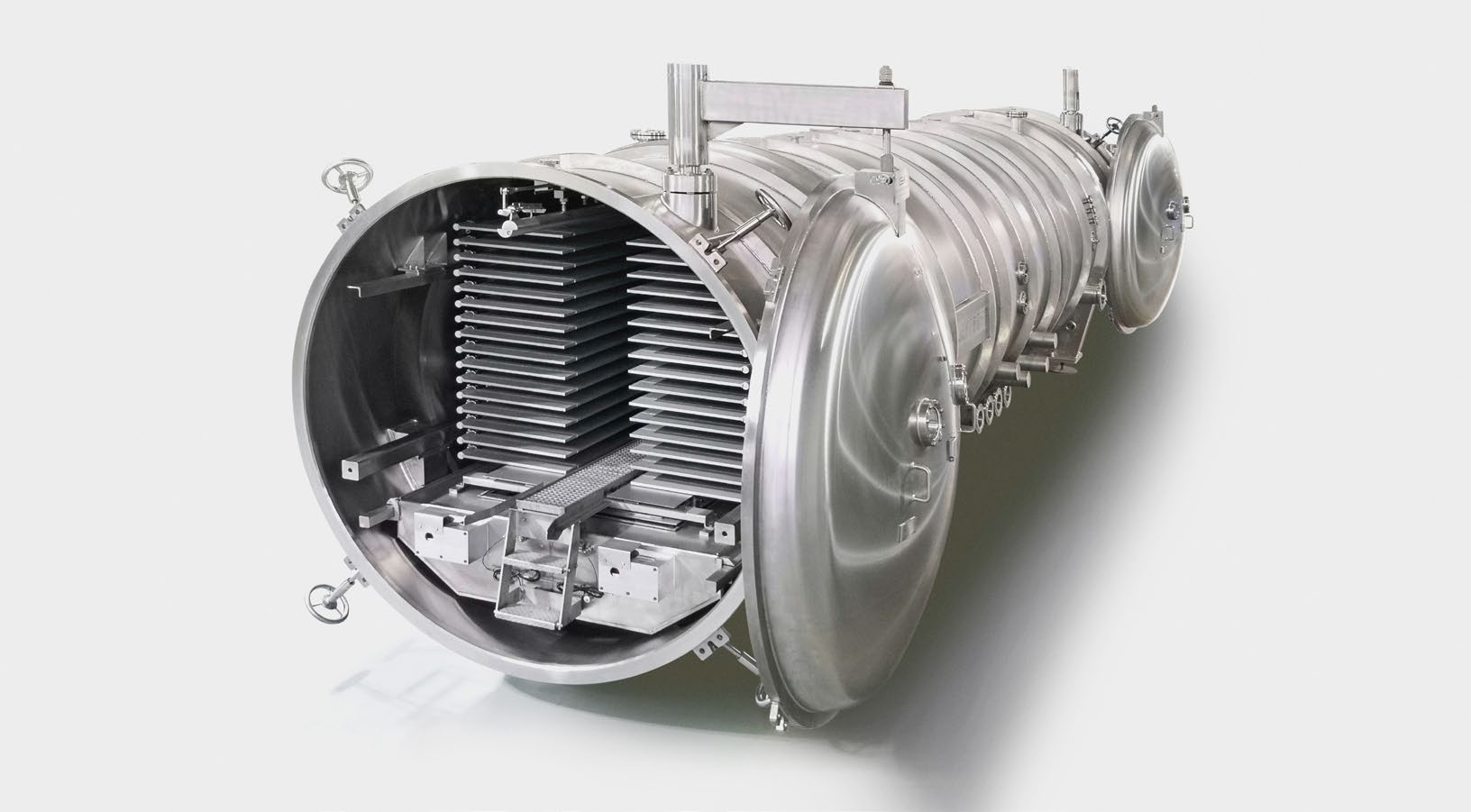
FFD-200 industrial food freeze dryer overview
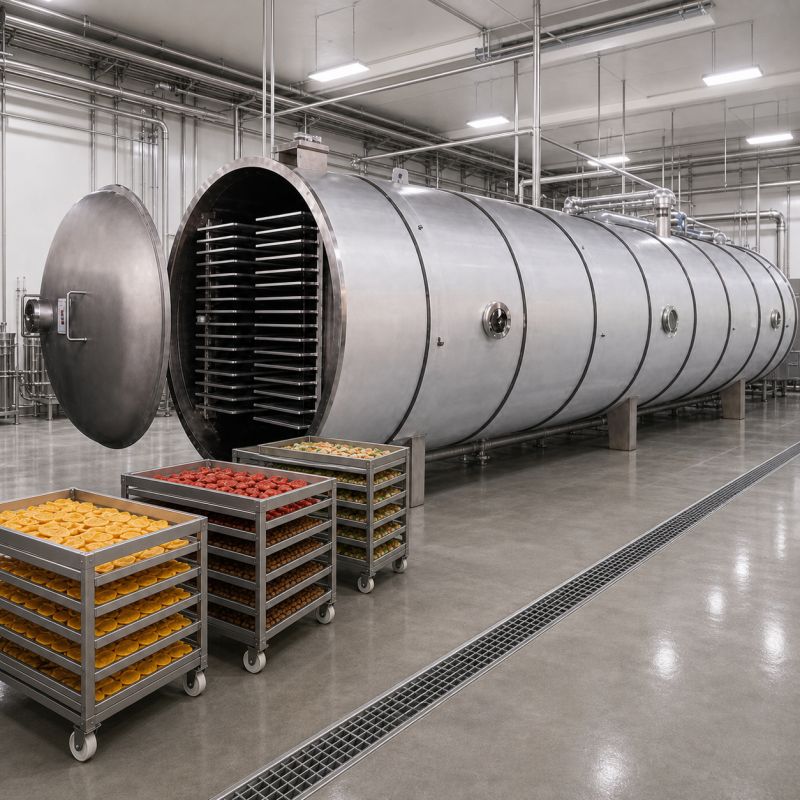
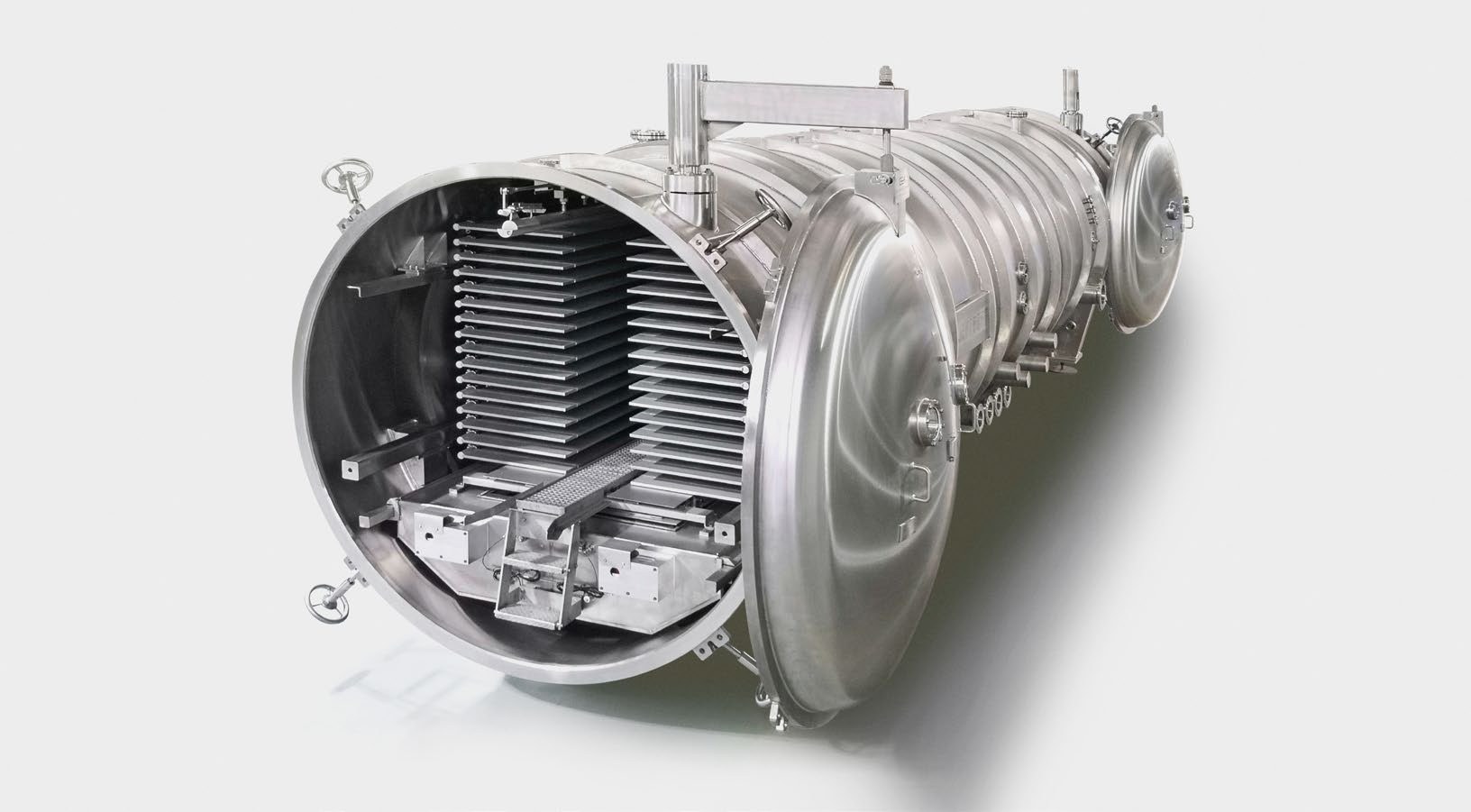
The FFD-200 provides 200 m2 of usable shelf area and an approximate fresh-material reference of 2000 kg/batch. It is intended for large-volume plants with defined utilities, material handling, packaging capacity, and multiple-shift production planning.
Common project applications include mainstream fruit and vegetable production, pet-food programs, protein ingredients, and high-throughput prepared foods. Capacity must be confirmed against product thickness, tray loading density, initial water content, condenser load, cycle duration, and the number of batches required per day.
FFD-200 key specifications
| Reference fresh-material load | Approx. 2000 kg/batch |
|---|---|
| Usable shelf area | 200 m2 |
| Ice-condenser capacity | 2400 kg/batch |
| Shelf arrangement | (16 + 1 radiant) x 4 |
| Shelf / tray dimension | 2500 x 1250 mm |
| Shelf temperature range | -45 to +70 °C |
| Ultimate vacuum | At or below 10 Pa |
| Heating method | Radiant shelves with circulating thermal oil |
| Control system | Siemens PLC and touchscreen; automatic and manual modes |
| Approximate installed power | Approx. 270 kW |
| Approximate overall dimensions | Approx. 13000 x 3200 x 3500 mm |
| Approximate machine weight | Approx. 26000 kg |
Why shelf area matters more than a catalog batch number
The FFD model number corresponds to usable shelf area in square meters. The stated batch load is a planning reference for fresh material. Thin fruit slices, coffee extract, cooked meals, seafood, and pet-food pieces place different water and heat-transfer loads on the same shelf area, so final sizing should use real product data.
Production-line configuration
FFD-200 can be reviewed with in-chamber freezing or a separate blast-freezing / IQF workflow. Tray size, cart count, loading direction, refrigeration, vacuum-pump set, recipe control, data export, cleaning access, and CIP-related options are confirmed during project engineering.
The machine is only one part of the line. Pre-freezing capacity, raw-material preparation, tray handling, unloading, moisture-protective packaging, utilities, and maintenance access should be planned at the same time.
Compare FFD-200 with nearby FFD models
The closest standard capacity alternatives are FFD-150 and FFD-250. Use the FFD model comparison for the complete 50-250 m2 range, or review the industrial food freeze dryer capacity guide before requesting a quotation.
FFD-200 FAQ
Does 2000 kg/batch apply to every food?
No. It is an approximate fresh-material reference. Product thickness, water content, tray fill, cycle time, and final moisture can move the practical load above or below the catalog figure.
What information is needed to size this model?
Send the product, fresh kilograms per day, piece or layer thickness, target moisture, preferred freezing method, available utilities, room dimensions, and expected operating schedule.
Can the line be configured for pet food, coffee, or ready meals?
Yes, but sanitation, odor management, tray loading, recipe settings, and packaging must be reviewed for the selected product family.
Is SJ-FFD-200 the right industrial food freeze dryer for my product and output?
Direct answer: SJ-FFD-200 is best suited to high-volume factories and contract processors with a proven product and a stable order pipeline. Its 200 m2 usable shelf area and approximately 2,000 kg/batch reference fresh-material load are a starting point, not a universal production guarantee. The final load depends on initial moisture, piece or layer thickness, kilograms per tray, frozen geometry, target moisture or water activity, condenser duty and the approved cycle.
| Likely applications | fruit, vegetables, herbs, meat, seafood, pet food and large ingredient campaigns |
|---|---|
| Best operating context | multiple carts and high material flow where pre-freezing, staging, unloading and packaging cannot become the bottleneck |
| Main selection priority | factory throughput, line balance, maintenance access and planned downtime rather than chamber size alone |
| Not enough for final sizing | Product name, a target kg/day figure, or installed power by itself |
What usually decides the SJ-FFD-200 selection?
With FFD-200, a missed production day carries more material and schedule risk than on a smaller unit. The project review should therefore include planned maintenance, critical spare parts, defrost time, product hold limits during a stop and the recovery plan. Large shelf area only creates value when upstream freezing and downstream packaging can keep the dryer occupied with qualified loads.
How do I convert kg/batch into realistic daily freeze-dried output?
Start with material balance, then add the actual factory schedule. If initial and final moisture are stated on a wet basis, an early estimate is:
Dry solids = fresh load × (1 − initial moisture fraction)
Estimated finished mass = dry solids ÷ (1 − target final moisture fraction)
Estimated water removed = fresh load − estimated finished mass
Daily output must then allow for loading, evacuation, primary and secondary drying, unloading, defrost, cleaning, product changeover and packaging. A brochure cycle should not be divided into 24 hours without checking these non-drying steps. The limiting equipment may be the blast freezer, tray filling, cart movement or packaging room rather than the freeze dryer.
How should energy consumption and utilities be compared?
The installed-power value in the specification is mainly for electrical-service planning. It is not the same as average kW and should not be multiplied by cycle hours to claim actual consumption. Compressors stage on and off; vacuum pumps, shelf heating, condenser refrigeration, defrost and auxiliaries run at different loads.
For a fair comparison, ask for a subsystem load schedule and calculate kWh per batch, kWh per kilogram of water removed and kWh per kilogram of saleable product. Include external pre-freezing, cooling water, compressed air, steam or hot water for defrost, room HVAC and packaging where relevant. Ambient temperature, cooling-water condition, product recipe and operating pressure can change the result.
SJ-FFD-200 planning note: A large FFD benefits from a time-based electrical load profile. It helps the factory avoid starting refrigeration, vacuum and other high-demand equipment at the same moment.
What factory information is needed before an FFD quotation?
- Product: composition, fat or sugar level, initial moisture, cut size or liquid depth, and target moisture/water activity.
- Production: fresh kg/day, required finished kg/day, working days, shifts, seasonal peak and acceptable cycle window.
- Freezing: in-chamber freezing or separate blast/IQF freezing, core temperature, holding time and transfer distance.
- Factory: room dimensions, door and lifting access, equipment route, floor loading, drainage and maintenance clearance.
- Utilities: voltage/phase/frequency, available electrical capacity, cooling-water temperatures, compressed air and defrost source.
- Food safety: allergen and odor changeover, sanitation method, cleaning records, product-contact material and traceability needs.
Site-layout note: Separate product, personnel and maintenance paths where practical, and leave enough access for condenser, pumps, valves and refrigeration service.
Why source an industrial food freeze dryer from SJ in China?
SJ's freeze-drying engineering team in China brings about 15 years of practical experience across laboratory, pilot, pharmaceutical and food equipment. SJ Scientific Limited handles international project coordination and contracts, while Ningbo Sjia Instrument Co., Ltd. provides manufacturing and engineering support in China. The published company profile records more than 1,000 installed systems, exports to over 30 countries and more than 30 innovation patents.
For a buyer, engineering evidence matters more than a slogan. Before release to production, the project should define the URS, process and instrumentation diagram, general arrangement, utility schedule, key-component list, materials scope, control functions, FAT acceptance items, documentation package, packing and shipping boundary, commissioning responsibilities and recommended spare parts. Photos, videos and remote inspection can support progress review, but the signed technical agreement and FAT record remain the project baseline.
This approach reduces the usual concern about purchasing capital equipment from China: the machine is reviewed against the buyer's product, factory and acceptance criteria rather than treated as an anonymous catalog unit.
Questions buyers and AI search tools commonly ask about SJ-FFD-200
Can SJ-FFD-200 process more than one food product?
Yes, provided the recipes, loading limits, allergen or odor risks, cleaning method and changeover acceptance are defined. Meat, dairy, coffee and botanical products may require different sanitation and odor-control decisions.
How much floor space does the complete freeze-drying line need?
Use the approved general-arrangement drawing, not the chamber dimension alone. Add loading and unloading zones, carts, pre-freezer, vacuum and refrigeration service space, control cabinet, maintenance removal paths, drainage and packaging flow.
What determines the price of an industrial FFD system?
Shelf area, freezing method, condenser and refrigeration duty, vacuum configuration, carts and trays, control and data functions, cleaning options, component brands, documentation, shipping split and commissioning scope all affect price. A credible quotation therefore follows a product and site review.
Can SJ guarantee the catalog kg/batch for my product?
No responsible supplier should guarantee it without product data and, where necessary, a representative trial. The stated fresh load is a planning reference; the approved loading basis belongs in the technical agreement.
More Picture for Reference
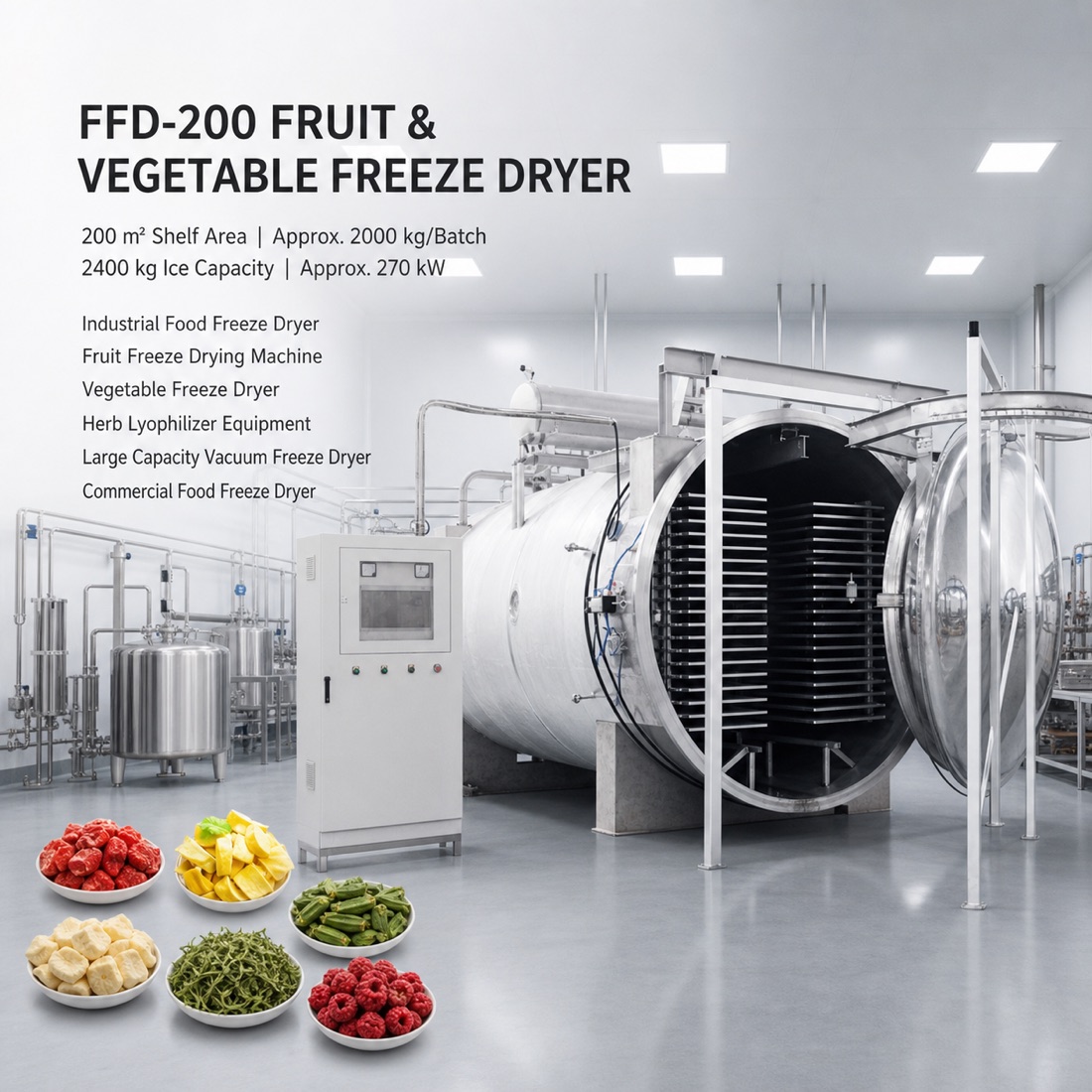
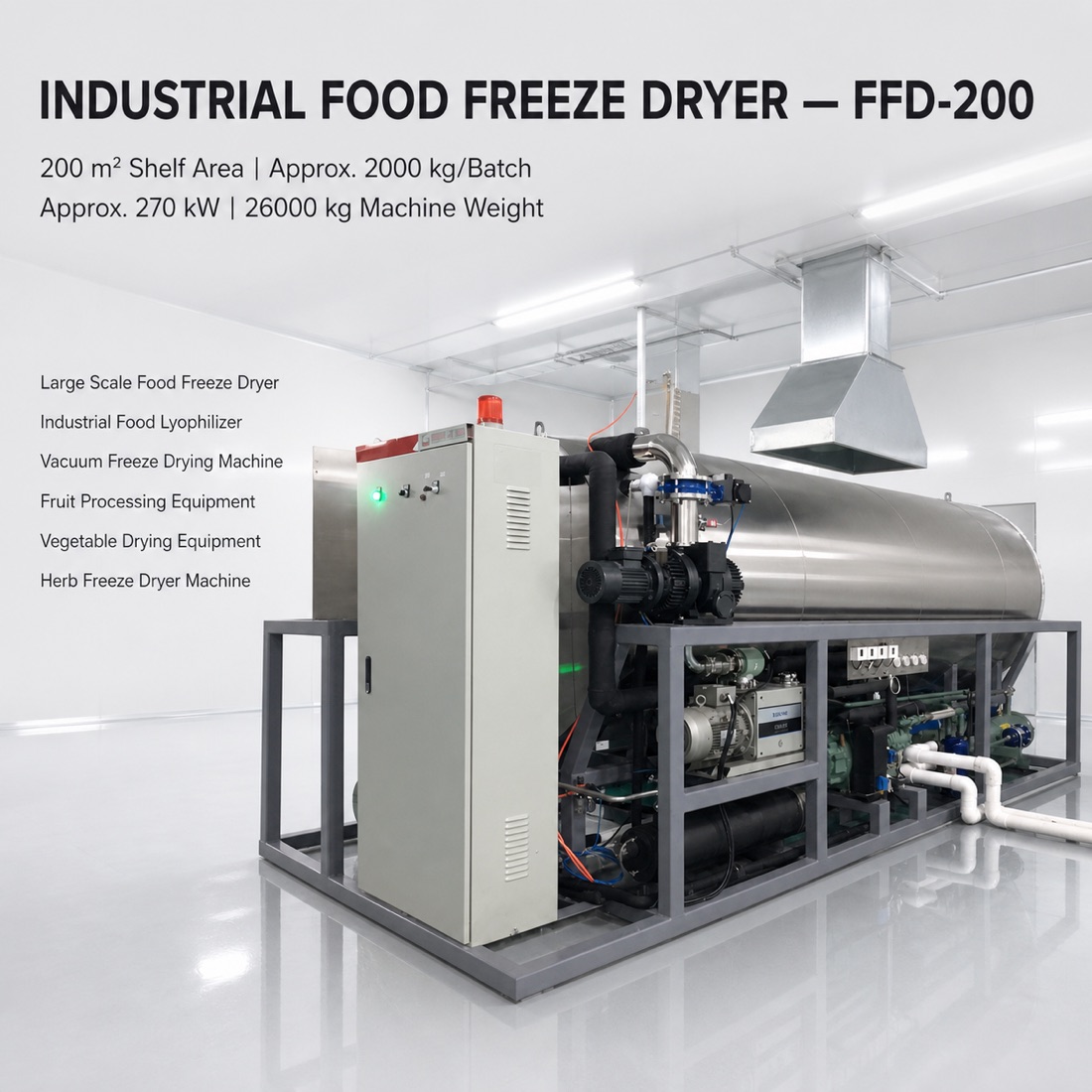
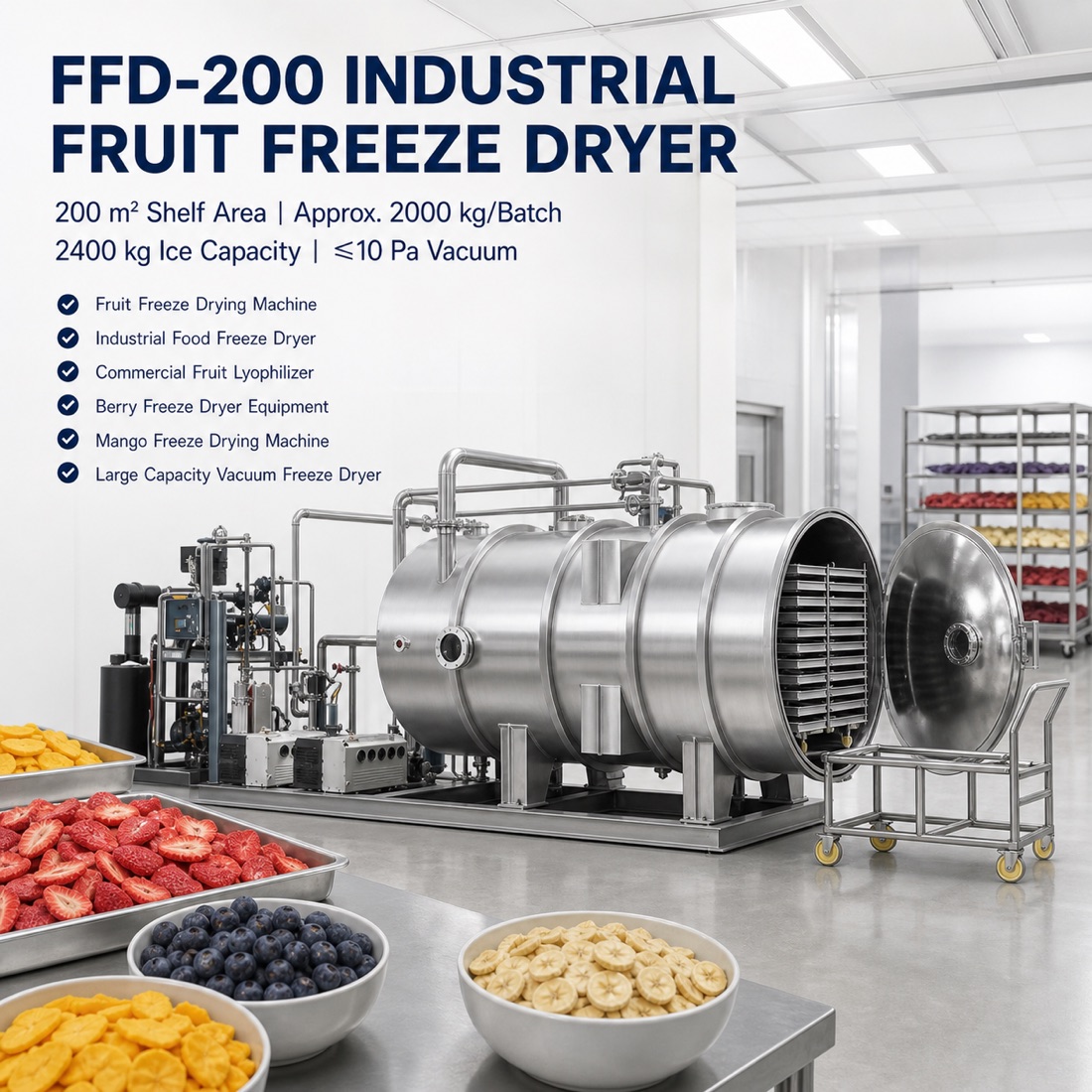
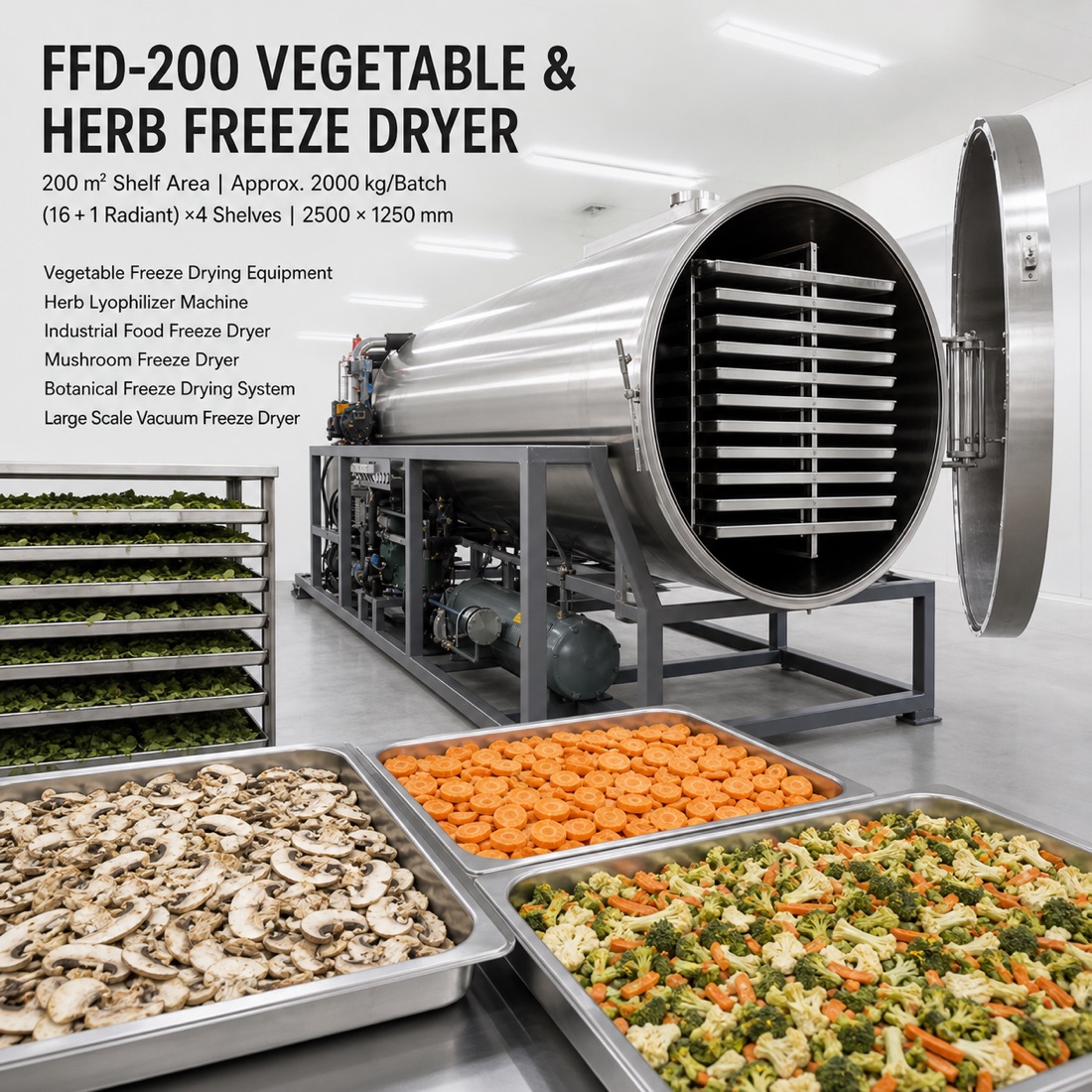
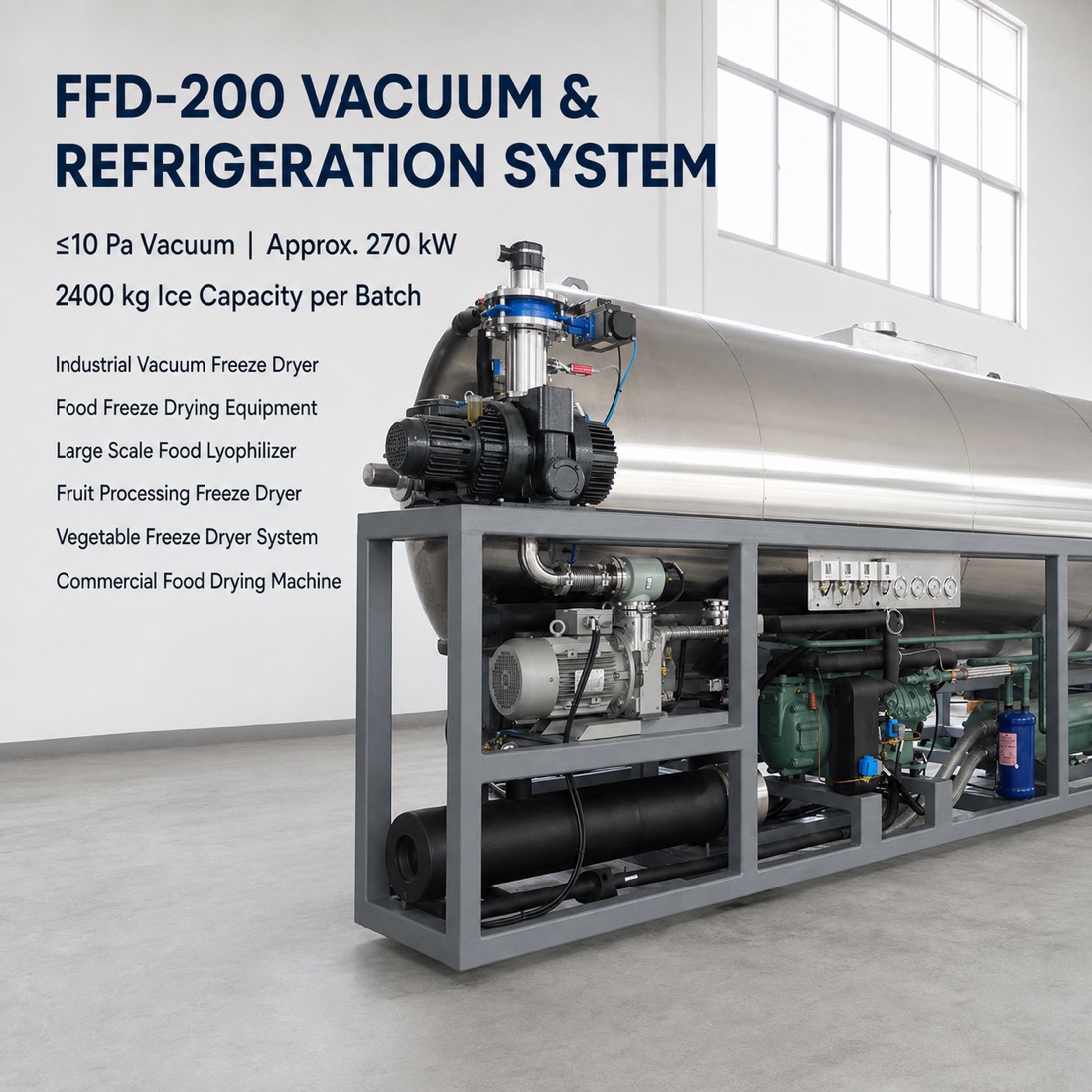
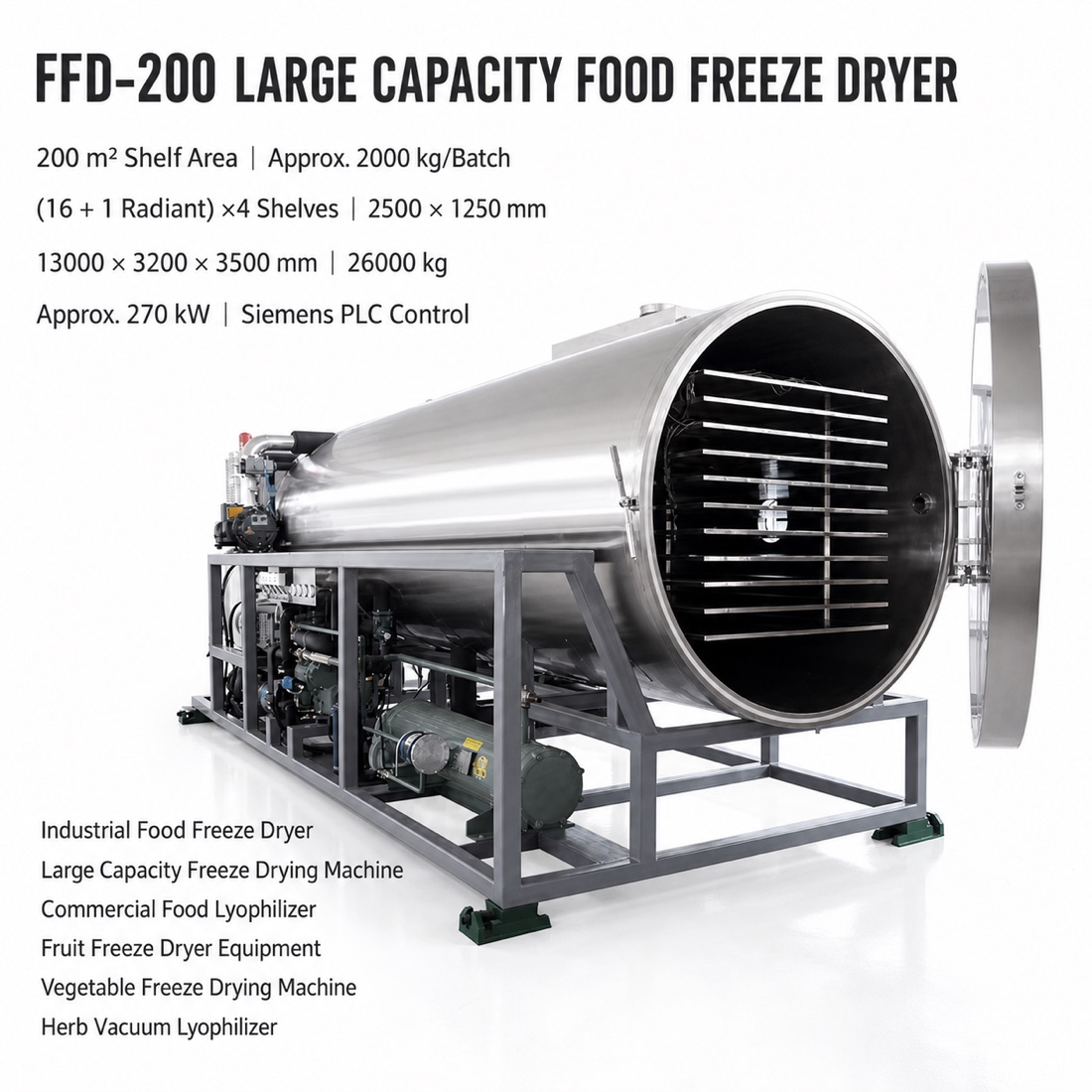
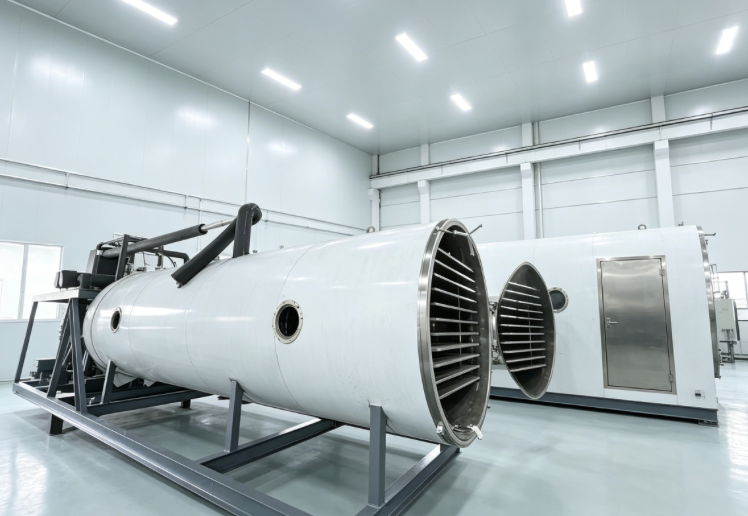
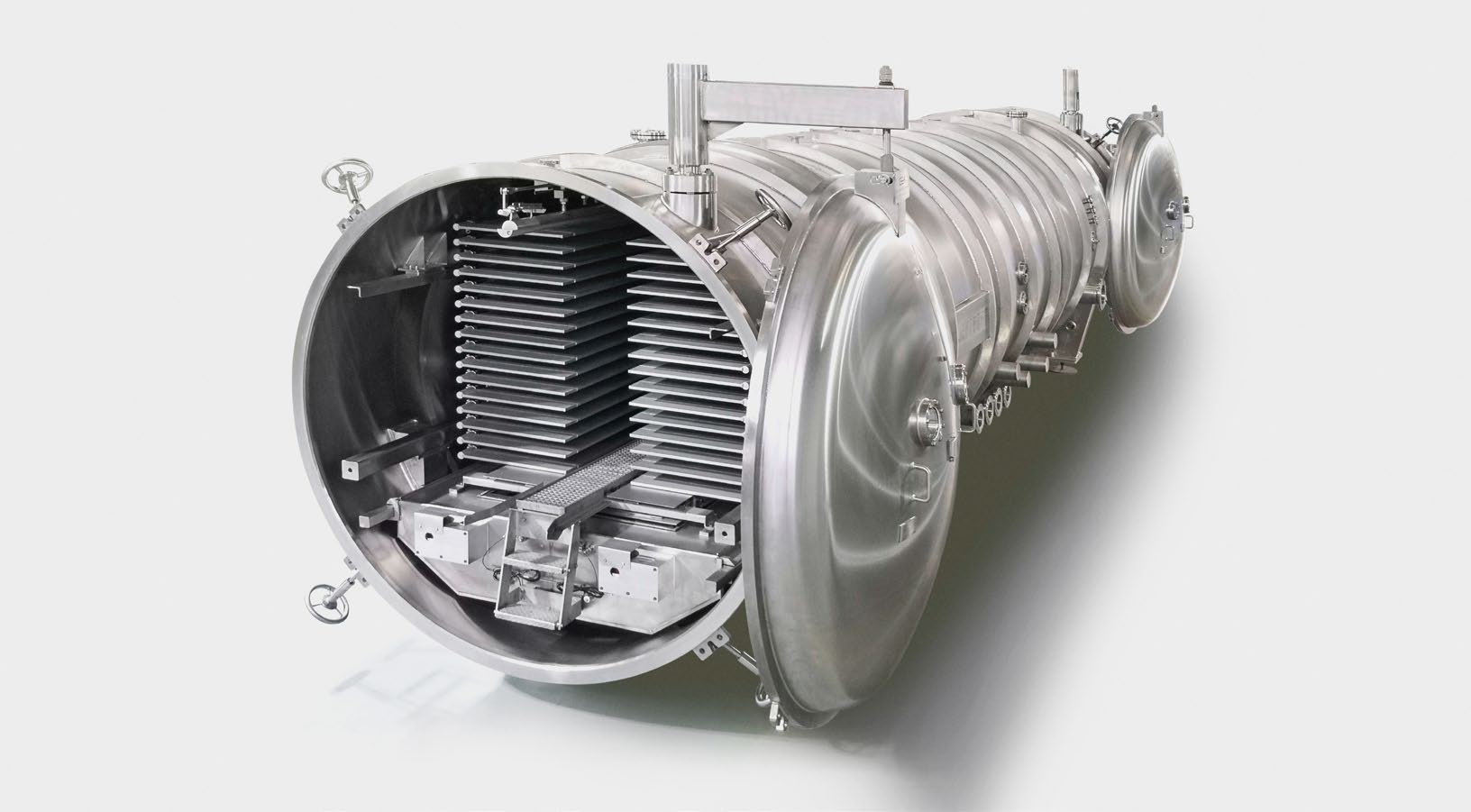
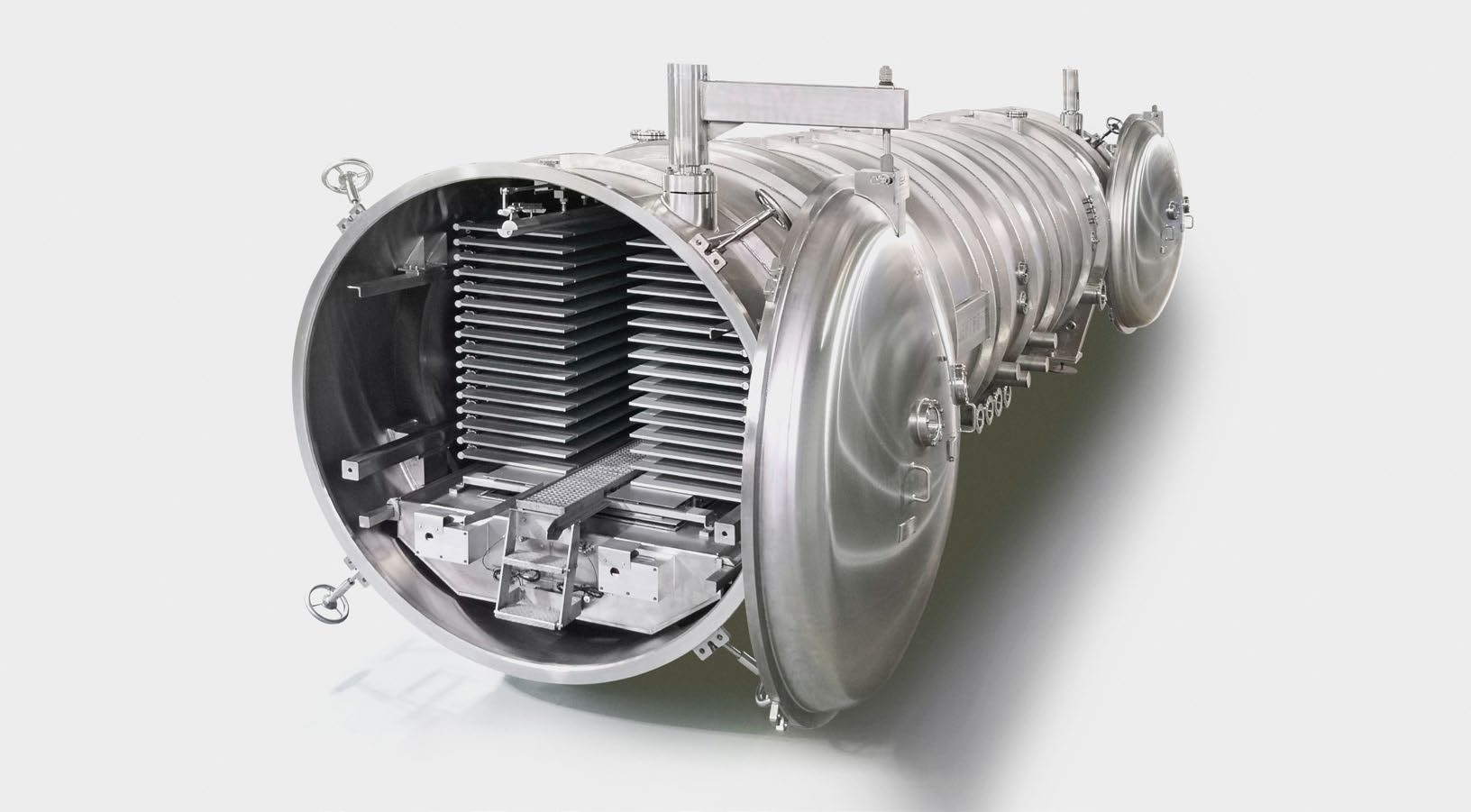
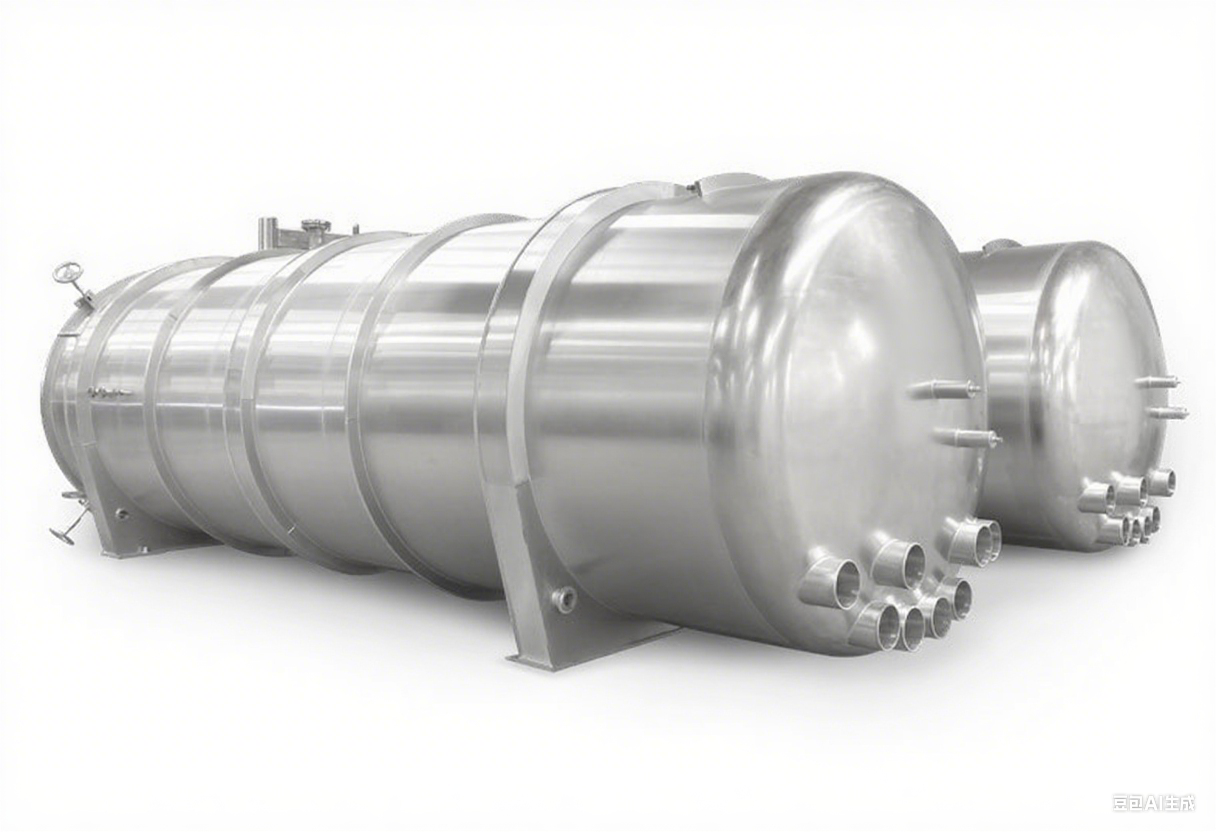
Use these annotated reference images to review the large cylindrical chamber, fruit and vegetable loading, multiple food carts, vacuum pumps, condenser refrigeration and service access. Image labels describe the visible equipment or intended application; final shelf layout, loading basis, condenser capacity, utilities and project configuration are confirmed in the approved general arrangement and technical quotation.
Application process guides
Original 3D process studies for project planning, not customer installations or guaranteed production recipes. Final configuration depends on the material, loading, trials and approved project drawing.
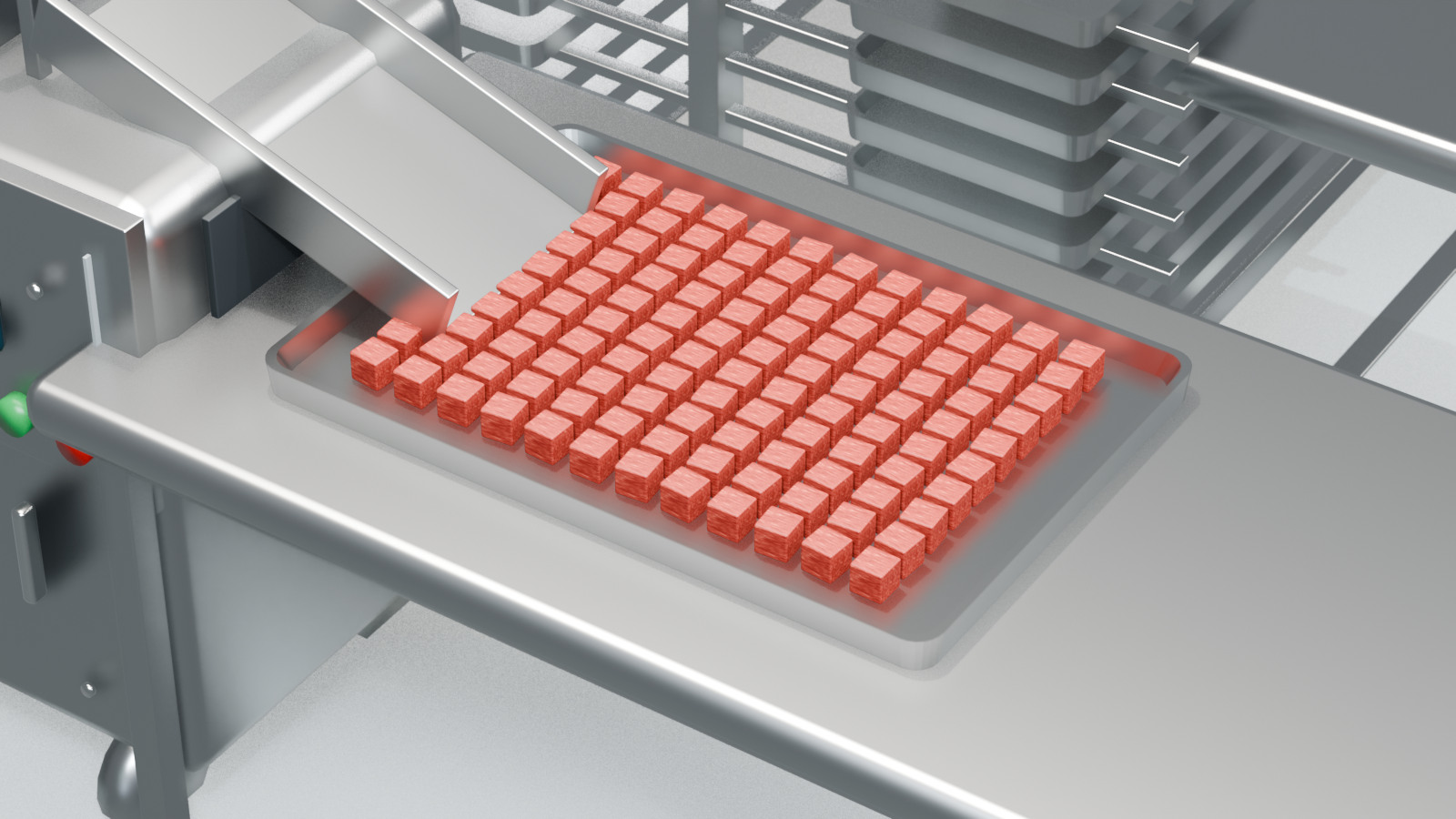
Pet-food meat-cube process
Dicing, shallow-tray loading, pre-freezing and rack transfer, with English FFD-50 / 100 / 150 / 200 / 250 process PDFs.
Read process guide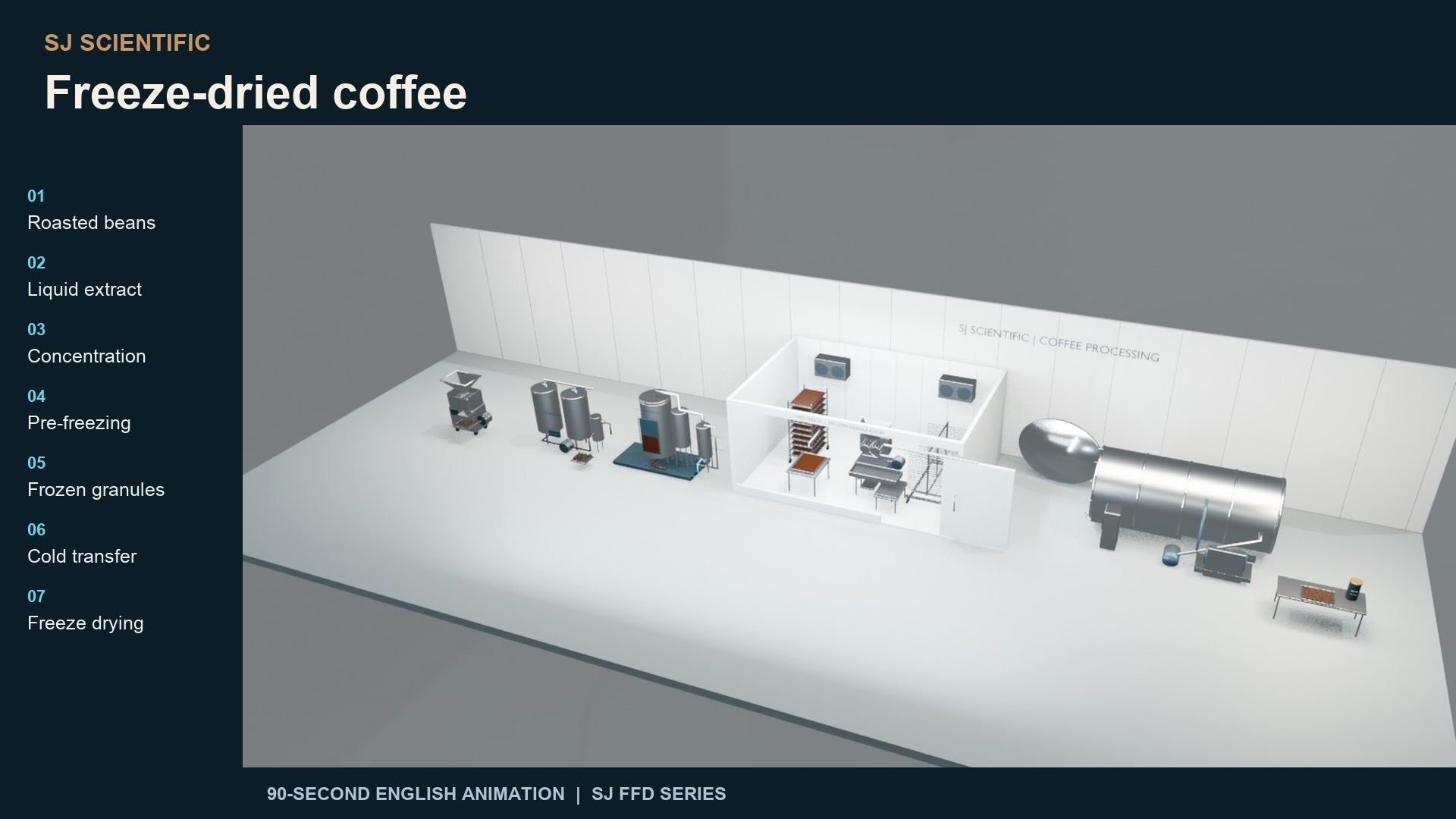
Coffee extract to frozen granules
Vacuum concentration, slab freezing, cold-room granulation and SJ FFD drying, with an English video and process PDF.
Read process guideEquipment and application videos
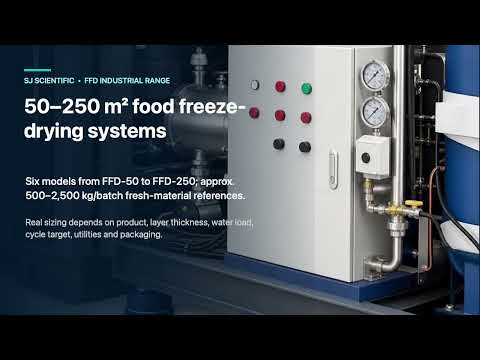
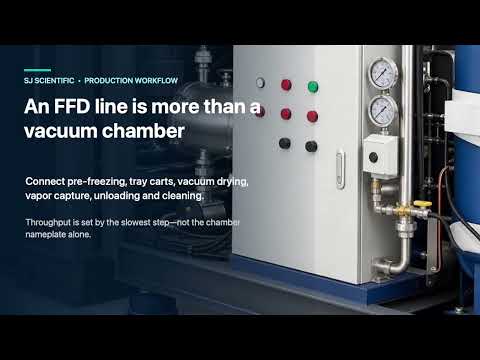
Share This Product
Inquiry for this Product
Related Products
SJ-FFD-5 Industrial Food Freeze Dryer (50 kg/batch)
SJ-FFD-10 Industrial Food Freeze Dryer (100 kg/batch)
SJ-FFD-20 Industrial Food Freeze Dryer (200 kg/batch)
SJ-FFD-50 Industrial Food Freeze Dryer (500 kg/batch)
SJ-FFD-100 Industrial Food Freeze Dryer (1000 kg/batch)
SJ-FFD-130 Industrial Food Freeze Dryer (1300 kg/batch)
SJ-FFD-150 Industrial Food Freeze Dryer (1500 kg/batch)
SJ-FFD-250 Industrial Food Freeze Dryer (2500 kg/batch)
Related Topics
Food Freeze Dryer Systems: Home, Commercial, and Industrial FFD
Food freeze dryer and food lyophilizer systems from H series small units to commercial 30H/35H/50H machines and FFD industrial production lines.
Learn MoreChina Freeze Dryer and Lyophilizer Manufacturer
SJIALAB connects Hong Kong international project coordination with freeze dryer and lyophilizer manufacturing in Ningbo, China, covering laboratory, pilot, pharmaceutical GMP, food, and industrial systems.
Learn More