How to Lyophilize Peptides Successfully: A Practical Freeze-Drying Guide
A practical, evidence-based guide to peptide lyophilization covering formulation risk, critical temperatures, freezing, primary and secondary drying, endpoint decisions, scale-up, troubleshooting, and real Command-series field experience.
Peptide Lyophilization Process
Short answer: successful peptide lyophilization starts with the formulation and its critical temperatures, not with a copied machine recipe. Freeze the entire fill reproducibly, keep the product below its justified critical temperature during primary drying, confirm the ice is gone before secondary drying, and stop secondary drying at a residual-moisture range supported by stability and reconstitution data. The shelf temperature, chamber pressure, ramp rate, and hold time must then be transferred with the vial, fill volume, loading pattern, and freeze dryer in mind.
This practical guide is for scientists and engineers asking how to lyophilize peptides, how to improve a peptide freeze-drying cycle, or how to move a peptide API or vial product from a development lyophilizer to a GMP peptide lyophilizer. It applies to many research peptides, peptide APIs, and GLP-1-related development projects, but it is not a formulation prescription. Excipients, process limits, and acceptance criteria must be justified for the specific molecule and presentation.
What does “a good peptide lyophilization cycle” mean?
A neat cake is useful, but appearance alone does not prove peptide stability. Define the target product profile before changing the cycle. Depending on the project, the development report may need to compare the following attributes before drying, after drying, after reconstitution, and during stability studies.
| Quality question | Typical evidence | Why it matters |
|---|---|---|
| Did the peptide remain chemically intact? | Assay, purity, related substances, oxidation or deamidation methods as applicable | A visually acceptable cake can still contain degraded peptide. |
| Did the physical state remain acceptable? | Aggregation or particle testing where relevant, cake structure, microscopy or solid-state methods | Freezing and drying can change molecular association and the solid matrix. |
| Is the remaining water appropriate? | Karl Fischer or another justified moisture method | Too much water can increase mobility; overly aggressive drying can also damage some products. |
| Does it reconstitute as intended? | Reconstitution time, appearance, pH, concentration and visible/subvisible particles as applicable | The user receives the reconstituted product, not the cake photograph. |
| Is the container system suitable? | Stopper position, vacuum or headspace target, container-closure integrity for sterile products | A good cycle cannot compensate for a poor seal. |
| Is the process repeatable across the load? | Edge and center vial data, endpoint evidence, residual-moisture distribution and repeat runs | The warmest and coldest vials do not necessarily finish together. |
1. Start with a formulation risk map
Peptides can lose quality through different pathways, including oxidation, deamidation, hydrolysis, adsorption, aggregation, or other molecule-specific reactions. Freezing adds a second problem: ice rejects solutes, so the peptide, buffer, salts, and excipients become concentrated in the unfrozen fraction. Local pH, ionic strength, and peptide concentration can therefore differ from the starting liquid.
Before the first cycle, document peptide concentration, buffer system, pH, excipients, fill volume, vial and stopper, allowable oxygen or light exposure, and known degradation pathways. Screening should compare the liquid, freeze-thaw exposure, lyophilization, reconstitution, and storage. An excipient that produces an attractive cake is not automatically a stabilizer. Recent polypeptide research also shows why crystallization behavior must be characterized rather than assuming that a familiar bulking agent will protect every peptide.
2. Measure the formulation before choosing setpoints
For an amorphous peptide formulation, useful measurements commonly include the glass-transition temperature of the maximally freeze-concentrated solution (Tg') and the collapse temperature (Tc). A crystalline system may instead be limited by a eutectic or melting event. Differential scanning calorimetry, freeze-drying microscopy, and complementary solid-state methods help establish a defensible product-temperature limit.
Primary drying is then designed around product temperature, not shelf temperature alone. The shelf supplies heat, but vial geometry, chamber pressure, contact with the shelf, radiation from the chamber, fill depth, and resistance of the growing dry layer determine the actual product temperature. A practical development cycle normally keeps the warmest product at a justified margin below the critical temperature unless studies support a different operating strategy.
3. Build a reproducible frozen structure
Freezing determines ice-crystal size and therefore the pore network left after sublimation. Deep supercooling followed by random nucleation can increase vial-to-vial variation. Larger ice crystals can reduce resistance and shorten primary drying, while a very rapid freeze may produce smaller pores and a different product structure. Neither “fast” nor “slow” is universally correct.
- Use enough time for the warmest vial and the full fill depth to freeze, rather than relying only on the shelf sensor.
- Record nucleation behavior and product probes at representative edge and center positions.
- Evaluate controlled nucleation when batch uniformity or primary-drying variability justifies the added complexity.
- Use annealing only after thermal analysis. It can promote ice growth or excipient crystallization, but it can also change phase behavior and is not a universal peptide-cycle fix.
For a low-concentration peptide, the frozen matrix can be especially sensitive to small changes in fill, vial, or nucleation history. Repeatability during freezing often matters more than achieving the lowest possible shelf temperature.
4. Control primary drying without chasing the lowest pressure
During primary drying, shelf heat supplies the energy for sublimation and the pressure difference drives vapor toward the condenser. Lower chamber pressure is not automatically faster or safer. Pressure changes gas conduction between the shelf and vial; very low pressure can reduce heat transfer, while excessive vapor flow can challenge duct and condenser capacity.
Develop the shelf-temperature and chamber-pressure combination as a pair. Monitor product temperature, condenser performance, pressure control, and signs of product failure. Edge vials often receive more radiant heat than center vials, so the warmest vial can define the upper process limit while the coldest vial can define the time needed to finish primary drying.
Capacitance manometer and Pirani readings, product probes, pressure-rise testing, and model-based tools can provide complementary endpoint evidence. A Pirani-to-capacitance convergence is useful in many aqueous cycles, but it should not be treated as the only proof that every vial is free of ice.
5. Do not begin secondary drying while ice remains
Moving to a high secondary-drying temperature before the coldest part of the load has completed sublimation can cause collapse, meltback, or uneven moisture. Add a justified endpoint margin and challenge it during development. The margin should account for sensor uncertainty, edge-to-center differences, full-load behavior, and the fact that instrumented vials do not perfectly represent every vial.
Primary-drying endpoint and total cycle endpoint are different decisions. Primary drying removes ice. Secondary drying reduces more strongly bound water by desorption.
6. Set secondary drying from stability, not from “as dry as possible”
Secondary drying normally uses a controlled ramp and a warmer shelf condition, but the permissible temperature and duration depend on the peptide and the dry matrix. Residual moisture can influence molecular mobility, glass-transition behavior, reconstitution, and degradation. The correct target is a validated range supported by stability data, not simply the lowest number the equipment can reach.
Measure moisture with a suitable method and sample across the load. If the batch shows a wide distribution, first investigate incomplete primary drying, vial or stopper variation, loading pattern, leak rate, pressure measurement, and shelf uniformity before extending the entire cycle.
7. Treat vial, fill volume, and loading pattern as process parameters
A cycle does not transfer by copying the recipe file. A new vial bottom changes heat transfer. A deeper fill increases dry-layer resistance. A partial load changes radiation and vapor flow. A higher peptide or excipient concentration changes thermal behavior. Even the same shelf count can represent a different process when the shelf size, vial pitch, or ice load changes.
For scale-up, record at least: vial drawing, stopper, fill volume and depth, vial count, loading map, shelf area, shelf spacing, formulation solids, water load, critical temperatures, product-temperature locations, chamber pressure, shelf ramps, endpoint method, condenser margin, and acceptance results. This package is more useful than a screenshot of the recipe.
What real Command-series projects taught us
Case 1: 13-shelf Command F installation for a U.S. peptide project
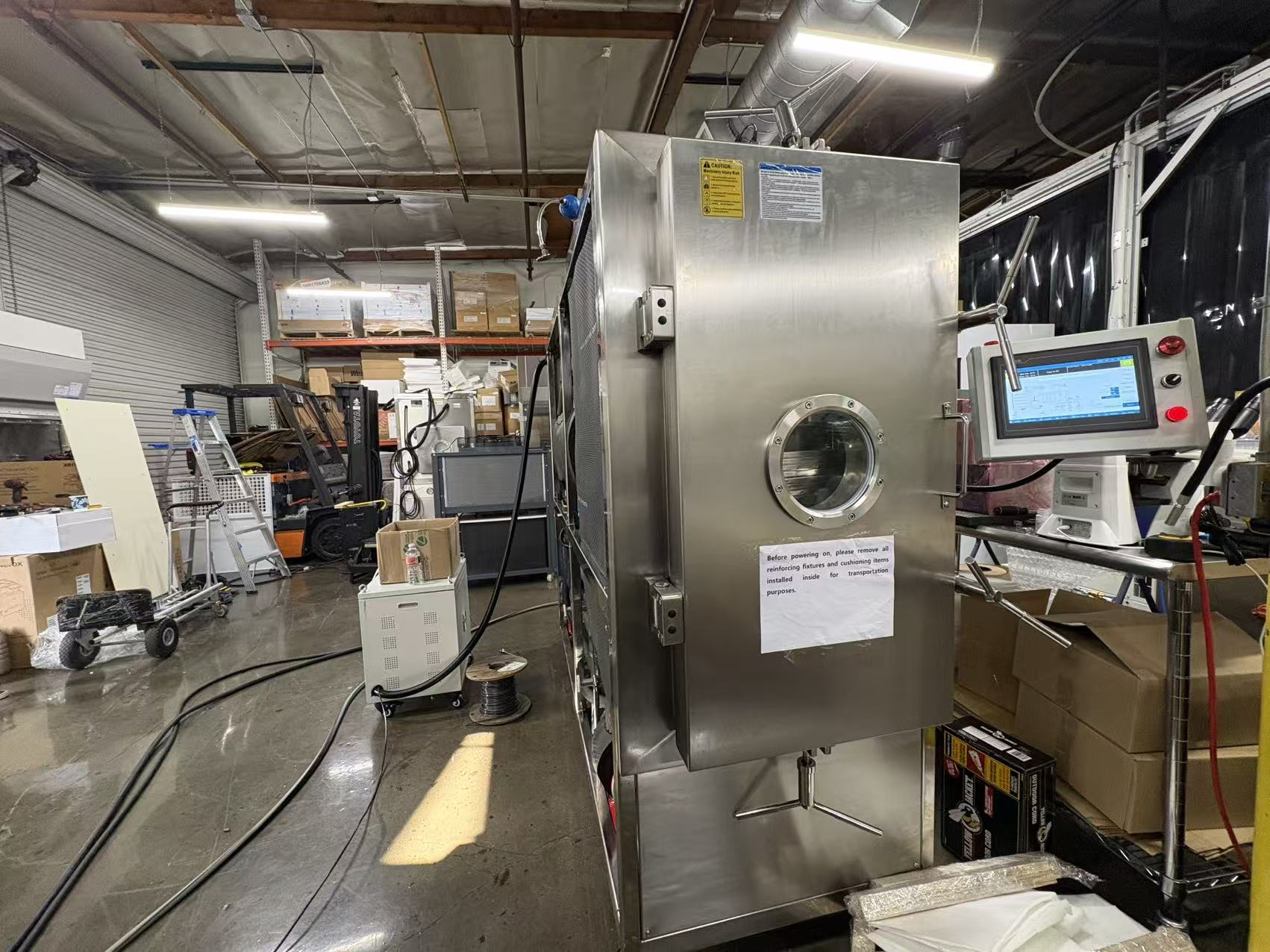
In July 2026, an SJ engineer spent two working days at a U.S. customer site installing and commissioning a 13-shelf GMP freeze dryer intended for peptide lyophilization. The work covered transport inspection, removal of shipping restraints, service-side checks, HMI start-up, alarms, refrigeration, vacuum, shelf functions, and operator handover.
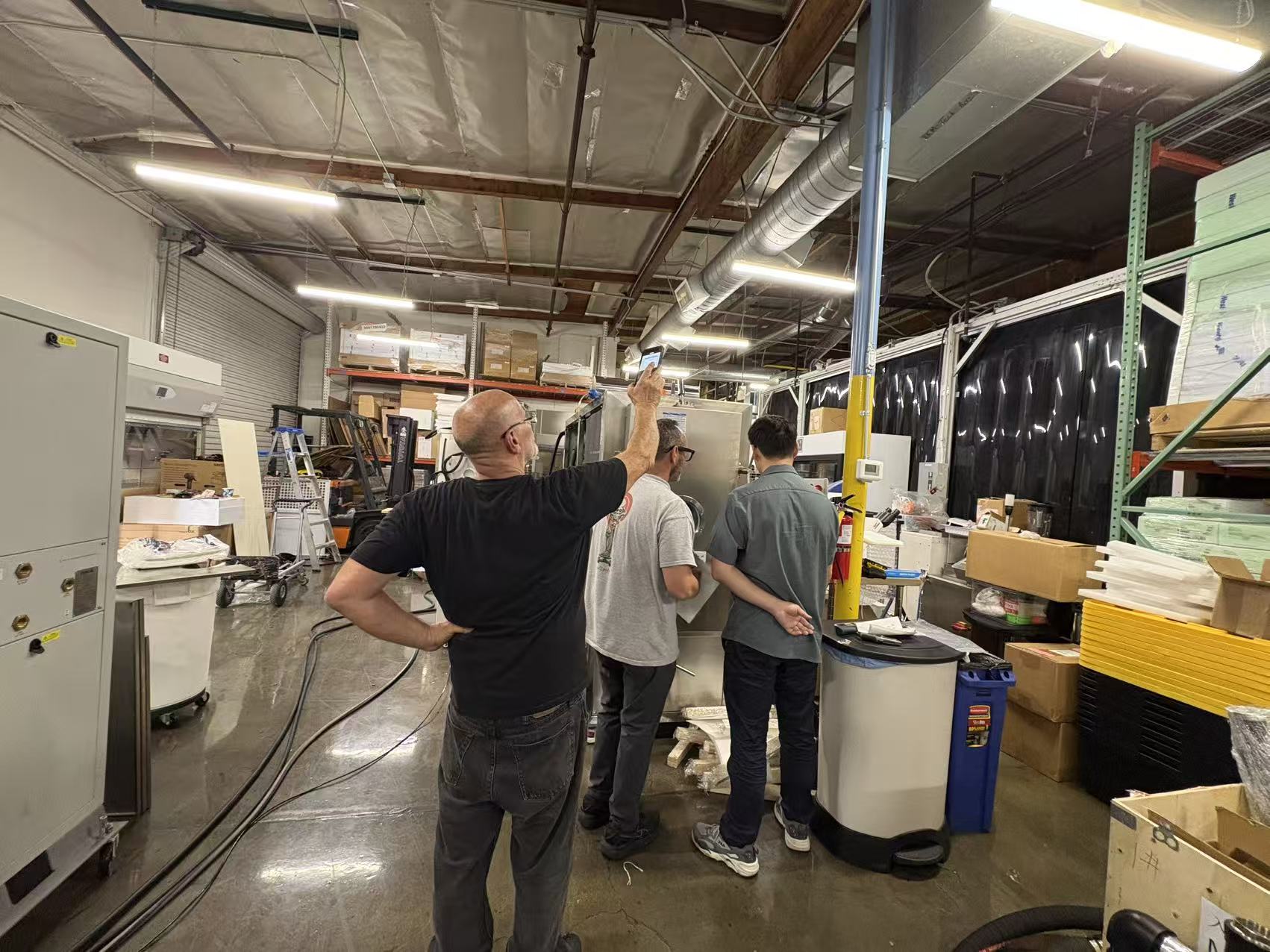
The important lesson was the boundary between equipment readiness and product readiness. The machine functions could be checked in two days; the peptide cycle still required customer-owned development, analytical acceptance criteria, qualification, and validation. Read the complete U.S. 13-shelf installation field report.
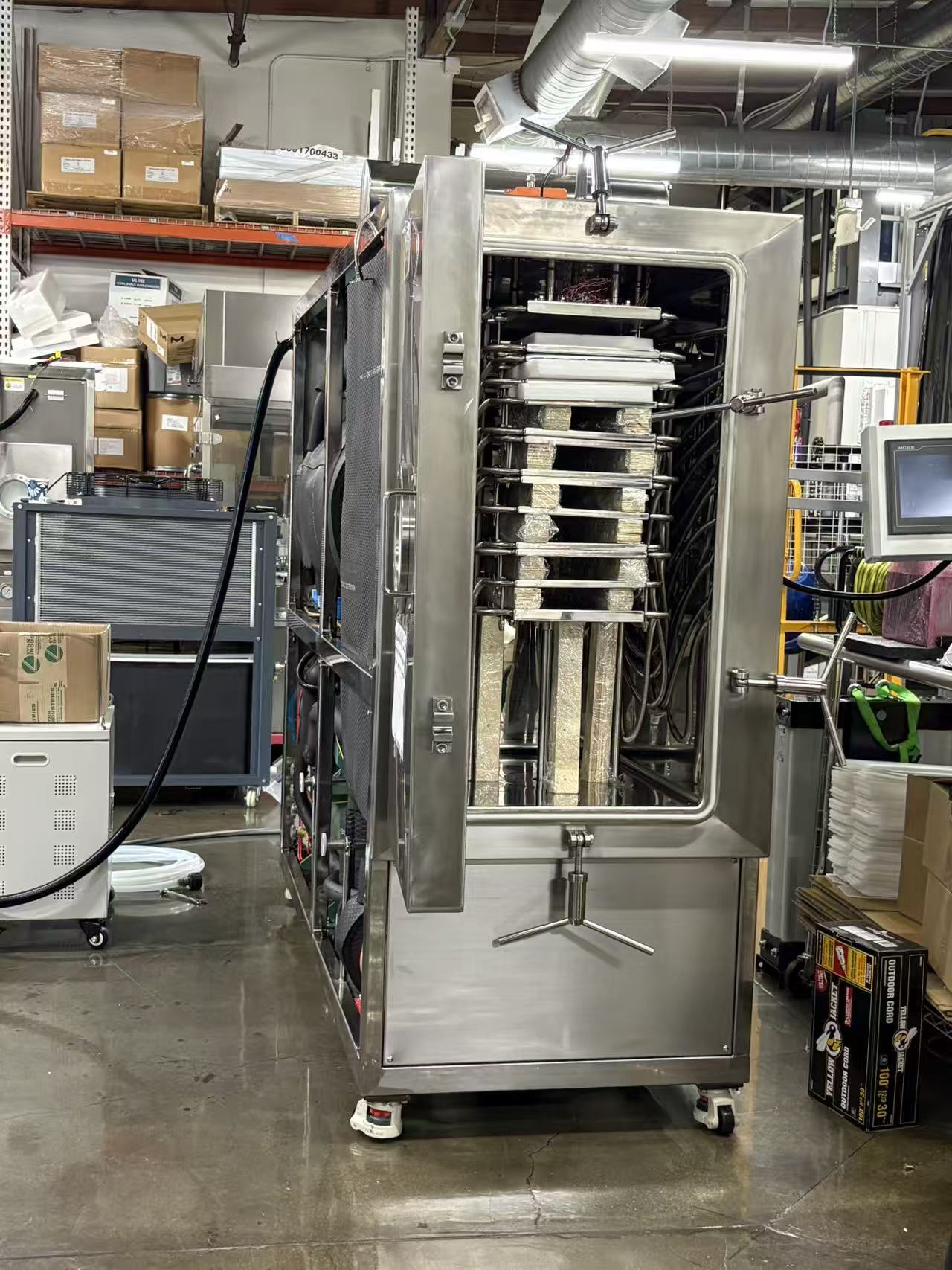
Case 2: a sudden product-probe drop during vacuum pull-down
During another customer run, selected product probes appeared to drop sharply as vacuum was first applied, while the shelf system and refrigeration performance remained normal. The useful response was not to label the event a compressor fault from one trace. The team reviewed probe position, freezing history, pressure transition, formulation behavior, and whether the reading represented the bulk product.
This type of observation can involve local evaporative cooling, probe contact, supercooling or incomplete equilibration, but the cause must be demonstrated from the run data. Annealing may be evaluated when thermal analysis supports it; it should not be inserted automatically. The broader lesson is to interpret product probes together with shelf temperature, pressure instruments, freezing history, and repeated runs. See the vacuum pull-down temperature investigation.
Case 3: several U.S. peptide users, different vial and batch questions
Across multiple U.S. peptide inquiries and Command-series projects, customers often begin by asking for shelf count or vial count. Those are useful purchasing questions, but they do not define a cycle. Different customers use different peptide concentrations, vial formats, fill volumes, load patterns, and quality targets on machines from the same family.
Our recurring engineering task is therefore to convert “How many shelves?” into a process brief: how many vials, which vial drawing, how much liquid per vial, how much ice per batch, what critical product temperature, what stoppering format, what endpoint evidence, and what documents are required. This prevents a shelf-count comparison from becoming an unsupported capacity claim.
Which SJ platform fits each development stage?
| Project stage | Typical SJ platform | What to confirm before selection |
|---|---|---|
| Formulation screening and cycle development | SJ-Creator 2S Research FD | Minimum controllable load, product probes, recipe flexibility, condenser load and vial format |
| Clinical or compact GMP peptide batches | Command SJ-50F(T) or Command SJ-100F(T) | Stoppering, controls, data records, shelf mapping, cleaning and qualification scope |
| Flexible vial count and shelf configuration | Command F Flexible Shelf GMP Freeze Dryer | Shelf size and count, shelf spacing, vial height, full-load ice mass and matched condenser duty |
| Larger pharmaceutical production | SJ-Command F25M and engineered Command systems | URS, room interface, utilities, CIP/SIP where required, loading, FAT/SAT and validation documents |
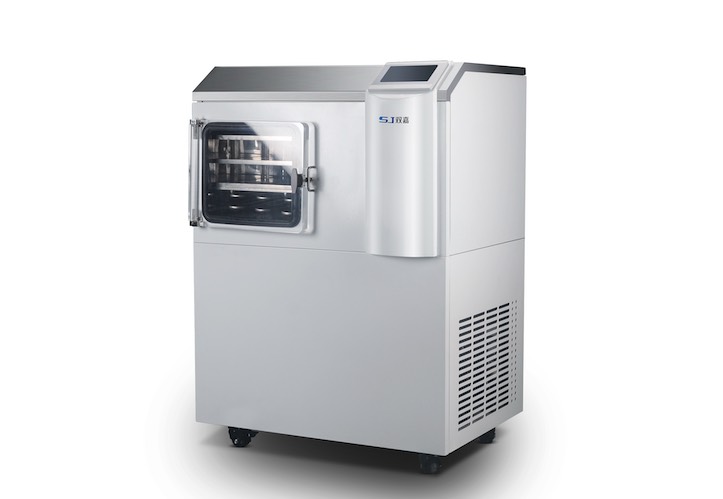
SJ-Creator 2S
Research and peptide lyophilization cycle development
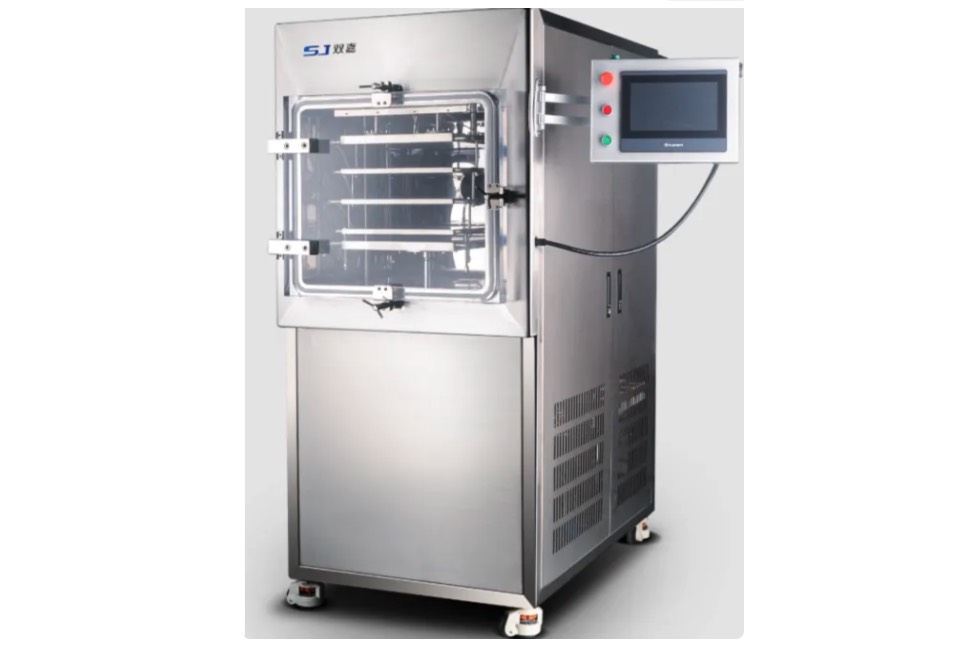
Command SJ-50F(T)
Compact clinical and GMP vial batches
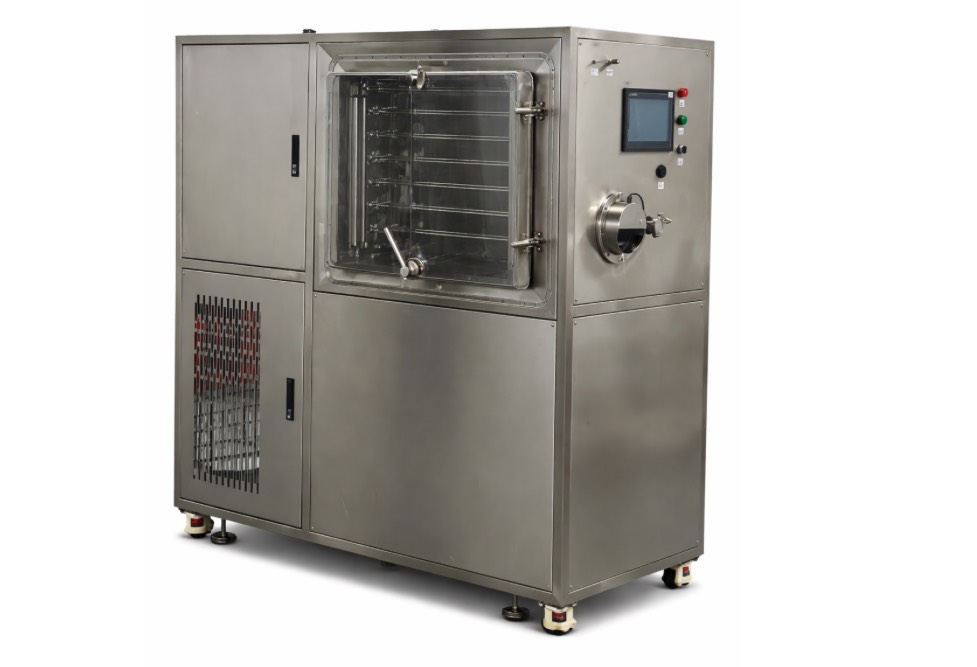
Command SJ-100F(T)
Small-batch GMP peptide production
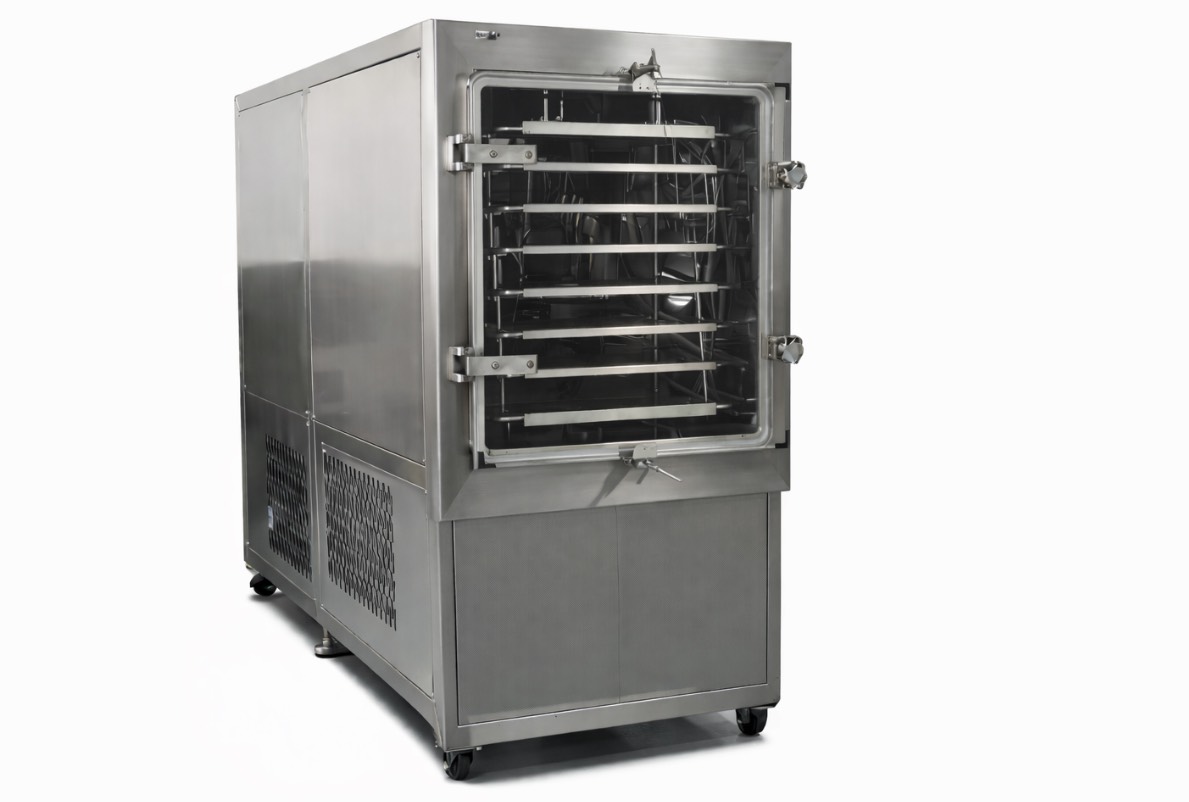
Command SJ-200F(T)
Larger vial loads and production scale-up
Peptide lyophilization troubleshooting table
| Observation | Questions to investigate | Do not assume |
|---|---|---|
| Collapsed or shrunken cake | Was product temperature above the justified critical limit? Did ice remain before the ramp? Was the edge vial warmer? | That lower shelf temperature alone will fix the formulation. |
| Foaming or product loss | Was there incomplete freezing, an aggressive pressure transition, volatile solvent, or excessive fill? | That every low pressure is suitable for every formulation. |
| Long primary drying | Check fill depth, nucleation, dry-layer resistance, pressure, heat transfer, condenser and vapor-path limits. | That a larger vacuum pump automatically shortens sublimation. |
| Wide residual-moisture variation | Check primary endpoint, edge/center behavior, leaks, shelf uniformity, stopper variation and sampling plan. | That extending secondary drying is the only answer. |
| Slow or incomplete reconstitution | Review cake structure, excipient solid state, over-drying risk, aggregation/particles and reconstitution procedure. | That a beautiful cake must reconstitute well. |
| Unexpected probe spike or drop | Review probe contact, location, calibration, nucleation, pressure transition and other independent measurements. | That one sensor trace proves an equipment fault or product event. |
A defensible development workflow
- Define peptide stability risks and measurable product-quality attributes.
- Screen formulation, buffer, pH, excipients, concentration, vial and stopper.
- Measure relevant thermal transitions and establish a product-temperature limit.
- Design freezing and, where justified, nucleation or annealing studies.
- Develop primary-drying shelf temperature and pressure as a linked design space.
- Confirm endpoint with more than one useful signal and an appropriate margin.
- Develop secondary drying against residual moisture, stability and reconstitution.
- Repeat with representative edge, center, partial-load and full-load conditions.
- Transfer using vial heat transfer, fill depth, load, shelf area and equipment capability.
- Lock the recipe only after analytical acceptance, equipment qualification and process validation requirements are aligned.
For equipment sizing, continue with the peptide freeze dryer selection guide. For a deeper three-stage process discussion, read peptide lyophilization cycle development. Teams preparing a regulated project can use the GMP peptide lyophilizer validation and scale-up checklist or send a formulation-neutral process brief through the engineering inquiry form.
References and further reading
- FDA: Lyophilization of Parenterals
- Practical Advice on Scientific Design of Freeze-Drying Process: 2023 Update
- Recommended Best Practices for Lyophilization Validation: Process Design and Modeling
- Practical Advice in the Development of a Lyophilized Protein Drug Product
- Study of crystalline excipients and freeze-dried polypeptide stability
Frequently asked questions
What is the best freeze-drying cycle for a peptide?
There is no universal peptide cycle. The formulation, vial, fill volume, critical product temperature, loading pattern, residual-moisture target, and stability data determine the appropriate freezing, primary-drying, and secondary-drying conditions.
Should peptide primary drying use the lowest possible chamber pressure?
No. Chamber pressure affects heat transfer as well as the sublimation driving force. Shelf temperature and pressure should be developed together while product temperature, vapor flow, condenser capacity, and pressure-control limits are monitored.
How far below collapse temperature should product temperature remain?
The margin must be justified for the specific formulation and measurement method. Development commonly uses a conservative margin below the critical temperature, then confirms robustness with representative vials, loading conditions, and analytical results.
Does every peptide formulation benefit from annealing?
No. Annealing can promote ice growth or excipient crystallization, but it can also alter phase behavior. Use thermal and solid-state data to decide whether the temperature and hold time are appropriate for the formulation.
What tests show that a peptide was lyophilized successfully?
Typical evidence includes assay and purity, relevant degradation or aggregation methods, residual moisture, reconstitution time and appearance, pH after reconstitution, cake structure, particles where applicable, and container-closure integrity for sterile products.
Can a laboratory peptide cycle be copied directly to a Command GMP lyophilizer?
No. Transfer should account for vial heat transfer, fill depth, edge effects, shelf area, partial or full loading, pressure-control range, condenser and vapor-path capacity, endpoint method, and the receiving equipment qualification state.