Freeze-Dried Coffee Process: From Extract Preparation to Industrial Freeze Dryer Selection
A field-oriented guide to coffee extract preparation, freezing, drying, condenser sizing, FFD model selection, and packaging rhythm.
Food Applications
Watch the process
Coffee Freeze-Drying Process with SJ FFD: 3D Process Study
Trace coffee extraction, vacuum concentration, freezing and frozen granulation before FFD drying. Connect each stage with equipment selection and moisture-protective packing.
3D concept. Coffee capacity and process conditions need project-specific review.
Original 3D process concept, not customer-site footage or a validated production recipe. Loading, equipment configuration and process settings require project review.
Open video & English captionsShort answer: an industrial coffee freeze dryer is sized from prepared coffee extract and water removal, not from green-bean weight. A serious RFQ states extract solids, kilograms per batch, tray layer depth, frozen slab or granule geometry, target moisture or water activity, aroma-handling method, daily throughput, packaging rate and utilities. Those inputs determine shelf area, condenser duty, carts, cycle trials and the practical FFD model range.
Coffee process study: concentrate, freeze, granulate, then dry
SJ Scientific process study, September 2026. This independent 90-second 3D concept follows roasted beans through extraction, low-temperature vacuum concentration, slab freezing, frozen granulation and SJ FFD drying. It is not a customer installation or real equipment footage. No coffee batch capacity or validated drying recipe is assigned to the animation.
Watch the English coffee process video Download the 2-page English process PDF
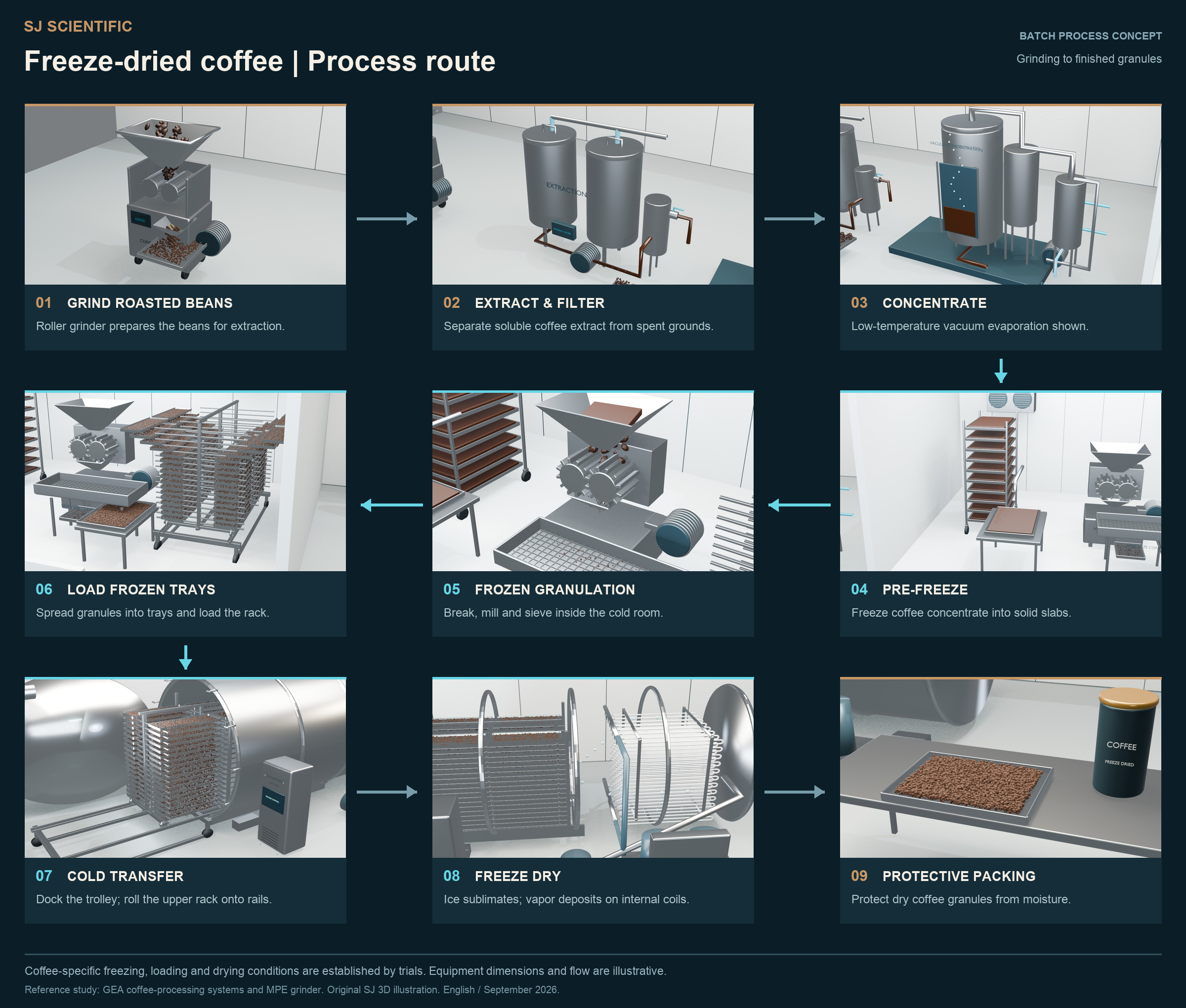
Equipment, incoming material and the next process state
| Equipment / step | What moves to the next stage |
|---|---|
| Roasted-bean grinder | Controlled ground coffee for extraction. The particle-size choice belongs to the extraction process, not the freeze dryer's shelf specification. |
| Extraction vessel and filter | Water extracts soluble coffee; filtration separates insoluble spent grounds. The dryer will process the prepared extract, not whole beans or spent grounds. |
| Vacuum concentrator | Low-temperature evaporation under reduced pressure removes some water, leaving a liquid concentrate. It is not the pre-freezing step. |
| Trays and refrigerated room | The concentrate freezes into solid slabs. Confirm the condition through the loaded material before size reduction. |
| Cold-room breaker, granulator and sieve | Break the slabs and separate the chosen particle-size range while the material remains frozen. Manage fines and avoid warming the feed during handling. |
| Shallow trays and upper product rack | Spread the frozen granules to a controlled depth and load the rack. Record weight per tray and keep the material frozen during transfer. |
| Pre-cooled SJ FFD | Dock the lower transfer trolley outside. Move the upper rack into the chamber, close the door and run the developed freeze-drying cycle. |
| Dry handling and barrier packing | Inspect and test the porous granules, limit humidity exposure, and seal in the intended moisture-protective package. |
Why the breaker and sieve are inside the cold room
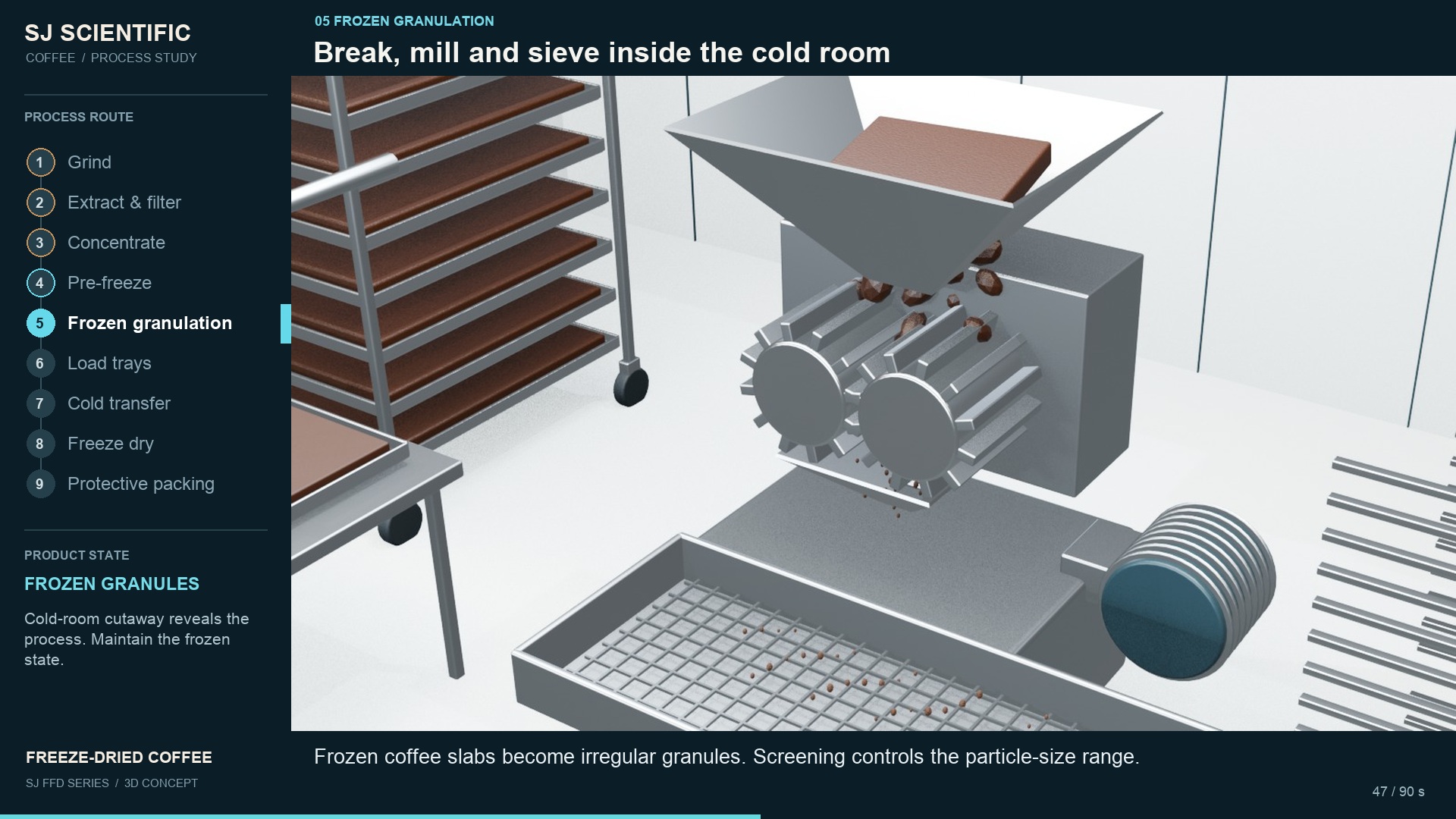
In this route, granulation is a frozen-feed preparation step before freeze drying. Grinding warm or partially thawed concentrate is not the same operation. Define the frozen particle range, fines policy, tray depth and allowed transfer conditions together. A process trial should use that same geometry; changing it later changes the load presented to the dryer.
Vacuum concentration and freeze concentration are alternatives
The depicted concentrator removes water by evaporation at reduced pressure. Freeze concentration instead forms and separates ice while retaining a liquid concentrate. Either selected upstream route still needs its own downstream freezing and granule-preparation plan. The GEA freeze-concentration reference explains that alternative; the rendered vessel is not a GEA machine, and no supplier partnership or packaged upstream supply is implied.
Cold transfer and the internal vapor path
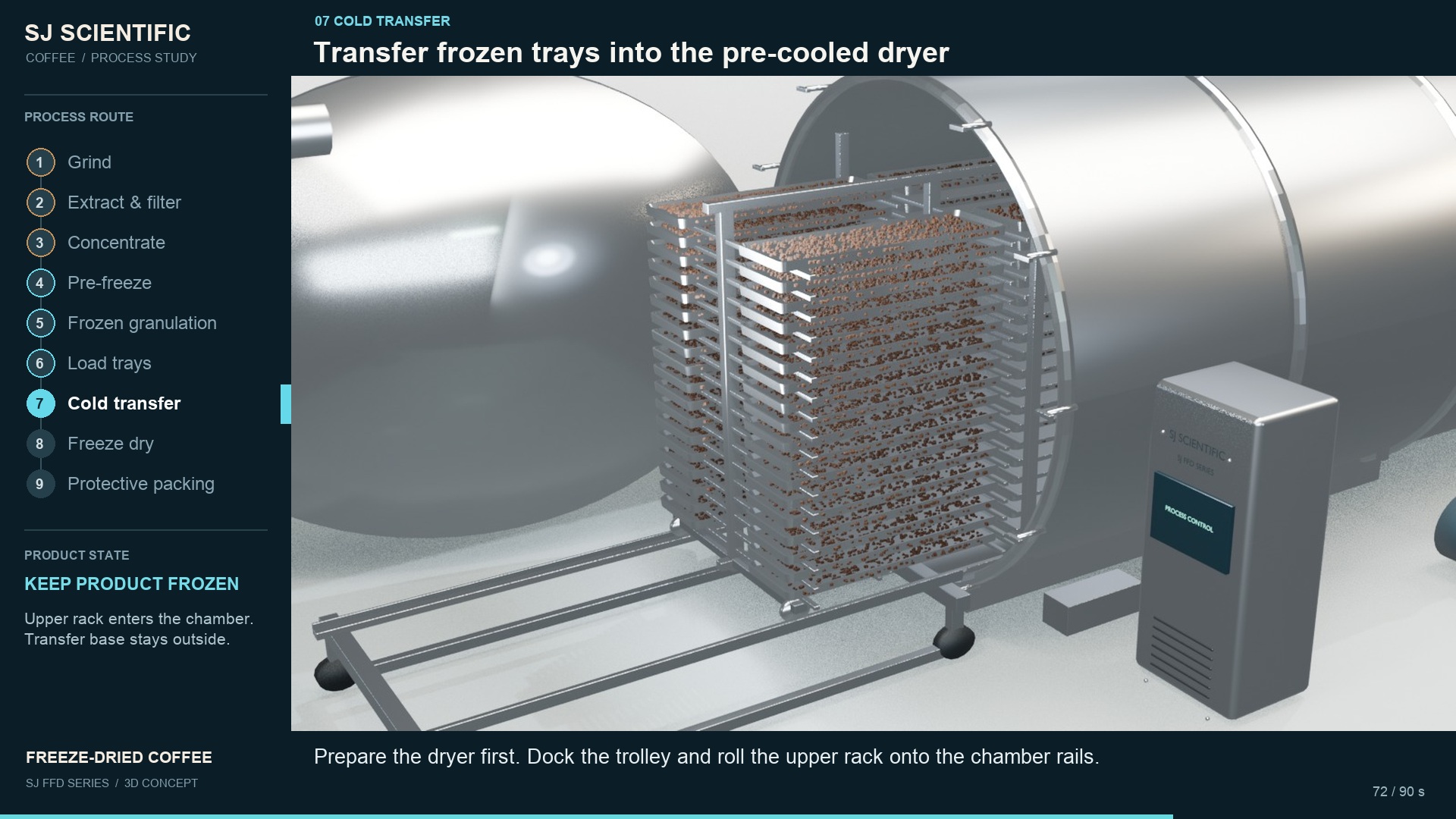
Pre-cool the dryer using loading conditions established for the coffee formulation, then minimize the transfer time. The upper rack enters the chamber while the separate lower trolley remains outside. During drying, water leaves the frozen product as vapor and deposits as ice on the internal refrigerated coil bank. Twin shelf banks, rails and coil placement shown here are conceptual; the selected FFD model and approved project drawing determine the actual arrangement.
What is needed to select a coffee freeze dryer?
Provide extract solids before and after concentration, frozen feed mass per tray, granule dimensions, tray fill depth, target residual moisture, required dry coffee output, trial cycle data and available utilities. Size removable water from the material that actually enters the dryer; do not subtract upstream evaporated water a second time.
For energy comparisons, request the measurement boundary: extraction, concentration, freezing, the FFD cycle, defrost and packing may be accounted for separately. The animation establishes no kWh/kg result, fixed temperature program or production guarantee.
Start with the SJ industrial FFD model range. Compare FFD-50, FFD-100, FFD-150, FFD-200, FFD-250 as shelf-area platforms, not published coffee-throughput guarantees. First establish the coffee tray and water balance; then settle the shelf layout, condenser duty and upstream equipment interfaces with engineering.
The English coffee process PDF includes the equipment reference list. The video page provides the English captions and timeline. For a solid-food comparison, read the pet-food meat-cube process guide; do not transfer its fresh-load or pre-cooling examples into a coffee specification.
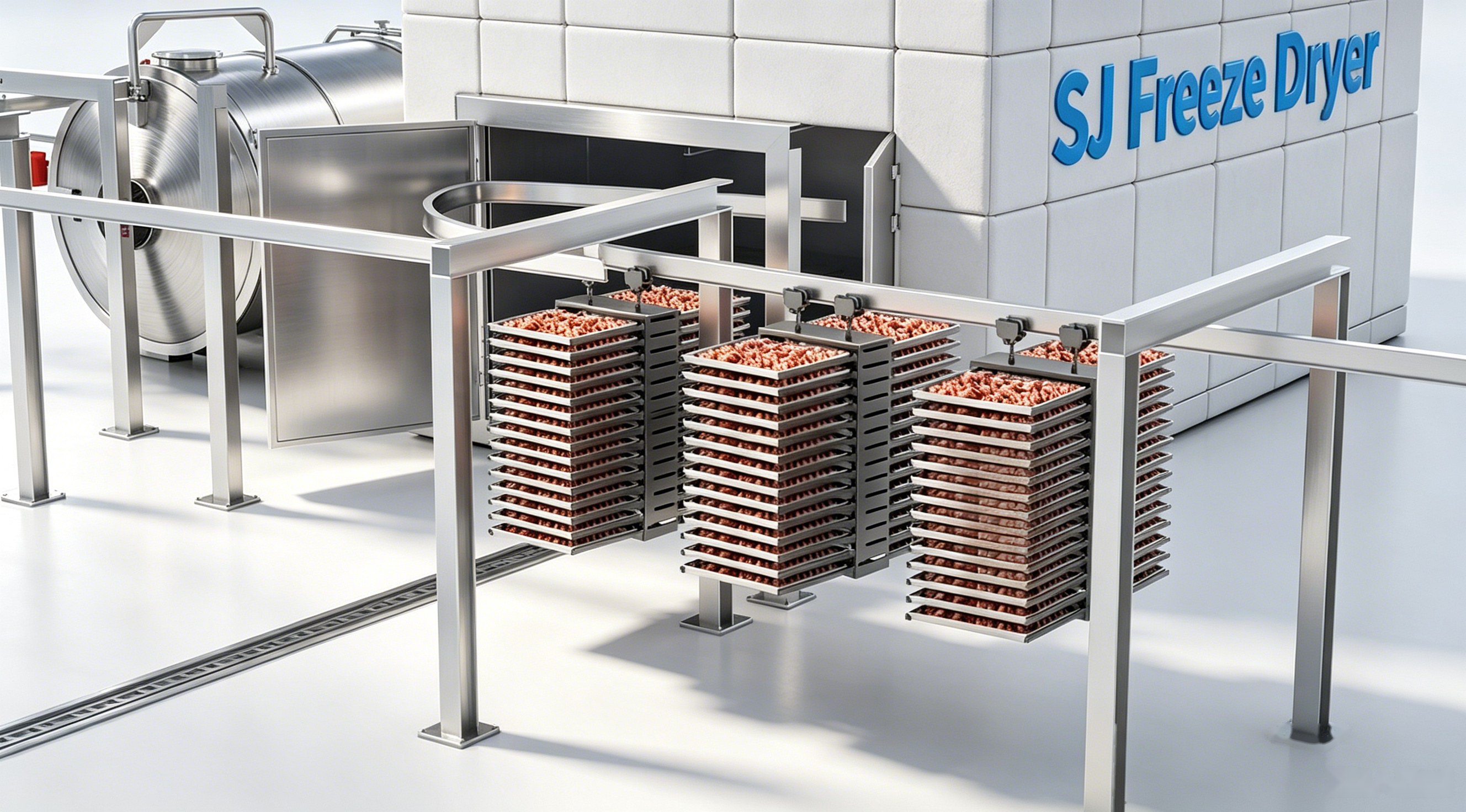
Freeze-dried coffee is a line process, not one chamber
The production boundary starts with roasted-coffee extraction and ends with moisture-protective packaging. Depending on the plant, concentration, aroma recovery or foaming may sit before freezing. In the frozen-granule route below, breaking and sieving follow slab freezing and precede freeze drying. The FFD receives a defined frozen coffee geometry; it should not be expected to correct inconsistent extract or variable layer depth.
| Stage | What must be controlled | Why it changes the dryer |
|---|---|---|
| Extraction and clarification | Extract composition, insoluble solids and filtration | Deposits and variability affect trays, cleaning and final texture |
| Concentration | Total solids, viscosity, temperature and aroma strategy | Changes water to remove, freezing behavior and mass-transfer resistance |
| Freezing and structuring | Layer depth, nucleation, frozen slab or granule dimensions | Controls pore structure, sublimation path and drying time |
| Primary and secondary drying | Product temperature, pressure, shelf input and endpoint | Determines collapse risk, residual moisture and cycle duration |
| Dry handling and packaging | Breakage, particle distribution, humidity exposure and seal rate | Sets unloading method and packaging-room capacity |
Five inputs that make a coffee RFQ meaningful
- Prepared extract per batch: use kilograms of extract entering trays, not raw beans purchased by the factory.
- Total solids and water to remove: concentration changes both condenser load and frozen structure.
- Layer depth and frozen geometry: a deeper slab creates a longer vapor path. Report tray dimensions and kilograms per tray.
- Finished-product target: define residual moisture or water activity, granule range, bulk density, reconstitution and aroma-quality method.
- Daily rhythm: include freezing, frozen granulation, cart transfer, drying, defrost, unloading, cleaning and packaging instead of dividing 24 hours by a brochure cycle.
Why freezing matters so much for coffee extract
Ice formation creates the pore network used by water vapor during primary drying. The freezing route therefore affects drying resistance, particle structure and aroma retention. Research on coffee extract has shown that changing the freezing method can materially change porosity, sublimation rate and volatile retention. This does not create one universal recipe; it means freezing must be treated as a process-development stage.
For a new product, record extract solids, viscosity and temperature; tray depth; cooling history at center and edge; final frozen temperature; hold time; and dimensions of frozen pieces entering the FFD. Use the same loading method during the dryer trial.
A practical development sequence
- Run small trays to compare concentration, layer depth and freezing route without changing many variables at once.
- Set a conservative primary-drying condition and monitor representative product locations.
- Identify endpoint evidence and inspect collapse, shrinkage, color, aroma, granule strength and reconstitution.
- Confirm residual moisture or water activity and package samples quickly in the intended barrier system.
- Repeat the preferred condition at a larger cart load to check edge and center behavior.
- Only then lock planning kilograms per tray, carts per batch and expected cycle range for factory sizing.
Sizing condenser duty from coffee extract
Water entering the dryer = frozen feed mass entering the dryer × its water mass fraction.
Approximate water to capture = water entering the dryer - water remaining at the specified endpoint. Upstream water removal is already excluded from the incoming frozen feed mass.
The condenser needs holding capacity plus operating margin, but ice capacity alone is not enough. Peak sublimation flow, available condensing surface, vapor-path conductance, refrigeration duty under load and defrost turnaround also matter.
From H-series trials to an FFD factory line
Small H-series equipment can support product and packaging trials when the aim is to learn how a coffee product freezes, dries and rehydrates. An FFD project becomes appropriate when the process has a defined tray load, sanitation plan, cart workflow, utilities and repeat demand.
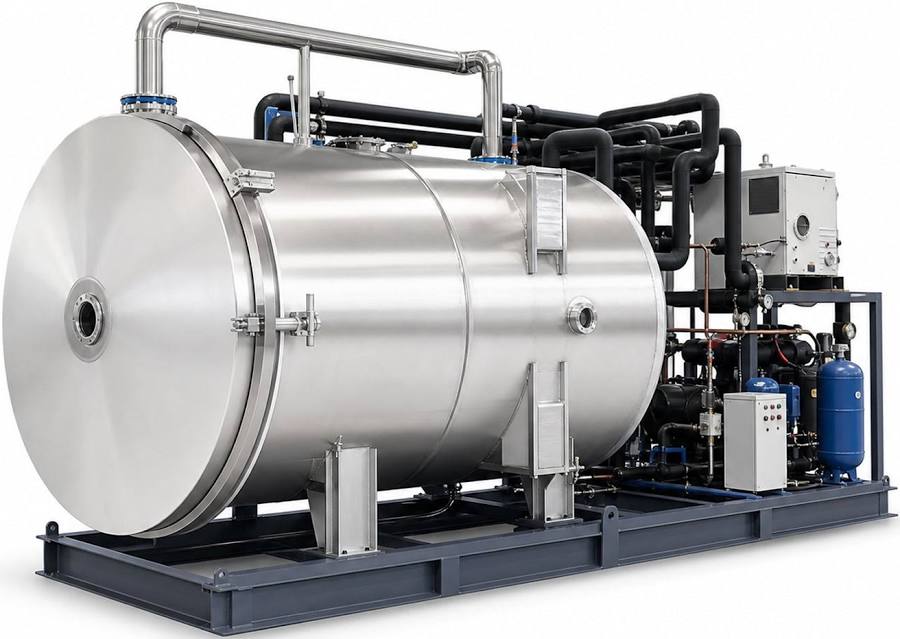
SJ-FFD-50
50 m²-class platform for defined industrial food or ingredient projects after tray load and water balance are established.
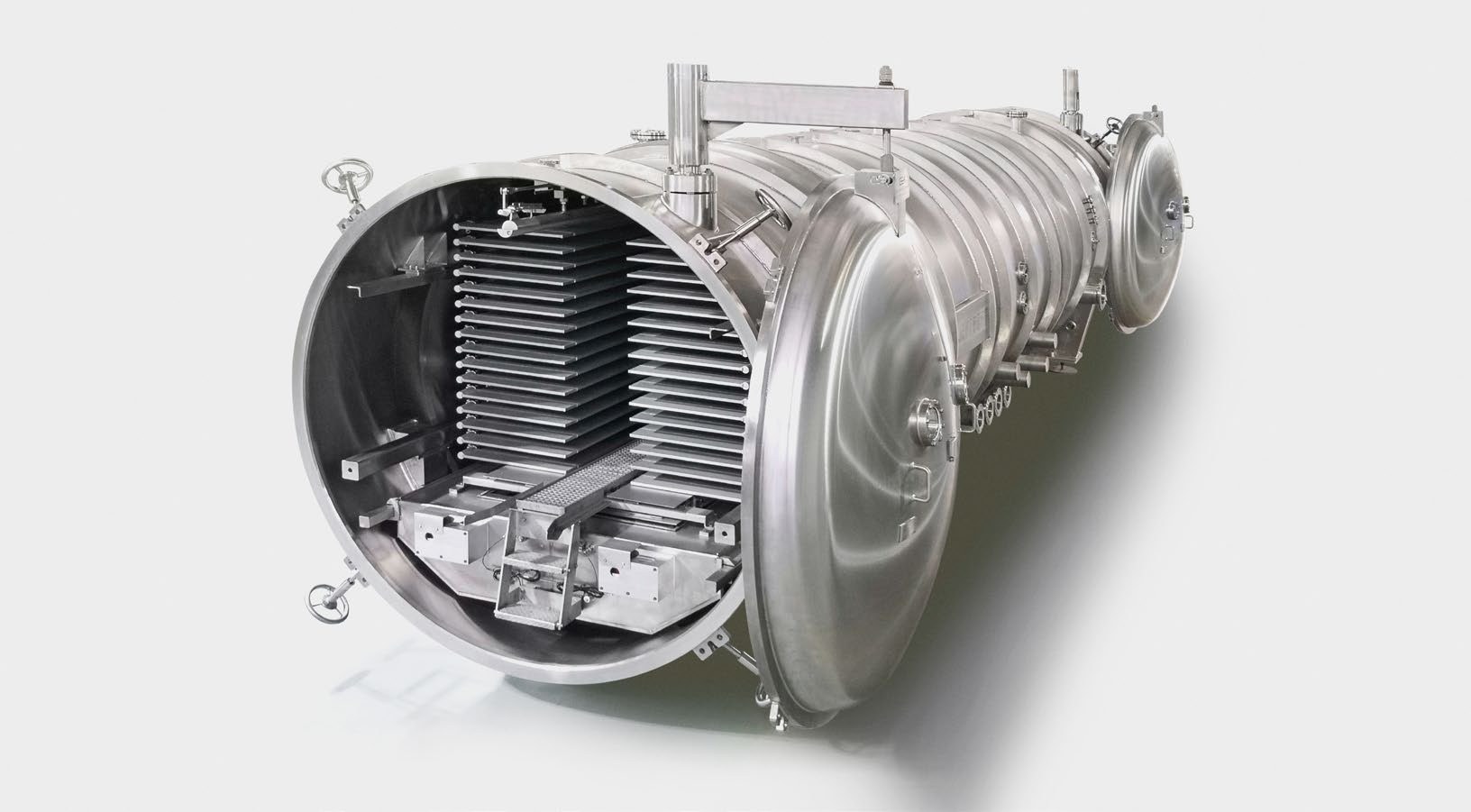
View FFD-50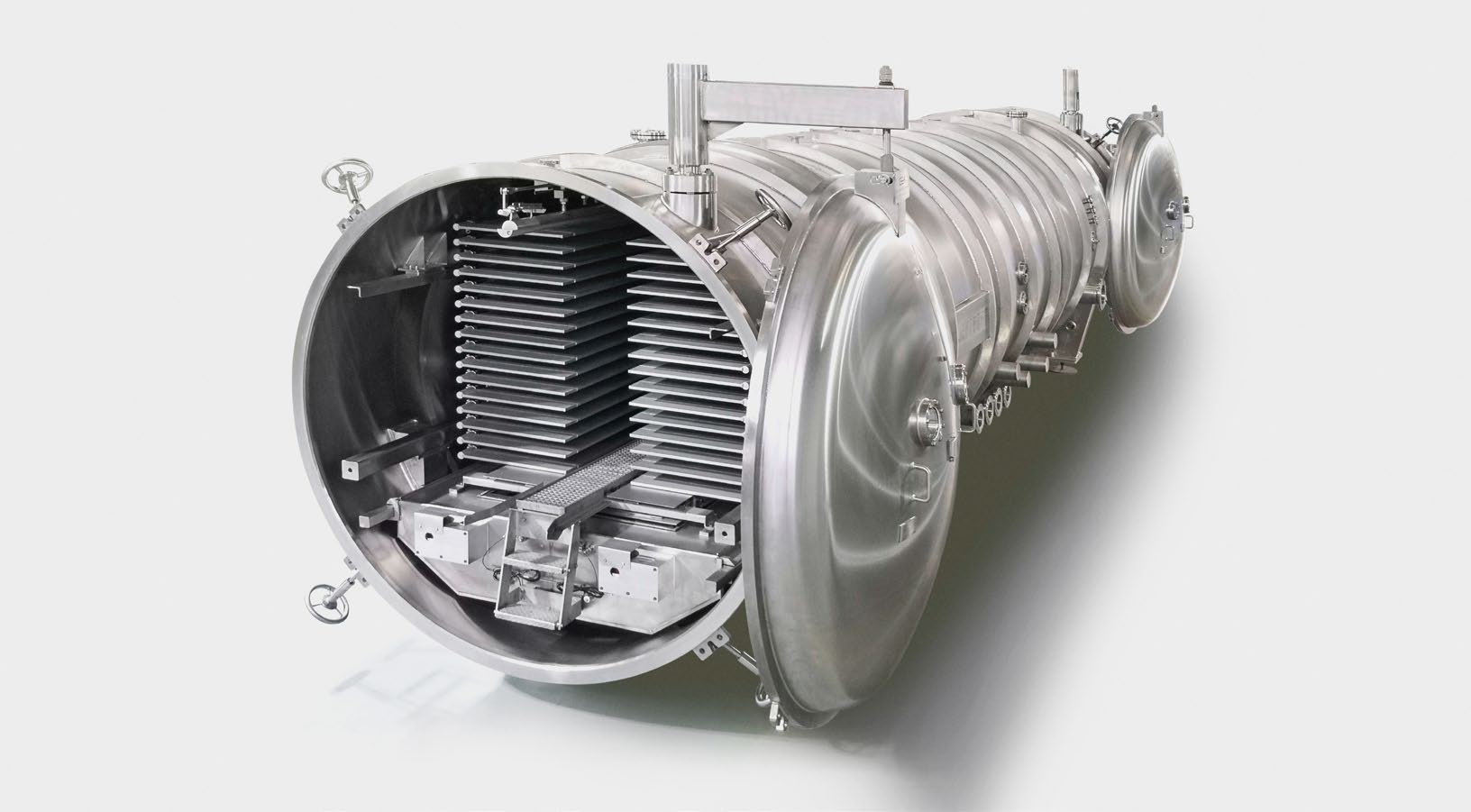
SJ-FFD-100
100 m²-class platform for regular factory production where extract, cart load and cycle basis are documented.
View FFD-100Compare the wider range on the industrial food freeze dryer series page. For factory arrangement, use the FFD line layout guide.
Coffee-specific questions for the RFQ
- Is the feed brewed extract, concentrate, foamed extract or another structured feed?
- What are minimum, nominal and maximum total solids?
- How many kilograms enter each tray, and what is the filled layer depth?
- How is the product frozen, stored and transferred to the dryer?
- What defines primary-drying and final endpoints?
- How will aroma, residual moisture or water activity, granulation and reconstitution be assessed?
- How quickly can the complete dried batch be handled and sealed after unloading?
- What are site power, cooling-water, drainage, ventilation and defrost conditions?
Questions buyers ask
Is freeze-dried coffee simply brewed coffee placed in a food freeze dryer?
No. Industrial work normally uses a controlled extract or concentrate and a designed freezing structure. In this concept, frozen granulation comes before freeze drying; protected packing follows drying.
Can the FFD model be chosen from fresh bean kilograms?
No. Size from prepared extract entering the dryer, its water fraction, tray geometry, cycle and daily production plan.
Why is freeze-dried coffee selected for premium soluble coffee?
Low-temperature sublimation and the porous dried structure can support aroma quality and rapid reconstitution, but the result depends on extraction, concentration, freezing, drying and packaging together.
Technical references
Frequently asked questions
Is coffee granulated before or after freeze drying in this process?
In this concept, the concentrate is first frozen into slabs. It is then broken, granulated and sieved inside the cold room while frozen, before shallow-tray loading and freeze drying.
Does the coffee animation show a complete supplied or validated production line?
No. It is an independent 3D process study. Upstream equipment scope, coffee loading, cycle, energy, utilities and the selected FFD configuration require project review and product trials.