Pharmaceutical Freeze Dryer Sizing: Vials, Shelf Area, and URS
An engineering guide to sizing a pharmaceutical lyophilizer from vial drawings and fill volume through condenser load, stoppering, controls, and validation scope.
Pharmaceutical Freeze Dryer
Short answer: size a pharmaceutical freeze dryer from the vial drawing and process load outward. First calculate usable vial positions and fill volume. Then confirm total water to remove, peak sublimation demand, condenser and vapor-path margin, shelf spacing, stoppering, cleanroom interface, controls, and qualification scope. Shelf area alone is not a complete URS.
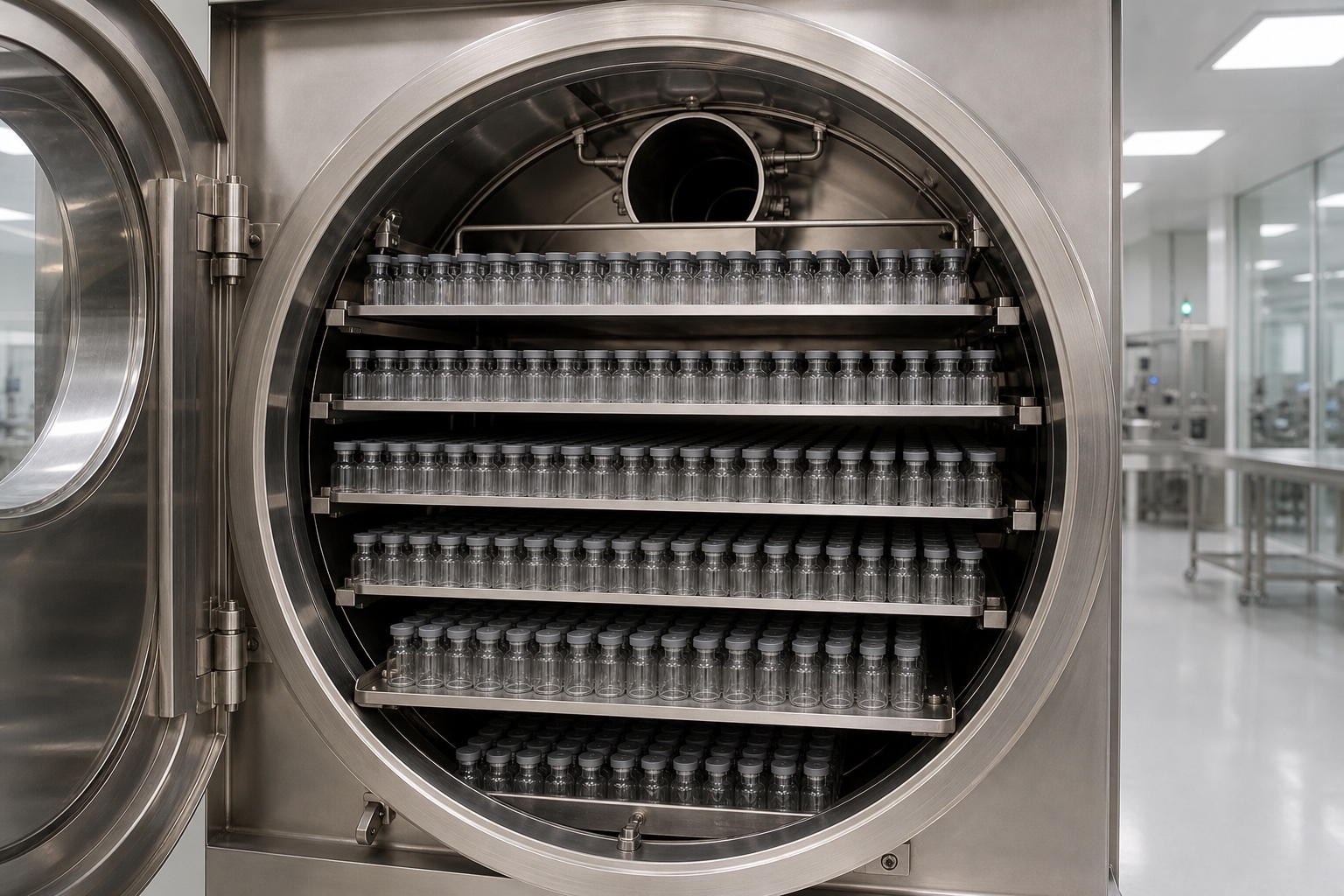
This article supports teams selecting a pharmaceutical freeze dryer or pharmaceutical lyophilizer for sterile vials, peptides, biologics, vaccines, diagnostics, or bulk API. It complements the GMP freeze dryer requirements guide and pharmaceutical GMP validation guide.
Start the URS with the product and container
Do not begin with a model number. Begin with the intended product family and worst-case process. Record:
- Vial standard, nominal size, outside diameter, body height, neck and stopper drawings
- Fill volume and formulation density
- Target vial count per batch and expected partial loads
- Initial water or solvent load and final residual-moisture range
- Critical product temperature, collapse temperature, or eutectic limit where known
- Freezing, annealing, primary drying, and secondary drying ranges
- Stoppering, inert-gas backfill, closure, and loading method
- CIP, SIP, manual cleaning, and aseptic interface requirements
- Batch record, audit trail, electronic signature, and data-retention expectations
- FAT, SAT, IQ, OQ, and PQ responsibilities
Calculate vial count from real geometry
Nominal vial names such as 2R, 10R, or 20R are not enough for a final layout. Different suppliers and loading systems may require different pitch. Use the approved vial drawing, stopper position, tray or rail geometry, and a conservative usable loading field.
The following SJ Command F values are planning counts for one 450 × 600 mm shelf, based on the current loading layout supplied by SJ Scientific. They are useful for early comparison, but the purchase specification should confirm the customer's vial drawing.
| Vial format | Reference OD | Reference height | Approx. vials per 450 × 600 mm shelf |
|---|---|---|---|
| 2R | 16 mm | 35 mm | 1,036 |
| 3R | 16 mm | 40 mm | 1,036 |
| 4R | 16 mm | 45 mm | 1,036 |
| 6R | 22 mm | 40 mm | 540 |
| 8R | 22 mm | 45 mm | 540 |
| 10R | 24 mm | 45 mm | 450 |
| 15R | 24 mm | 60 mm | 450 |
| 20R | 30 mm | 55 mm | 300 |
| 25R | 30 mm | 65 mm | 300 |
| 30R | 30 mm | 75 mm | 300 |
| 50R | 40 mm | 73 mm | 165 |
| 100R | 47 mm | 100 mm | 108 |
Multiply the verified per-shelf count by the usable shelf count, then subtract any positions lost to loading rails, probes, edge clearances, or automated handling. Review the detailed Command F vial-loading table for configurable shelf counts and clearances.
Shelf count must preserve vial and stopper clearance
More shelves increase nominal area only if the selected vial, stopper position, loading method, and stoppering travel still fit. Low shelf spacing can suit 2R or 3R vials but exclude taller 20R, 30R, 50R, or 100R formats. A flexible product family should define approved vial envelopes for each shelf configuration instead of presenting every shelf count as universally compatible.
Also allow room for temperature probes where used, loading frames or trays, and the vertical movement required for stoppering. The highest-count configuration is not automatically the most flexible configuration.
Convert fill volume into water and ice load
For an aqueous formulation, an early water-load estimate is:
Total liquid load = vial count × fill volume × formulation density.
Approximate water to remove = total liquid load × water mass fraction - retained moisture.
Example: 10,000 vials filled with 5 mL contain about 50 L of formulation before allowing for density and solids. The condenser and cycle cannot be sized from “10,000 vials” alone. A 1 mL diagnostic vial and a 20 mL fill in the same vial count create very different ice loads.
If organic solvent is present, do not treat the batch as a standard water calculation. Review freezing behavior, material compatibility, capture temperature, vacuum-pump protection, exhaust, inerting, and site safety.
Condenser capacity is more than kilograms of ice
The condenser must hold the expected batch ice with margin, but it must also capture vapor at the required rate while maintaining chamber pressure. The limiting point may be condenser refrigeration duty, available condensing surface, ice accumulation, the chamber-to-condenser duct, or the pressure-control system.
Ask the manufacturer to explain:
- Total ice capacity per batch and recommended operating margin
- Expected peak sublimation rate for the intended shelf temperature and pressure
- Condenser temperature under load, not only no-load pull-down
- How ice accumulation changes surface and pressure behavior
- Defrost method and turnaround time
- Whether the same condenser is proposed across different shelf areas, and why
Define shelf and pressure performance as acceptance criteria
A GMP lyophilizer URS should use measurable criteria. Define the shelf operating range, heating and cooling ramp requirements, temperature uniformity or mapping approach, chamber leak rate, pressure-control range, sensor types, calibration range, and acceptable stability during representative load conditions.
Ultimate vacuum is useful for diagnostics. Primary drying performance depends more on stable, measured, controllable pressure and sufficient vapor flow.
Stoppering and aseptic integration can change the chamber
Confirm vial height with the stopper in the lyophilization position, stoppering stroke, compression force, shelf flatness, stopper behavior, nitrogen backfill, and closure sequence. For automatic loading, define line speed, row geometry, accumulation, shelf level change, RABS or isolator interface, and recovery from a jam.
The cleanroom and technical-area boundary also affects door arrangement, service access, condenser location, CIP/SIP piping, drains, and maintenance strategy.
Write controls and validation into the URS
For regulated use, specify recipe lifecycle, user roles, audit trail, alarm acknowledgement, electronic signatures where required, batch reports, data export, backup, restore, time synchronization, and retention. “21 CFR Part 11 ready” should lead to a feature and test matrix, not remain a marketing phrase.
Align the document package before purchase: URS response, DQ, P&ID, component and instrument lists, software description, risk assessment, FAT/SAT, IQ/OQ, material and calibration certificates, manuals, maintenance, and traceability.
A compact RFQ template
Send the manufacturer one table containing vial drawing, vial count, fill volume, formulation type, water/solvent load, shelf spacing, stoppering, batch frequency, critical temperatures, pressure range, condenser margin, cleanroom interface, cleaning/sterilization, controls, documents, utilities, and installation location. Ask every supplier to respond to the same table and list exceptions.
For peptide-specific decisions, continue with the peptide freeze dryer solution and peptide lyophilizer selection guide.
Frequently asked questions
How do I calculate pharmaceutical freeze dryer vial capacity?
Calculate usable vials per shelf from the approved vial diameter, pitch, loading field, rails, and clearances, then multiply by usable shelf count and verify vial height and stoppering travel.
How large should a pharmaceutical freeze dryer condenser be?
It should hold the expected water load with margin and capture the peak vapor rate while maintaining process pressure. Ice capacity, refrigeration duty, surface area, duct conductance, and defrost time all matter.
What belongs in a GMP lyophilizer URS?
Include product and vial data, loading, shelf and pressure performance, condenser load, stoppering, cleaning and sterilization, aseptic interfaces, data integrity, utilities, FAT/SAT, qualification, and documents.