Peptide Freeze-Drying Case Study: Uniform Vial Cakes with SJ-Creator 1S(T) Max
A documented small-batch peptide lyophilization case using the SJ-Creator 1S(T) Max, with customer-site equipment photography, post-cycle vial images, visible cake observations, and a practical checklist for turning a good-looking result into a defensible process.
Peptide Lyophilization Process
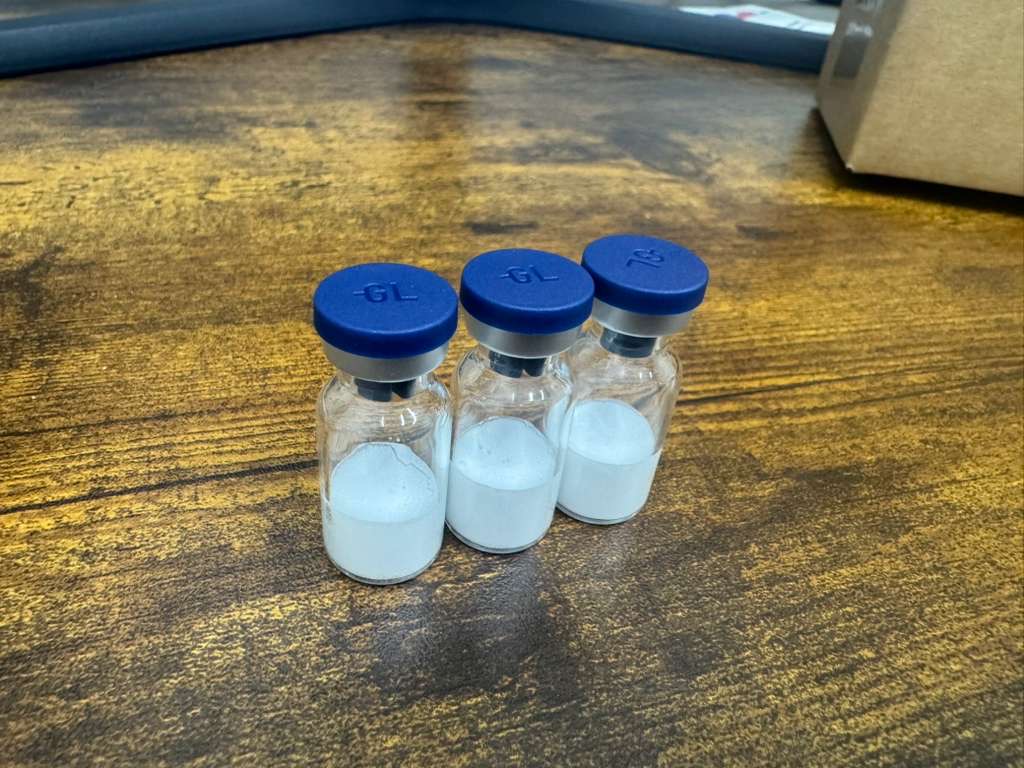
Case summary: a customer used an SJ-Creator 1S(T) Max peptide freeze dryer for a small vial batch. The customer-provided photographs show the machine at the application site and three post-cycle vials with white, coherent, visually similar lyophilized cakes. The images support a successful visible result. They do not, by themselves, establish peptide identity, purity, potency, residual moisture, reconstitution time, sterility, or storage stability.
This peptide freeze-drying case study is useful because it connects a real small-batch peptide lyophilizer to the evidence a development team should record. It also shows why “perfect peptide” cannot be judged from cake appearance alone. A good-looking vial is the beginning of the decision, not the end of it.
Peptide lyophilization case at a glance
| Application | Customer-described small-batch peptide formulation in vials |
|---|---|
| Freeze dryer | SJ-Creator 1S(T) Max research and process-development lyophilizer |
| Published shelf class | 0.12 m²; 300 × 400 mm controlled shelf platform |
| Visible result | White, coherent cakes with broadly similar appearance across the three photographed vials |
| Not claimed | Purity, potency, residual moisture, reconstitution, sterility, shelf life, or a universal cycle recipe |
The customer-site peptide freeze dryer
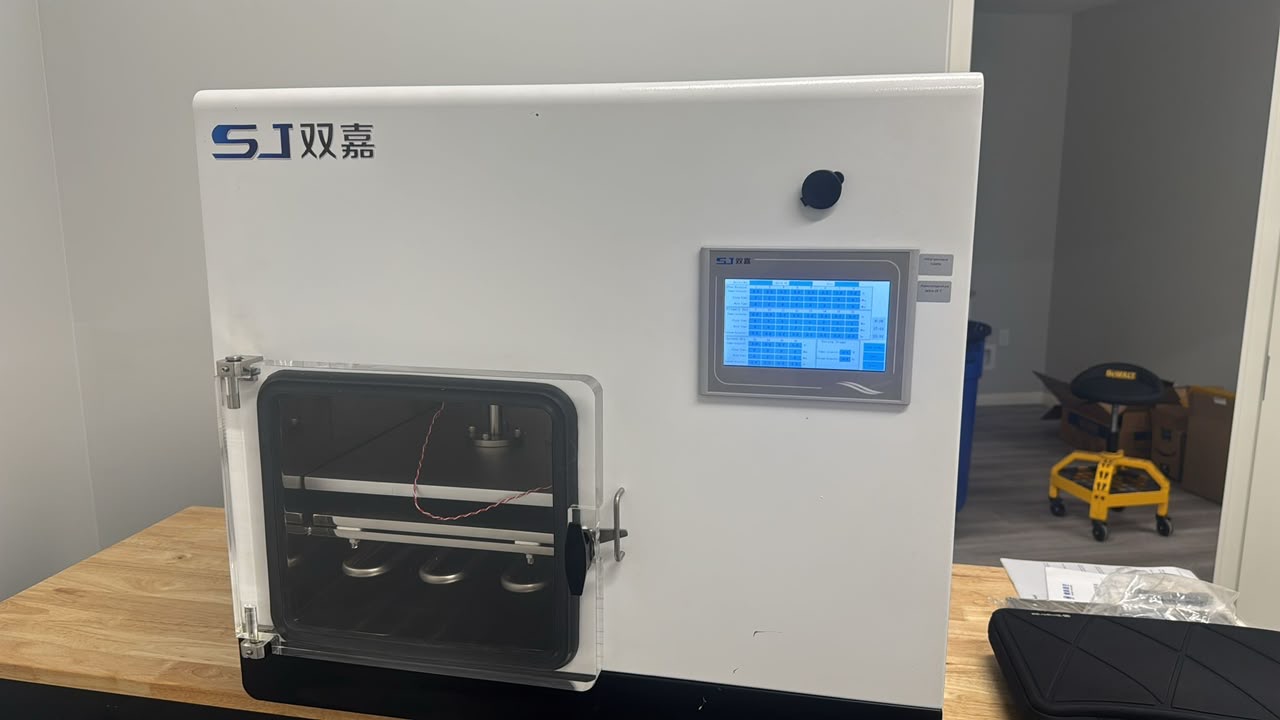
The Creator 1S(T) Max is positioned between a simple collector-style laboratory freeze dryer and a larger GMP production lyophilizer. Its value in research peptide freeze drying is not just that it becomes cold or reaches vacuum. The controlled shelf, programmed stages, pressure-control capability, and recorded trends let a developer connect equipment conditions to what happened inside representative vials.
| Creator 1S(T) Max reference | Why it matters for peptide vial work |
|---|---|
| 0.12 m² shelf area | Supports compact experimental loads without forcing an early study into a production-size chamber. |
| 300 × 400 mm controlled shelf | Provides a defined heat-transfer surface for freezing, primary drying, and secondary drying. |
| Max configuration: lowest shelf at or below −60°C | Gives added low-temperature capability for formulation-specific freezing studies. |
| Max condenser reference at or below −85°C | Provides vapor-pressure margin for demanding aqueous peptide development loads; solvent compatibility still needs review. |
| Programmable vacuum control and recipes | Makes controlled pull-down, hold stages, repeat runs, and comparison of cycle changes more practical. |
| Optional pressure-measurement tools | Pirani and capacitance measurements can support endpoint interpretation when configured and used with product data. |
These are current published selection references, not a substitute for the approved quotation and technical agreement for a particular machine.
What the photographed peptide cakes tell us
The three vials have a white, continuous dried structure rather than an obviously melted or heavily collapsed mass. Their visible height and surface appearance are reasonably consistent in the photograph. That is a useful development observation because large vial-to-vial differences can point to freezing variation, edge effects, uneven fill, endpoint differences, stopper position, or handling after the cycle.
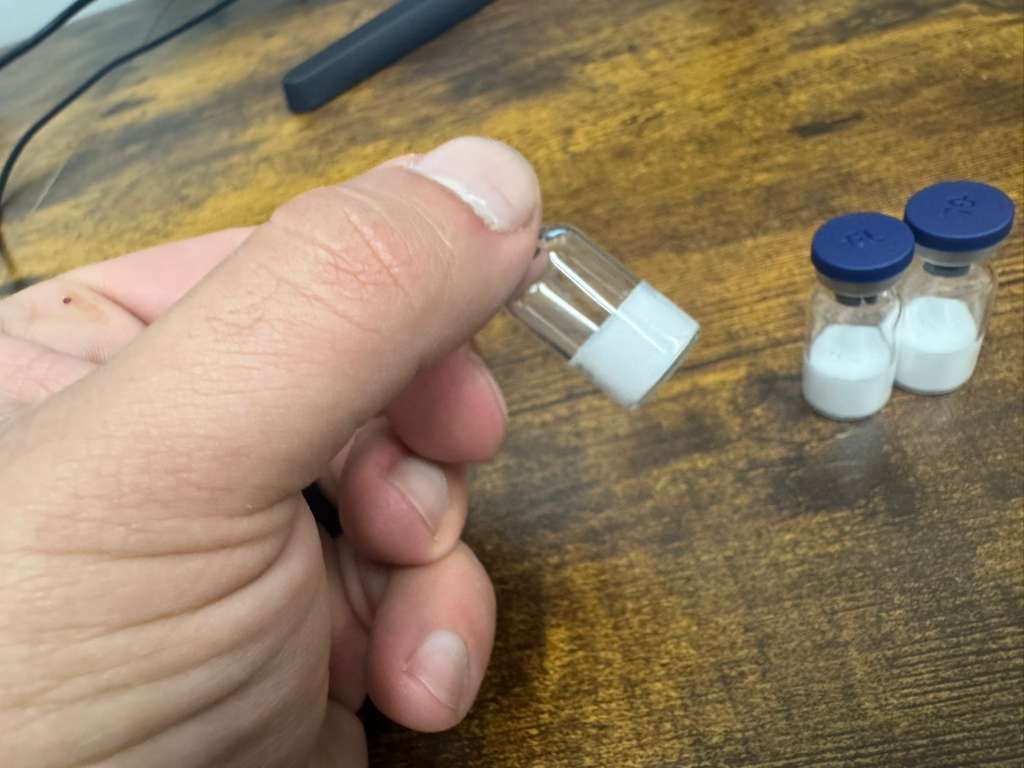
Visual inspection should be standardized instead of reduced to “looks good.” Record the vial position, cake height, color, shrinkage, cracking, collapse, meltback, splash marks, powder on the stopper, and any difference between edge and center locations. Photograph the same background and lighting after every development run. That turns an impression into comparable evidence.
What the photographs cannot prove
A white intact peptide cake does not reveal how much active peptide is present. It does not show whether oxidation, deamidation, aggregation, adsorption, or another product-specific change occurred. It also cannot establish residual moisture, reconstitution time, biological activity, container-closure integrity, sterility, or long-term storage conditions.
A defensible peptide lyophilization study links the visual result to the product's critical quality attributes. Depending on the molecule and intended use, the test plan may include assay and purity, relevant degradants, residual moisture, reconstitution, pH after reconstitution, particles or aggregation, potency or activity, solid-state behavior, and stability. The right panel is formulation-specific.
A practical run record for reproducing this result
The customer's exact recipe is not published, and it should not be copied from a photograph. A team planning a similar small-batch peptide freeze-drying process should record the following fields so each run answers a defined question.
| Stage | Record | Decision supported |
|---|---|---|
| Formulation and container | Peptide class, concentration, buffer, excipients, solvent traces, vial and stopper drawing, fill volume and load map | Separates formulation, container, and equipment effects. |
| Freezing | Shelf ramp and holds, representative product temperatures, nucleation behavior, annealing if justified | Confirms complete freezing and the structure entering primary drying. |
| Vacuum pull-down | Pressure ramp, shelf and product-temperature response, powder movement or foaming | Checks that the transition does not create blowout or an uncontrolled temperature excursion. |
| Primary drying | Shelf temperature, chamber pressure, product temperature, Pirani/CM trend when available, condenser behavior and endpoint evidence | Shows whether sublimation stayed within the justified product-temperature margin. |
| Secondary drying | Ramp, hold, product temperature, pressure, residual moisture by sample location | Connects desorption history to moisture, reconstitution, and stability targets. |
| Final handling | Backfill, stoppering, unload exposure, cake photos, analytical and stability samples | Protects the dried product and completes the evidence package. |
Why this is a process-development result, not a universal peptide recipe
Peptide formulations do not share one safe shelf temperature, pressure, or drying time. A different buffer, bulking agent, vial, fill depth, load, or solvent trace can change the critical product-temperature limit and vapor resistance. Even the same nominal shelf setpoint can produce a different product temperature in another lyophilizer.
For that reason, this case is best read as evidence that a compact shelf-controlled peptide lyophilizer can produce a promising and visibly repeatable vial result when the formulation and cycle are developed together. For the underlying method, use our run-by-run peptide freeze-drying protocol tutorial and peptide lyophilization cycle-development guide.
From Creator small-batch work to a GMP peptide lyophilizer
The next scale should reproduce the intended product history, not merely copy the Creator recipe. Compare vial heat-transfer conditions, shelf mapping, chamber-to-condenser vapor flow, pressure-control behavior, condenser load, minimum and maximum batch patterns, and the location of the warmest product. Then confirm residual-moisture and other quality distributions across the receiving load.
For lab and pilot model selection, start with the peptide freeze dryer selection guide. For clinical or commercial transfer, review the Creator-to-Command peptide lyophilizer path and the GMP peptide lyophilizer validation checklist.
Is the Creator 1S(T) Max the right peptide freeze dryer?
It is a strong fit when the immediate need is formulation screening, controlled vial studies, small-batch peptide or protein lyophilization, cycle comparison, and data generation before a larger pilot or GMP purchase. The selection still depends on frozen water, vial count, fill depth, lowest required shelf and condenser temperatures, stoppering, pressure measurement, solvent compatibility, utilities, and documentation scope.
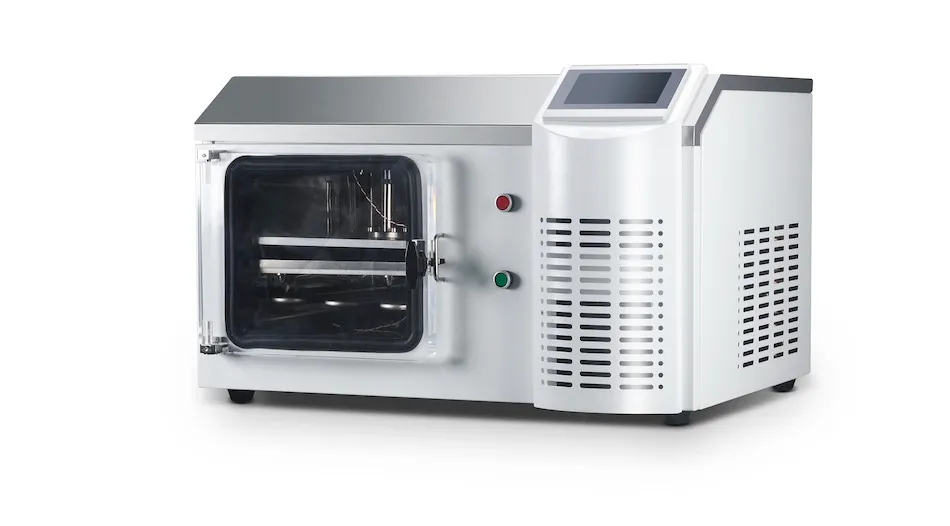
SJ-Creator 1S / 1S(T) Max
0.12 m² shelf-controlled research lyophilizer for peptide formulation screening, vial cycle development, and controlled small-batch studies.
Bottom line
This customer result is valuable because the evidence is concrete: the identified SJ-Creator 1S(T) Max is shown at the application site, and the post-cycle vials show coherent, visually similar white cakes. The careful conclusion is not “the peptide is perfect.” It is that the run produced a promising physical result worth carrying into analytical testing, repeat runs, and scale-up decisions.
Technical references
Frequently asked questions
Is the SJ-Creator 1S(T) Max suitable for peptide freeze drying?
It is a 0.12 m² shelf-controlled research and process-development lyophilizer intended for small vial batches, formulation screening, cycle development, and early scale-up evidence. Final suitability depends on formulation, vial, fill depth, ice load, solvent, pressure range, and analytical requirements.
What does a successful lyophilized peptide cake look like?
A useful visual result is often coherent, repeatable across comparable vials, and free from obvious collapse, meltback, severe shrinkage, or ejection. Appearance is only one observation and does not prove purity, potency, residual moisture, reconstitution, sterility, or long-term stability.
Does a white intact cake prove that a peptide freeze-drying cycle is validated?
No. A visually intact cake is encouraging, but validation or process approval requires recorded cycle data and product-specific testing such as assay, purity, residual moisture, reconstitution, stability, and other critical quality attributes.
Why use a shelf-controlled peptide lyophilizer instead of a simple manifold freeze dryer?
A shelf-controlled system lets the developer define freezing, primary-drying, and secondary-drying conditions and relate shelf temperature and chamber pressure to representative product temperatures. That makes run-to-run comparison and later process transfer more defensible.
Can a Creator peptide cycle be copied directly to a GMP lyophilizer?
Not directly. The receiving machine has different heat transfer, vapor flow, condenser loading, shelf mapping, pressure control, and load geometry. Transfer should reproduce the intended product-temperature and moisture history, then confirm edge and center vial behavior at the new scale.
What information is needed to size a small-batch peptide freeze dryer?
Send the formulation or solvent class, vial and stopper drawings, fill volume, vial count, frozen water per batch, target residual moisture, shelf-temperature need, condenser requirement, stoppering plan, voltage, and the data or validation scope expected from the project.