Freeze Dryer vs Dehydrator: Process, Product Quality, Cost, and Machine Choice
A practical food-equipment comparison explaining when sublimation under vacuum is justified and when heated-air dehydration is the simpler choice.
Food Freeze Dryer
Short answer: a freeze dryer and a food dehydrator both remove water, but they are not the same machine. A freeze dryer first freezes the product and then removes ice mainly by sublimation under vacuum; a dehydrator moves heated air across the product and removes liquid water by evaporation. Choose from the required finished texture, rehydration, heat sensitivity, food-safety plan, batch size, operating time, utilities, packaging, and total cost rather than assuming one method is always better.
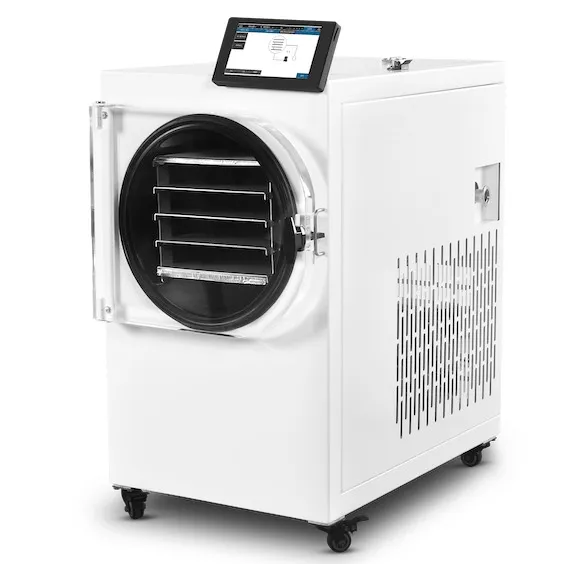
This guide answers freeze dryer vs dehydrator, freeze dryer vs food dehydrator, freeze dryer vs dehydrator cost, and freeze dryer not dehydrator. A lyophilizer is another name for a freeze dryer; it is not a separate dehydration principle.
The process difference
In freeze drying, water in the product is frozen. Chamber pressure is reduced, controlled heat is supplied, and ice changes directly to vapor during primary drying. The condenser captures that vapor as ice. Secondary drying then removes additional bound or adsorbed moisture according to the product and endpoint.
In convective dehydration, a fan moves heated air across or through the food. Liquid water evaporates at the surface while moisture migrates from the interior. Air temperature, velocity, humidity, piece thickness, loading, and time control the result. Vacuum drying and vacuum ovens are additional drying methods, but they should not be sold as freeze dryers unless the equipment supports a genuine frozen-product sublimation process and vapor capture.
Freeze dryer vs dehydrator at a glance
| Decision factor | Freeze dryer / lyophilizer | Food dehydrator |
|---|---|---|
| Water-removal path | Freeze, reduce pressure, sublime ice, then desorb remaining moisture | Evaporate liquid water with heated moving air |
| Main equipment | Vacuum chamber, condenser, refrigeration, vacuum pump, shelves or trays, controls | Insulated cabinet or enclosure, heater, fan, vents, trays, controls |
| Typical structure | Often porous, light, and less shrunken when the product and cycle are suitable | Often denser, chewier, or visibly shrunken depending on product and conditions |
| Rehydration | Porous structure can support rapid rehydration for suitable foods | Denser structure may rehydrate more slowly or be intended to be eaten dry |
| Heat exposure | Lower product temperatures are possible, but heat is still deliberately supplied during drying | Uses warm or hot air; actual product temperature depends on process conditions |
| Capital and complexity | Higher: refrigeration, vacuum, condenser, seals, pump, defrost, and controls | Lower and mechanically simpler for many food applications |
| Cycle and turnaround | Often longer; includes freezing, vacuum drying, unloading, defrost, and cleaning | Often shorter for suitable thin products, but varies by food and target |
| Best economic fit | Premium quality, porous texture, rehydration, sensitive ingredients, high product value | Jerky, herbs, fruit leather, chewy fruit, vegetables, and lower-cost high-throughput drying where suitable |
Compare the finished product, not marketing percentages
Freeze drying can better preserve shape, porous structure, aroma, color, and heat-sensitive attributes for many products, but the result depends on variety, formulation, pretreatment, freezing, pressure, heat input, endpoint, oxygen exposure, and storage. A dehydrator can produce an excellent product when a chewy texture, concentrated flavor, or traditional dried format is desired.
Do not rely on a universal claim that one method retains a fixed percentage of nutrients. Different nutrients respond differently, and published results depend on product, process, analysis, and storage. Run side-by-side trials using the intended raw material and package, then measure the attributes that matter to the buyer.
Products that often favor freeze drying
- fruit pieces where crispness, shape, color, and rapid rehydration support a premium product;
- complete meals or ingredients intended to regain structure after water is added;
- heat-sensitive cultures, extracts, flavors, or formulations after product-specific validation;
- products intended for lightweight transport where a porous dry structure is useful;
- high-value food ingredients where quality can justify longer cycles and higher equipment cost.
Products that may favor a dehydrator
- jerky and similar products using validated preparation, heating, and drying procedures;
- herbs, spices, mushrooms, and thin vegetables suited to controlled airflow;
- fruit leather and products designed for a chewy or dense texture;
- low-margin products where energy, capital, and throughput dominate the decision;
- operations that do not need a frozen product, vacuum system, condenser, or rehydration performance.
High-fat, high-oil, highly concentrated sugar, and some coated products can be difficult in a freeze dryer. A technical trial is more reliable than a list of foods labeled simply “yes” or “no.”
Neither method is automatically a food-safety kill step
Removing water can reduce water activity and prevent growth under defined conditions, but pathogens can survive drying and freeze drying. Freeze drying intentionally preserves many microorganisms in laboratory work. Safe production still requires approved ingredients, temperature control before drying, sanitation, prevention of cross-contamination and allergen cross-contact, validated cooking or other controls where required, endpoint verification, suitable packaging, and compliance with applicable regulations.
Vacuum packaging is not a substitute for drying or a food-safety plan. A product that retains unsafe moisture can remain hazardous in a low-oxygen package. Commercial operations should establish product-specific moisture or water-activity limits and verify them with an appropriate method.
Compare capacity using saleable output
For both machines, start with kilograms per tray or square meter, usable area, piece thickness, complete door-to-door time, good yield, and target kilograms or packages per day. A dehydrator can have a shorter process for some products; a freeze dryer may create a higher-value product. Compare cost per saleable package rather than only machine price or nominal fresh-load capacity.
| Cost category | Freeze dryer questions | Dehydrator questions |
|---|---|---|
| Equipment | Refrigeration, vacuum pump, condenser, chamber, trays, controls, defrost | Cabinet, heater, fan, trays, airflow and humidity control |
| Utilities | Freezing, refrigeration, vacuum, shelf heat, room ventilation | Heating, fan power, air exchange and exhaust |
| Labor | Preparation, loading, unloading, defrost, pump and seal checks, packaging | Preparation, tray rotation if needed, unloading, cleaning, packaging |
| Quality losses | Collapse, wet centers, breakage, moisture pickup after unloading | Case hardening, uneven drying, shrinkage, scorching, color or flavor change |
| Maintenance | Vacuum oil or dry pump, hoses, seals, sensors, refrigeration, drain and condenser | Fans, heaters, filters, airflow passages, sensors, trays |
How to tell whether an online machine is really a freeze dryer
Ask for a process diagram and exact specifications. A real freeze dryer needs a vacuum-rated chamber, vacuum pump, controlled pressure measurement, a cold condenser or ice trap sized to capture vapor, and a defined way to freeze the product before or inside the chamber. The supplier should state shelf or tray configuration, condenser temperature and ice capacity, vacuum range, heat input, defrost, electrical requirements, and a demonstrated process.
A cold cabinet with trays is a freezer, not a freeze dryer. A heated fan cabinet is a dehydrator. A vacuum oven without frozen-product sublimation and a suitable condenser is a vacuum dryer, not automatically a lyophilizer.
Where SJ food freeze dryers fit
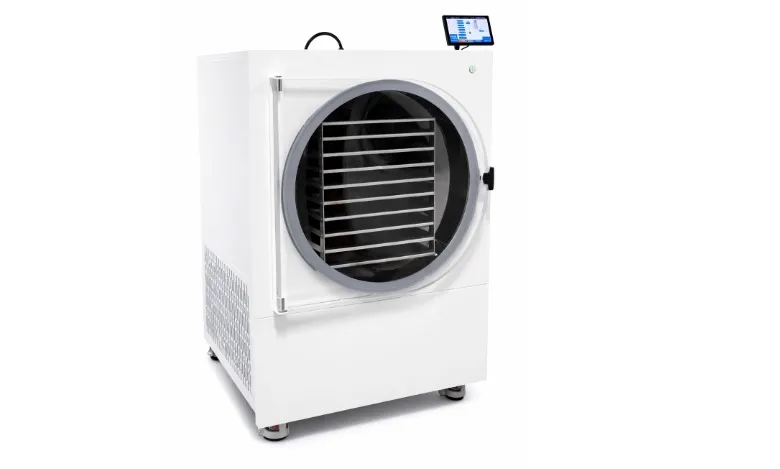
When the required product supports freeze drying, compare SJ-05H to SJ-20H for home, product trials, and micro-production; SJ-30H to SJ-50H for regular commercial batches; and SJ-FFD-50 to SJ-FFD-250 for engineered industrial production.
Questions to answer before choosing
- What finished texture, shape, flavor, color, and rehydration does the customer expect?
- Is the product suitable for freezing and sublimation, warm-air evaporation, or another process?
- What are the qualified load, cycle, yield, endpoint, and package for each method?
- What food-safety hazards and validated controls apply before, during, and after drying?
- What are the installed equipment, utility, labor, maintenance, and floor-space costs?
- What is the cost and selling price per saleable package after rejects and downtime?
Independent food-preservation references
Frequently asked questions
Is a freeze dryer the same as a dehydrator?
No. A freeze dryer removes ice mainly by sublimation under vacuum after freezing; a dehydrator evaporates liquid water with heated moving air.
Is a lyophilizer different from a freeze dryer?
No. Lyophilizer and freeze dryer are names for the same core process. Equipment design and application can differ, but lyophilization means freeze drying.
Which is better for fruit?
It depends on the intended product. Freeze drying often supports crisp porous fruit and rapid rehydration; dehydration often supports chewy fruit at lower equipment cost. Compare qualified trials and package stability.
Does freeze drying kill bacteria?
No. Freeze drying can preserve microorganisms. Use safe ingredients, sanitation, validated cooking or other controls where required, hygienic handling, endpoint verification, and suitable packaging.
Why does a freeze dryer cost more than a dehydrator?
It includes a vacuum-rated chamber, refrigeration, cold condenser, vacuum pump, seals, pressure measurement, controlled heat, defrost, and more complex controls and maintenance.