Freeze-Drying Endpoint Detection: When Primary and Secondary Drying Are Really Complete
A practical guide to combining independent process signals before declaring primary or secondary drying complete.
Process Development
Short answer: a freeze-drying endpoint should not be declared from one timer or one thermocouple. For primary drying, the best practical decision combines product-temperature behavior, Pirani and capacitance-manometer convergence when both gauges are fitted, a qualified pressure-rise test, and an adequate safety hold. Secondary drying ends only after the specified product-temperature history and residual-moisture target have been demonstrated for the formulation and load.
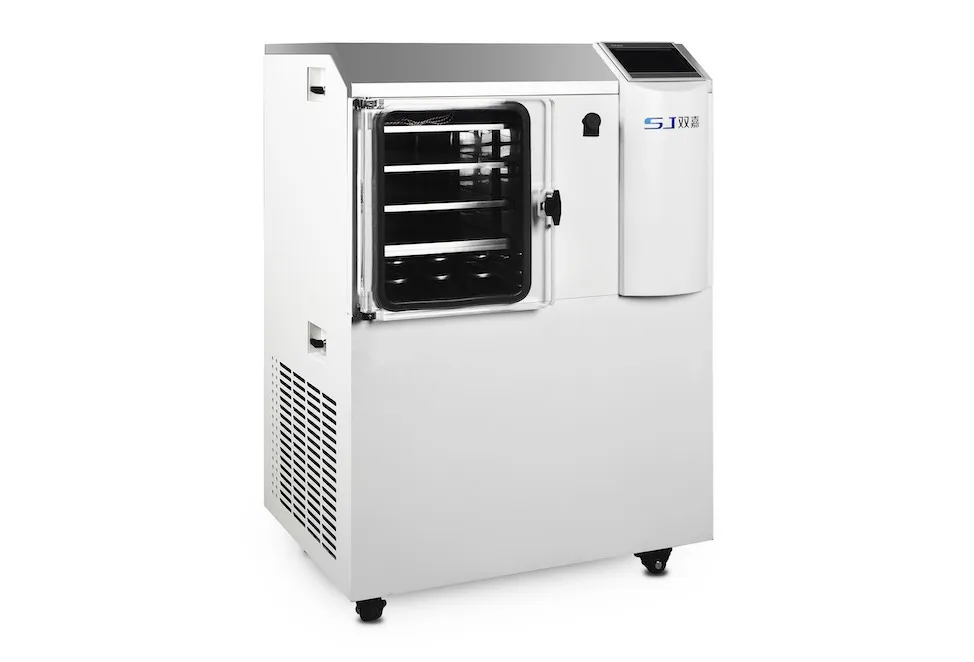
This field-oriented guide complements the broader freeze dryer process guide and the peptide lyophilization cycle-development article.
Primary and secondary drying have different endpoints
| Stage | What is being removed | Useful endpoint evidence | What can mislead |
|---|---|---|---|
| Primary drying | Ice by sublimation | Pressure-gauge convergence, pressure-rise behavior, product-temperature and condenser trends | A single warm thermocouple or a preset time copied from another load |
| Secondary drying | More strongly bound water by desorption | Defined product-temperature hold plus residual-moisture data from a representative sampling plan | Assuming that no visible ice means the product has reached its moisture target |
The signals we trust, and what each one says
Product thermocouples. Near the end of primary drying, a monitored vial often rises toward shelf temperature because sublimation cooling is disappearing. This is helpful, but the probe changes nucleation and represents only its vial. Edge vials can finish before colder center locations, and a probe may lose contact.
Pirani versus capacitance manometer. A Pirani gauge responds to gas composition, while a capacitance manometer measures absolute pressure more independently of gas type. During active water-vapor flow the readings differ; convergence can indicate that vapor load has fallen. The threshold still needs to be established on the actual equipment and load.
Pressure-rise test. Isolating the chamber briefly and observing pressure rise can support endpoint judgment. Test duration, isolation boundary, acceptable slope and the effect on product temperature must be qualified. A long test can disturb the batch.
Condenser and vapor-flow trends. A falling vapor load may be visible in condenser response, dew point or a mass-flow tool. These are supporting signals, but a quiet condenser can also reflect restricted vapor flow or an instrumentation issue.
A run-by-run endpoint workflow
- Before the cycle: define the formulation limit, vial and fill, load map, sensor locations, planned endpoint tests and acceptance criteria.
- During primary drying: trend shelf temperature, representative product temperatures, chamber pressure, both pressure gauges when available, and condenser behavior on one time axis.
- At the apparent endpoint: confirm that independent signals agree. If a pressure-rise test is part of the method, run the qualified test without exceeding the product-temperature limit.
- Add the safety hold: cover the coldest credible vial and normal batch variability. Do not use an arbitrary overnight hold to hide a poorly understood process.
- During secondary drying: control the product-temperature ramp and hold. Chamber pressure alone does not quantify bound water.
- After the run: compare cake appearance, residual moisture, reconstitution and other critical quality attributes by load position.
Why endpoints move when the batch changes
Fill volume, solids concentration, vial geometry, stopper position, shelf location, nucleation, load size and chamber heat transfer all change primary-drying duration. Partial loads can behave differently from full loads. A production lyophilizer can also have different vial heat transfer and vapor-flow resistance from the development dryer.
Transfer the endpoint method and acceptance rationale, not simply a number of hours. The biologics lyophilization tech-transfer guide explains the larger transfer package.
Common mistakes in endpoint reviews
- Using only the first thermocouple that reaches shelf temperature.
- Calling primary drying complete when visible ice disappears from one vial.
- Comparing gauges without confirming calibration and location.
- Running a pressure-rise test with no defined duration or acceptance limit.
- Shortening secondary drying without residual-moisture and stability evidence.
- Ignoring condenser or vapor-path limits when the shelf load increases.
What the equipment should record
For serious process development, the freeze dryer should provide stable shelf control, repeatable pressure control, representative product-temperature inputs, exportable trends, alarms and clear recipe histories. Optional Pirani and capacitance pressure measurement is particularly useful when endpoint development is part of the study.
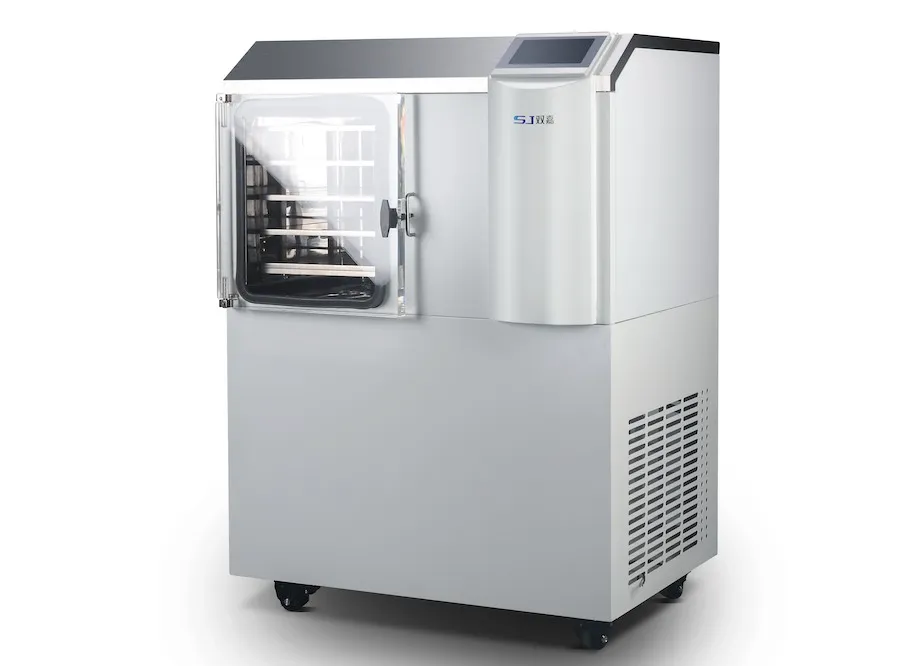
SJ-Creator pilot lyophilizer
Shelf-controlled platform for cycle comparison, product-temperature studies and small-batch development.
View Creator series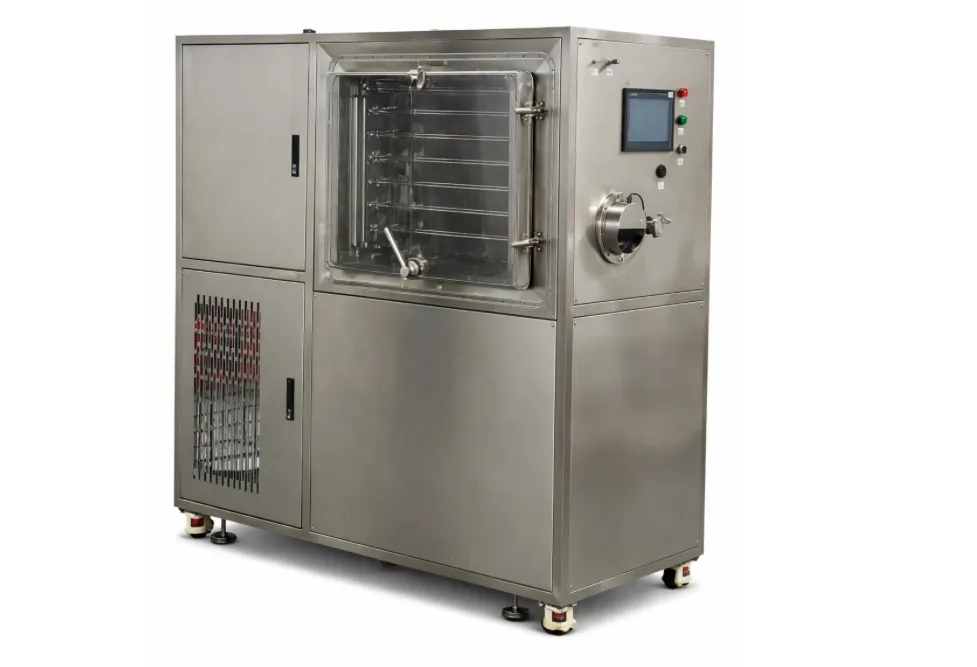
Command GMP freeze dryers
Pharmaceutical lyophilizers for vial production, stoppering and controlled vacuum.
Review pharmaceutical pathQuestions teams ask
Can product temperature alone prove the endpoint?
No. It is useful local evidence, but probe placement, vial behavior and load position limit what one thermocouple represents.
Does Pirani-capacitance convergence always mean all ice is gone?
It is a strong practical signal when configured correctly, but the process still needs a defined threshold, safety hold and product-quality confirmation.
How is the secondary-drying endpoint confirmed?
By the justified product-temperature and time history together with residual-moisture and relevant stability or performance data.