Peptide Freeze-Drying Protocol Development: A Run-by-Run Tutorial
A practical, formulation-neutral tutorial for planning peptide freeze-drying development runs, recording evidence, optimizing the cycle, and transferring it from Creator to Command lyophilizers.
Peptide Lyophilization Process
Short answer: a peptide freeze-drying protocol is a controlled development plan, not a table of universal temperatures and pressures. Start with the formulation, container, critical product temperature, and analytical targets. Use each development run to answer one defined question, then carry the evidence into the next run and into the receiving lyophilizer.
This run-by-run tutorial is for scientists and engineers searching for a peptide freeze-drying protocol, peptide lyophilization protocol, or a practical way to move from a lab recipe to a GMP peptide freeze dryer. It complements our broader how to lyophilize peptides guide and the three-stage cycle-development guide. It deliberately does not publish a copy-ready recipe: setpoints must be justified for the molecule, formulation, vial, fill, load, and equipment.
Choose the platform around the question each run must answer
Early work benefits from a lyophilizer that can run representative vials, record product temperature, control pressure steadily at partial load, and change recipes without slowing the study. A receiving GMP machine adds stoppering, data integrity, qualification, cleaning, and scale-up requirements. The following SJ platforms form a practical lab-to-production path.
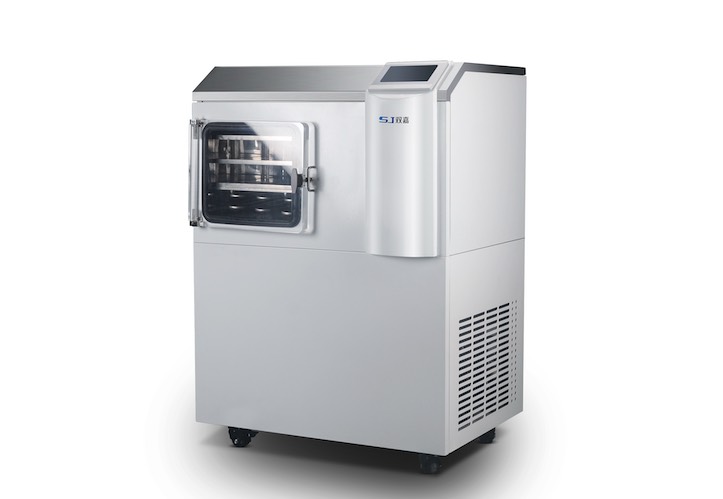
SJ-Creator 2S
0.24 m2 research and pilot platform for formulation screening and cycle development.
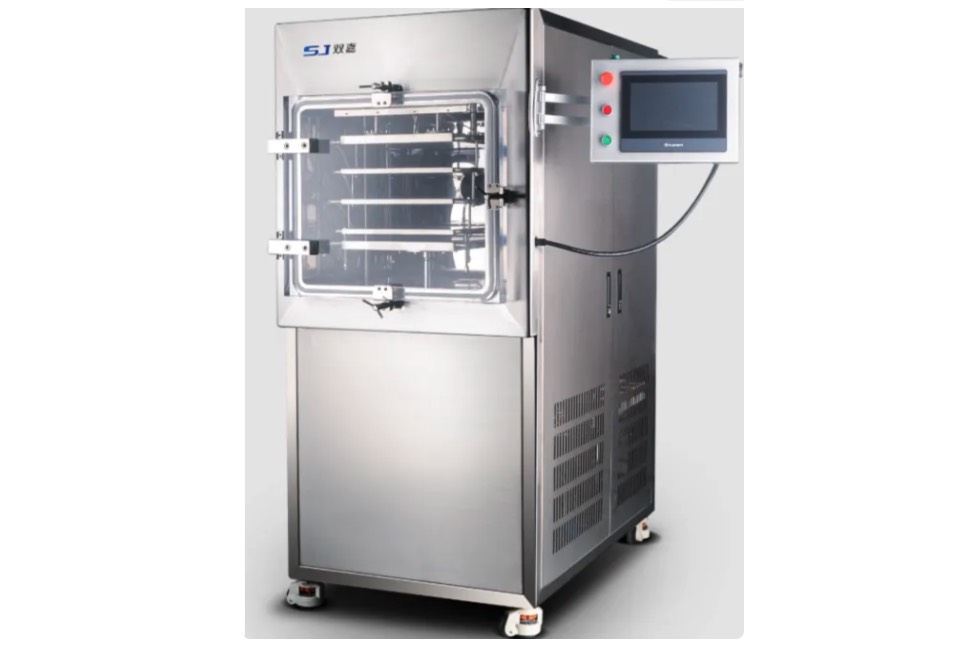
Command SJ-50F(T)
0.5 m2 compact GMP platform for clinical and small-batch peptide vial work.
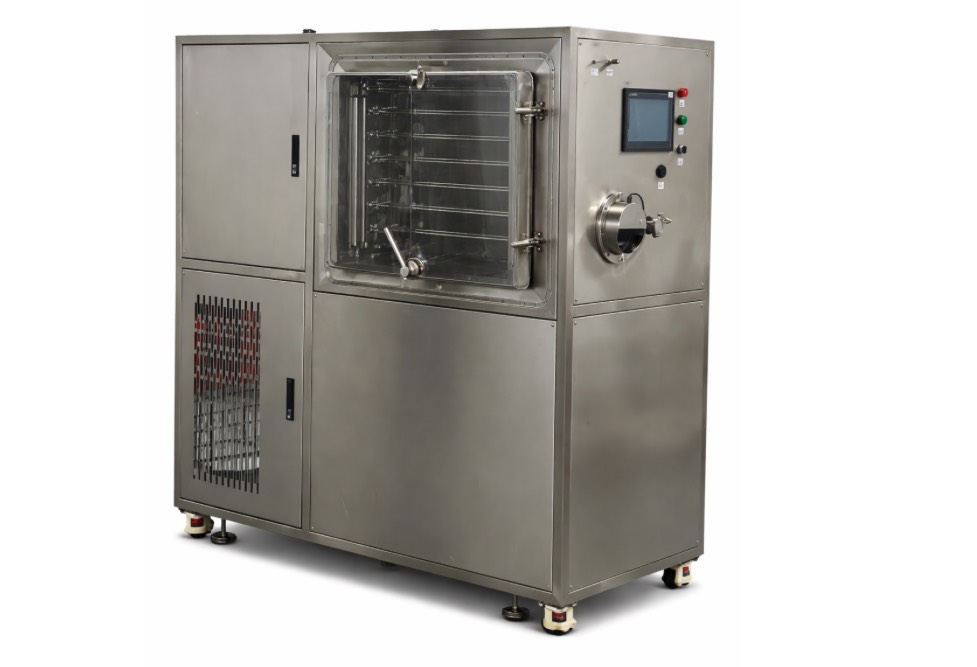
Command SJ-100F(T)
1.0 m2 GMP peptide freeze dryer for larger vial loads and process transfer.
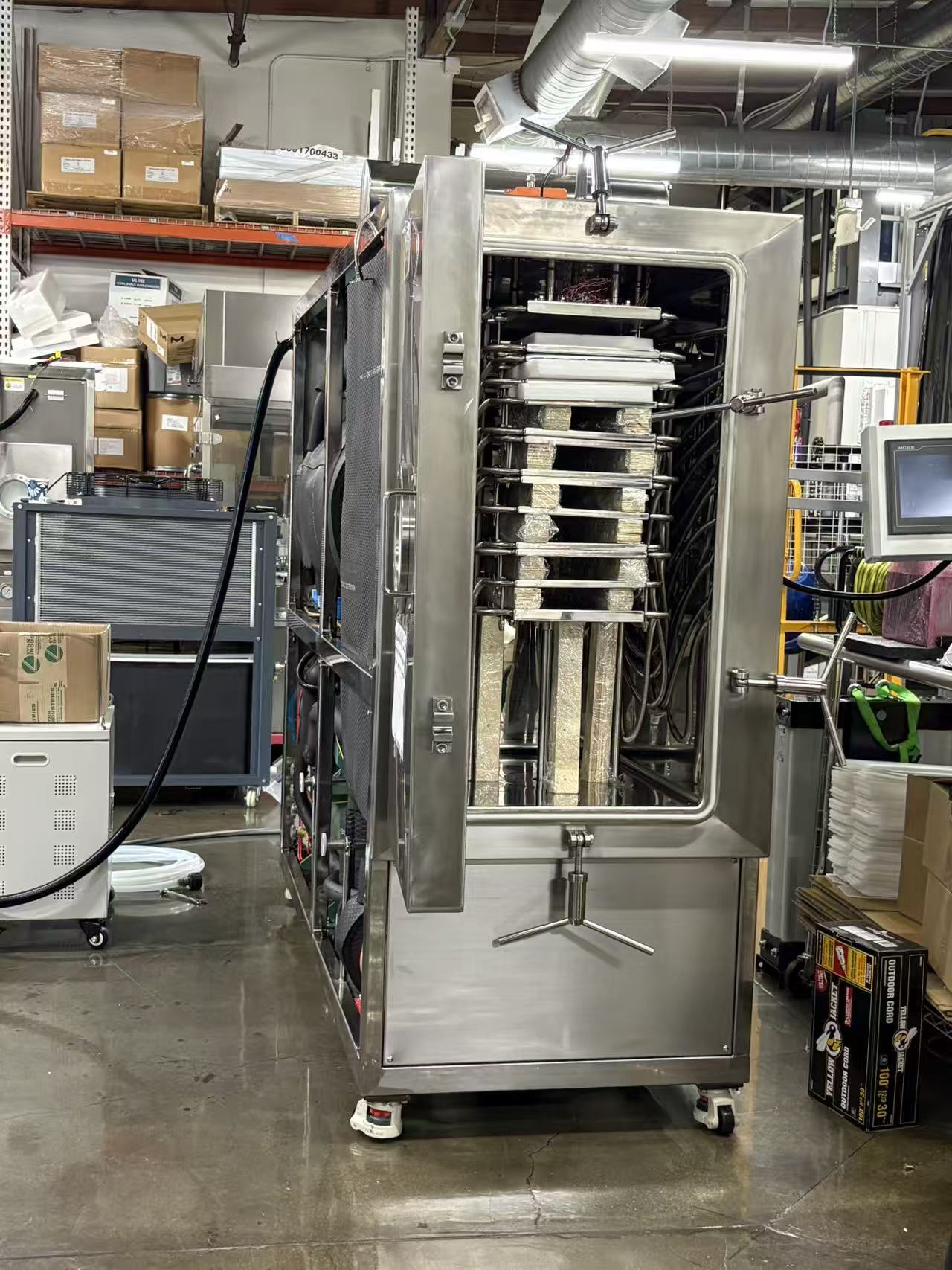
Command F Flexible Shelf
Configurable 450 x 600 mm shelves for confirmed vial formats and matched condenser sizing.
The protocol-development path at a glance
| Development run | Main question | Evidence to collect | Decision before continuing |
|---|---|---|---|
| Run 0: controls | Is the liquid and freeze-thaw formulation acceptable? | Assay, purity, degradation, aggregation or particles as applicable, pH, appearance | Separate formulation failure from lyophilizer failure. |
| Run 1: conservative mapping | Can the load freeze and dry with a defensible product-temperature margin? | Thermal data, edge/center probes, shelf and pressure history, endpoint signals, cake observations | Confirm the process window before trying to shorten it. |
| Run 2: primary-drying study | How much heat can be supplied without crossing the critical limit? | Product temperature, pressure gauges, endpoint, vapor and condenser behavior | Select a robust shelf-temperature and pressure combination. |
| Run 3: secondary-drying study | Which moisture range supports stability and reconstitution? | Residual moisture by location, assay, reconstitution, solid-state or stability data | Choose a range, not simply the lowest moisture result. |
| Run 4: robustness | Does the protocol repeat across realistic variation? | Repeat runs, minimum/maximum load, fill and vial tolerances, edge/center results | Define operating ranges and justified hold-time margins. |
| Run 5: transfer | Can the receiving Command lyophilizer reproduce the intended product history? | Equipment comparison, product temperature, endpoint, moisture distribution, CQAs | Approve the engineering and GMP confirmation plan. |
Step 1: freeze the development brief before freezing the product
Write down what will remain fixed and what is still under study. At minimum, capture peptide identity or class, concentration, buffer and pH, excipients, solvent traces, fill volume, vial and stopper drawings, vial count, load map, target presentation, known degradation pathways, and analytical acceptance criteria. For sterile products, include the aseptic filling, partial stoppering, loading, backfill, stoppering, and container-closure strategy.
Define the quality questions before the first cycle. A good-looking cake is not enough. Depending on the product, the evidence may include assay and purity, oxidation or deamidation, aggregation or particles, residual moisture, cake structure, reconstitution time, pH after reconstitution, potency or biological activity, and container-closure integrity.
Step 2: establish the product-temperature limit
For an amorphous formulation, measure or estimate the glass-transition temperature of the maximally freeze-concentrated solution (Tg') and collapse temperature (Tc). A crystalline system may instead be constrained by eutectic melting or another phase transition. Differential scanning calorimetry, freeze-drying microscopy, and supporting solid-state work help turn an assumed limit into a defensible one.
The protocol should state a justified maximum product temperature during primary drying and the margin used during development. Shelf temperature is only an input. Actual product temperature also depends on vial heat transfer, fill depth, dry-layer resistance, radiation, chamber pressure, and position in the load.
Step 3: design freezing as a measured process
Ice formation creates the pore network through which vapor later escapes. Deep and variable supercooling can produce vial-to-vial differences; very rapid freezing may create small pores and high resistance; slower freezing or controlled nucleation may create a different structure. There is no universal “best” cooling rate for every peptide.
- Confirm the full fill depth is frozen, including the warmest vial, before vacuum pull-down.
- Record cooling ramps, holds, nucleation behavior, and representative product probes.
- Evaluate annealing only when thermal and solid-state evidence gives it a clear purpose.
- Repeat the freezing segment when random nucleation masks the effect of later primary-drying changes.
Step 4: make the first primary-drying run conservative and informative
The first run should map behavior, not chase the shortest cycle. Select a shelf-temperature and chamber-pressure pair expected to keep the warmest product below its justified critical limit. Place product probes where they can reveal edge and center behavior, while recognizing that instrumented vials are imperfect representatives.
Record both Pirani and capacitance-manometer data when available. Their convergence can support endpoint assessment in many aqueous cycles, but it is not proof by itself that every vial has completed sublimation. Pressure-rise testing, product-temperature trends, model-based analysis, condenser behavior, and a justified post-endpoint margin can provide complementary evidence.
| Run-sheet field | What to record | Why it matters later |
|---|---|---|
| Load | Vial drawing, stopper, fill volume/depth, count, shelf map, edge shielding | Heat and mass transfer cannot be compared without the load. |
| Freezing | Shelf ramp, holds, product probes, nucleation or annealing event | The frozen structure controls primary-drying resistance. |
| Primary drying | Shelf setpoint and actual, chamber pressure, Pirani/CM, product temperatures | Shows margin, control stability, and endpoint behavior. |
| Condenser | Temperature under load, pressure response, alarms, estimated ice mass | Reveals vapor-handling limits before scale-up. |
| Secondary drying | Ramp, hold, product temperature, pressure, backfill and stoppering | Connects desorption history to moisture and stability. |
| Results | Cake by location, residual moisture, reconstitution, assay and other CQAs | Turns machine data into a product decision. |
Step 5: optimize one primary-drying variable at a time
Once a conservative run succeeds, test whether additional shelf heat, a different pressure, or a staged primary-drying approach improves time while preserving product-temperature margin and endpoint control. Shelf temperature and chamber pressure must be interpreted together because pressure changes both sublimation driving force and gas-mediated heat transfer.
Watch for limits outside the vial. A high sublimation rate can challenge the chamber-to-condenser vapor path, refrigeration duty, condenser surface, and pressure-control valve. A larger vacuum pump alone does not solve a choked vapor path or overloaded condenser.
Step 6: enter secondary drying only after ice is gone
A premature warm ramp can cause collapse, meltback, or moisture non-uniformity in vials that still contain ice. Separate the primary-drying endpoint decision from the total-cycle endpoint. Then develop the secondary-drying ramp and hold against measured residual moisture, stability, and reconstitution rather than a universal percentage.
Sample edge and center locations. If moisture varies widely, investigate primary-drying completion, load geometry, leaks, shelf uniformity, stopper variation, and pressure measurement before simply extending every cycle.
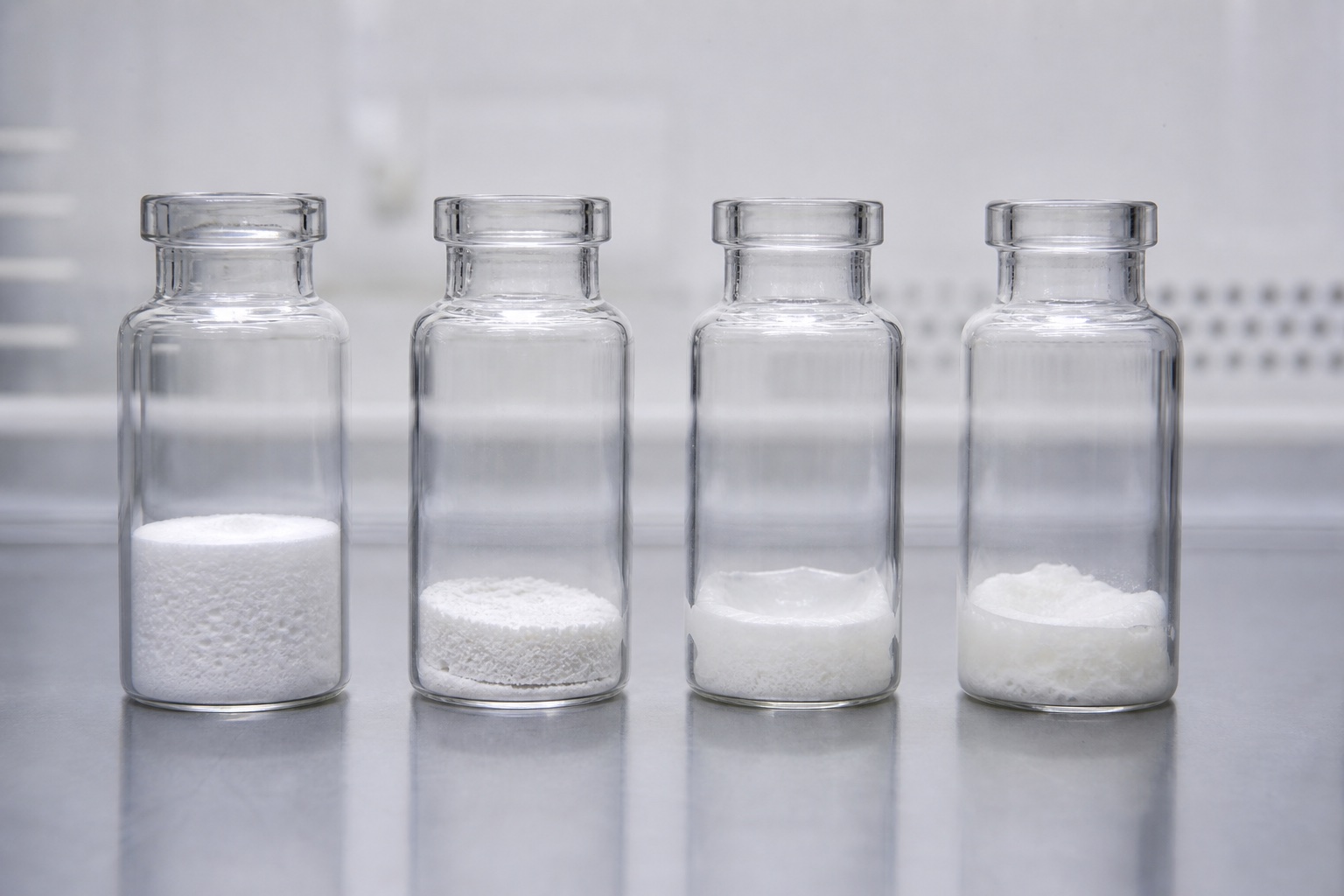
Step 7: decide with product evidence
Compare the liquid control, freeze-thaw control, dried product, reconstituted product, and stability samples. This helps distinguish a formulation weakness from freezing stress, drying stress, storage moisture, or container interaction. The analytical plan should match the known risks of the peptide instead of applying the same panel to every molecule.
Do not infer long shelf life, room-temperature shipping, or freedom from cold-chain requirements from a single attractive cake or one successful engineering run. Those claims require the product's stability program, packaging evidence, and approved storage conditions.
Step 8: challenge repeatability before scale-up
Repeat the selected protocol and challenge realistic variation: minimum and maximum load, vial or fill tolerances, edge and center positions, expected hold-time variation, and relevant equipment alarms. Fixed commercial hold times should be derived from endpoint evidence and a justified margin, not from arbitrary extra hours.
Transfer from Creator to Command
Protocol transfer preserves product history and quality intent, not identical machine setpoints. Compare shelf geometry and mapping, vial heat transfer, chamber radiation, pressure gauges and control response, minimum-load behavior, vapor-path conductance, condenser and refrigeration duty, product-probe strategy, stoppering, data records, and qualification status.
For the equipment side of transfer, continue with the biologics lyophilization technology-transfer guide. For a real project boundary between configuration, commissioning, and customer-owned validation, read the U.S. 13-shelf peptide lyophilizer case study.
Protocol-development package to retain
- Formulation, component, vial, stopper, fill, load map, and handling assumptions.
- Thermal and solid-state evidence supporting the critical product-temperature limit.
- Every recipe revision with shelf, pressure, product-temperature, endpoint, and alarm data.
- Analytical results by vial location, including residual moisture and reconstitution.
- Rationale for operating ranges, endpoint margin, minimum/maximum load, and scale-up changes.
- Receiving-equipment comparison, engineering-batch plan, deviations, and approvals.
Technical references
Frequently asked questions
Is there one standard peptide freeze-drying protocol?
No. The protocol depends on the peptide, formulation, vial, fill depth, critical product temperature, loading pattern, freeze dryer, residual-moisture target, reconstitution, and stability data.
Can published temperature and pressure ranges be copied into a peptide lyophilizer?
They can help frame an initial study, but they are not a validated recipe. Product temperature and drying behavior must be measured in the actual formulation, vial, load, and equipment.
Which run should be optimized first?
First obtain a conservative mapping run that protects the product and provides clear endpoint evidence. Then optimize primary drying, secondary drying, and robustness in controlled steps.
What data should be transferred from a Creator to a Command lyophilizer?
Transfer the formulation and container assumptions, thermal limits, load map, product-temperature and pressure data, endpoint method, moisture and quality results, plus a comparison of both freeze dryers.
Does a successful engineering run prove room-temperature peptide stability?
No. Storage temperature, shelf life, shipping conditions, and reconstitution claims require formulation-specific stability, packaging, and analytical evidence.