Commercial Fruit Freeze Drying: Machine Selection, Process, and Packaging
A process-first guide for farms, snack brands, and factories selecting a freeze-dried fruit machine from H-series trials to industrial FFD production.
Food Freeze Dryer
Short answer: size a freeze-dried fruit machine from the qualified product and daily production target. Define fruit variety and maturity, preparation, slice or piece thickness, kilograms and depth per tray, initial water, freezing method, cycle and turnaround time, finished yield, endpoint tests, packaging, utilities, sanitation, and seasonal operating schedule. A catalog fresh-load number is only a starting reference.
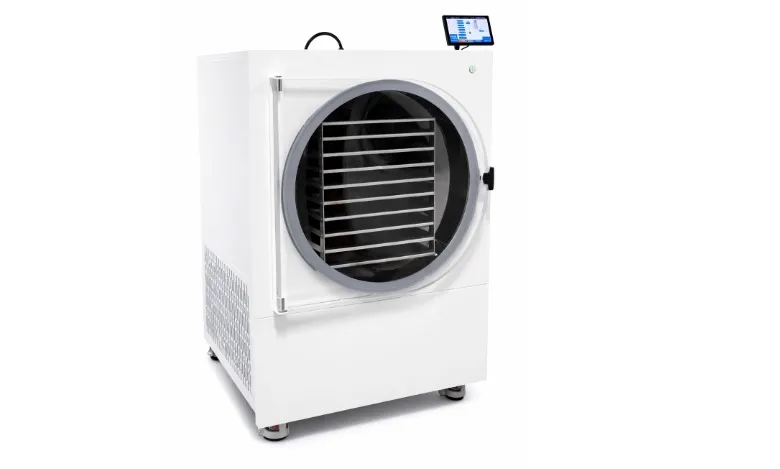
This article addresses freeze-dried fruit machine, fruit freeze dryer machine, freeze-dried fruit machine price, and commercial fruit freeze drying. The existing food freeze dryer selection guide remains the broad H-versus-FFD owner; this page focuses specifically on fruit process evidence and production planning.
Start with the product specification, not the freeze dryer
Write a finished-product brief before requesting equipment. Identify fruit species and variety, harvest maturity, fresh or frozen supply, intended format, color and flavor target, crisp or rehydratable texture, allowed ingredients and pretreatments, target piece integrity, moisture or water-activity specification, package, storage condition, and intended shelf life.
Strawberry halves, apple slices, mango cubes, whole berries, banana pieces, fruit puree, and fruit powder require different preparation and mass-transfer paths. A machine proven with one product does not establish the capacity or cycle for another.
Control incoming fruit variability
Season, variety, ripeness, soluble solids, acidity, firmness, initial temperature, damage, and storage history influence freezing, drying, color, texture, and yield. Define receiving specifications and lot records. If a factory buys from multiple farms, trials should include realistic high- and low-solids lots rather than one ideal sample.
Preparation and pretreatment must be product-specific
Typical steps can include sorting, washing, peeling, coring, slicing, dicing, perforating skins, blanching where justified, anti-browning treatment, draining, and controlled holding before freezing. Each intervention changes heat and mass transfer as well as color, texture, flavor, labeling, wastewater, and labor.
Whole fruit and intact skins can create a strong vapor barrier. Slicing or mechanical skin treatment may improve drying, but it also increases exposed surface, juice loss, oxidation, and breakage. Validate the tradeoff on the actual variety and package format. Do not present a universal slice thickness as a guaranteed recipe.
Standardize tray loading
Record kilograms per tray, kilograms per square meter, layer depth, piece dimensions, orientation, spacing, number of trays, and total water entering the cycle. Level, repeatable loading improves comparison between batches. Deep piles and overlapping pieces produce nonuniform resistance and can leave wet centers even when the tray edges appear dry.
| Product format | Loading issue to test | Quality check |
|---|---|---|
| Slices | Thickness tolerance, overlap, edge drying, sticking to liner | Center dryness, color, crispness, breakage |
| Cubes or chunks | Largest dimension, bed depth, voids between pieces | Wet core, case hardening, rehydration |
| Whole berries | Skin resistance, cracking or perforation, size distribution | Internal moisture, leakage, shape |
| Puree | Layer depth, solids, foaming, liner release | Uniform sheet, residual moisture, milling behavior |
| Powder ingredient | Dry sheet handling, milling, dust control, hygroscopicity | Particle size, caking, package stability |
Freeze consistently before primary drying
The freezing method affects ice structure and therefore the vapor pathways left during sublimation. Record product temperature, freezing equipment, air or shelf conditions, loading density, hold time, and transfer exposure. Products entering the dryer partly thawed or with different thermal histories can behave differently even under the same programmed cycle.
Small H-series machines can be configured for in-machine freezing. At larger scale, a separate blast freezer or IQF route may increase throughput and keep the freeze dryer available for drying, but frozen-cart transfer, room layout, labor, and temperature control must be engineered.
Drying capacity is a water-removal problem
Estimate water entering each batch from fresh load and initial solids, then compare it with the expected finished solids and moisture. The condenser must capture the removed vapor with operating margin, while refrigeration, vacuum, heat input, product resistance, vapor path, and pressure control must sustain the proposed cycle.
Condenser ice-holding capacity is not the same as demonstrated water-removal rate. Ask for both the storage basis and the vapor-load basis. A factory planning more heat to shorten primary drying must verify that the condenser, refrigeration, vacuum system, and vapor path can accept the higher sublimation rate.
Verify the endpoint instead of relying only on time
Develop endpoint criteria appropriate to the product: product-temperature behavior, pressure comparison where available, hold tests, mass change, representative core checks, residual moisture, water activity, texture, and package stability. Sampling should represent different trays and difficult locations, not only the easiest edge pieces.
Freeze drying does not sterilize food. Incoming hazards and cross-contamination still require control through sourcing, sanitation, validated preparation or kill steps where applicable, hygienic handling, environmental controls, and a product-specific food-safety plan.
Package immediately against moisture pickup
Freeze-dried fruit is porous and can rapidly absorb moisture from room air. Plan the unloading room, exposure time, package barrier, seal, headspace, oxygen management where justified, light protection, and finished-goods storage. Validate package performance with actual product over the intended distribution period. Do not infer shelf life from low initial moisture alone.
Translate trial data into machine size
| Scale | SJ starting point | Best use |
|---|---|---|
| Product and market trials | SJ-05H to SJ-20H | Variety comparison, pretreatment, thickness, loading, cycle, package, and first sales |
| Regular commercial batches | SJ-30H to SJ-50H | Farm, snack-brand, ingredient, and small-factory production with dedicated preparation and packaging |
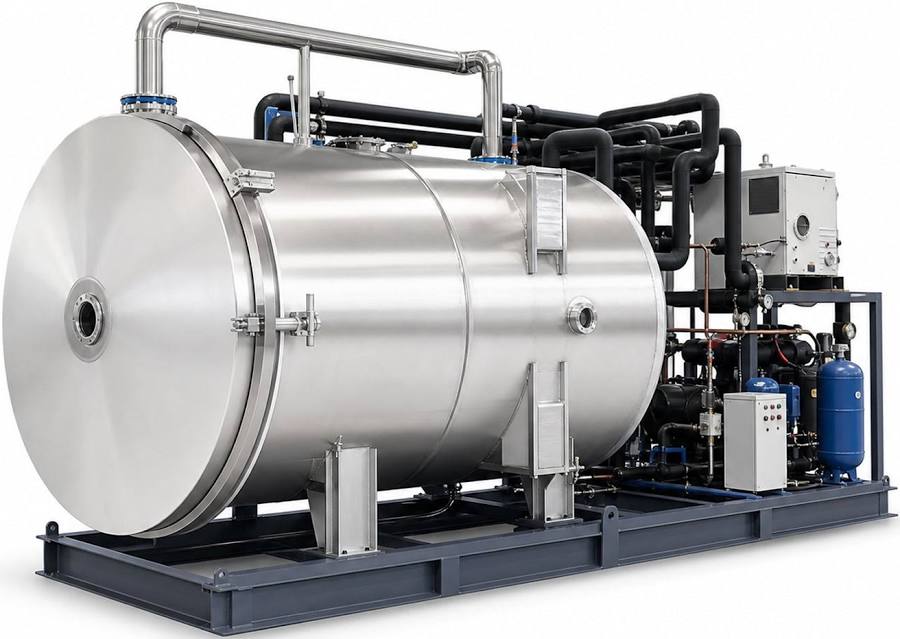
| Industrial factory production | SJ-FFD-50 to SJ-FFD-250 | Engineered cart-and-tray lines, higher daily output, separate pre-freezing, utilities, and factory workflow |
Use the model pages for current public tray area and reference capacity. Final fruit capacity should be recalculated from qualified kilograms per square meter, water load, usable area, cycle and turnaround time, yield, seasonal schedule, and target daily output.
Calculate realistic daily output
Begin with qualified fresh kilograms per batch. Divide available operating hours by the complete door-to-door time, including loading, drying, unloading, defrost, inspection, and cleaning. Apply good yield and planned availability. Seasonal factories should also consider harvest peaks, cold storage, pre-freezer capacity, packaging rate, maintenance windows, and whether one large machine or multiple smaller units gives the required scheduling resilience.
What changes freeze-dried fruit machine price?
Price changes with tray and shelf area, chamber construction, in-machine or external freezing, condenser and refrigeration duty, vacuum system, controls and data, carts and trays, cleaning and defrost, materials, utilities, electrical standard, installation, shipping, FAT, commissioning, training, documentation, spares, and support. Compare total installed line scope rather than a bare chamber price.
Information for a fruit freeze dryer quotation
Send fruit and format, fresh kilograms per day and per batch, seasonal schedule, thickness or piece dimensions, kilograms and depth per tray, initial solids or moisture, pretreatment, freezing method, target cycle and endpoint, finished yield, package, utilities, room drawing, cleaning plan, installation country, and required services. Submit them through the fruit freeze dryer inquiry form.
Technical and food-safety references
- Freeze-Drying of Plant-Based Foods: process and pretreatment review
- Review of physical pretreatments for fruit and vegetable freeze drying
- Comparison of drying methods and quality for apricot slices
- Utah State University: food freeze-drying safety and storage cautions
- FDA food CGMP and preventive-control overview
Frequently asked questions
What machine is used to make freeze-dried fruit?
A food freeze dryer with suitable trays, freezing method, controlled heat and vacuum, condenser and refrigeration duty, sanitation, and packaging workflow. SJ H-series machines cover trials and commercial batches; FFD systems cover industrial production.
How do I size a freeze-dried fruit machine?
Use qualified kilograms per square meter, usable tray area, initial water load, complete cycle and turnaround time, good yield, operating availability, seasonal schedule, and required fresh kilograms per day.
Does the stated kg per batch apply to every fruit?
No. Variety, maturity, solids, piece thickness, tray depth, freezing, cycle, target moisture, and finished yield change practical capacity.
Does freeze drying make fruit microbiologically safe?
No. Freeze drying is not a sterilization step. Control incoming hazards, sanitation, cross-contamination, validated preparation or kill steps where applicable, hygienic handling, and packaging.
What determines a commercial fruit freeze dryer price?
Tray area, chamber, freezing route, condenser and refrigeration, vacuum, controls, carts, cleaning, materials, utilities, electrical standard, installation, shipping, FAT, documentation, training, spares, and service determine the project price.