Commercial Food Freeze Dryer Scale-Up: 20H-50H to FFD
How to decide whether a food project needs SJ-20H, 30H, 35H, 50H, or an FFD industrial line based on real factory throughput.
Commercial Food Freeze Dryer
Short answer: use SJ-20H to SJ-50H when batches can still be handled as individual cabinet loads. Move to an FFD industrial food freeze dryer when output is driven by carts, pre-freezing, fixed loading density, condenser water load, defrost strategy, labor flow, and kilograms per day.
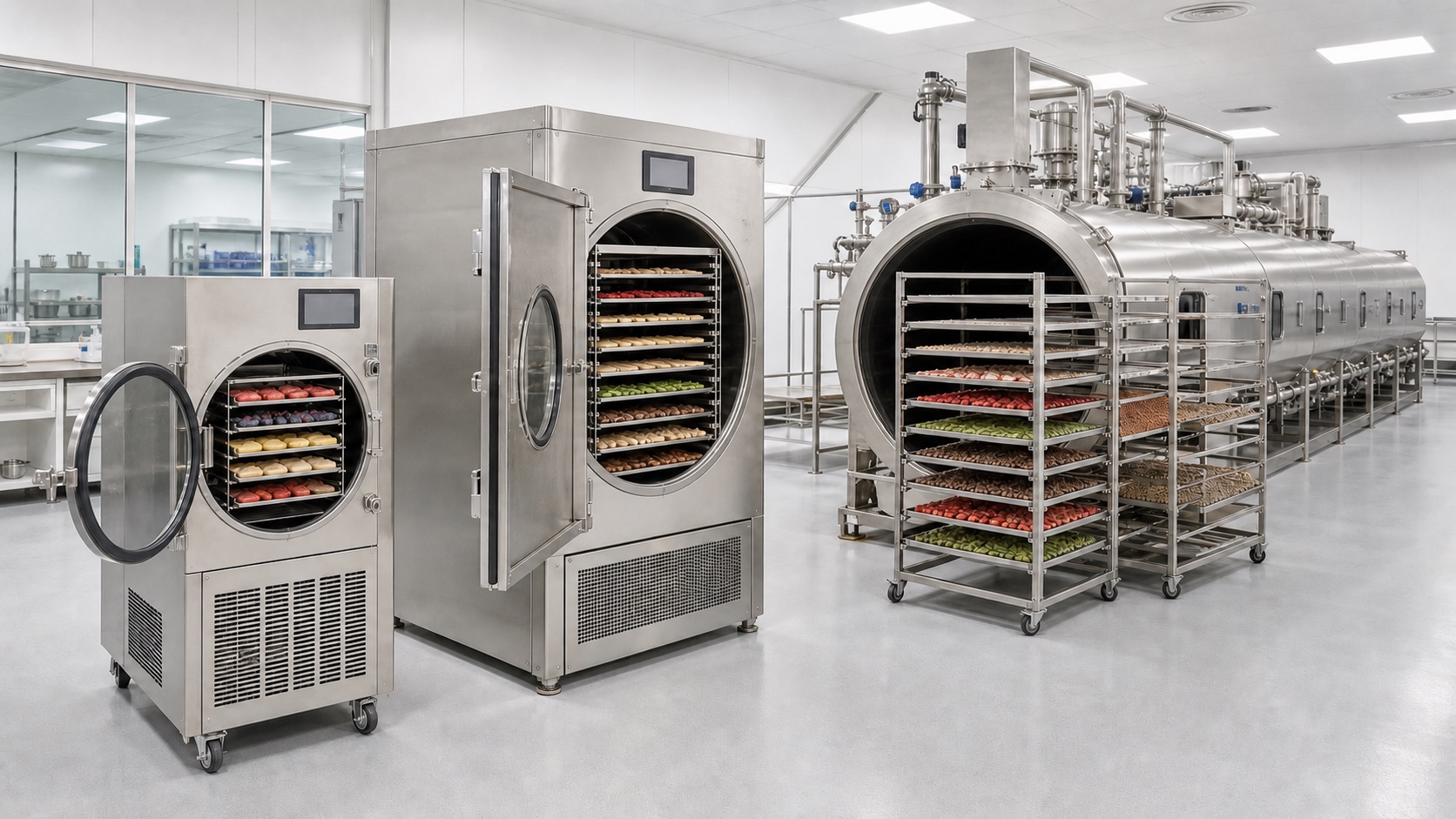
A commercial food freeze dryer buyer often starts with one number: kilograms per batch. That number is useful only when the product and cycle assumptions are stated. This guide connects the upper H series, the commercial H range, and the FFD industrial range.
Where each SJ food freeze dryer fits
| Model or line | Catalog batch reference | Usable area reference | Operational role |
|---|---|---|---|
| SJ-20H Smart | 20-30 kg/batch | 2.21 m² | Micro-production and commercial-readiness trials |
| SJ-30H | 30-45 kg/batch | 2.95 m² | Farm processing, pilot sales, specialty batches |
| SJ-35H | 35-52 kg/batch | 3.5 m² | Regular production with several food SKUs |
| SJ-50H | 50-70 kg/batch | 4.98 m² | Stable commercial batches and scale-up data |
| FFD-50 | Approx. 500 kg/batch | 50 m² | First industrial line and scheduled factory production |
| FFD-100 to FFD-250 | Approx. 1,000-2,500 kg/batch | 100-250 m² | Multi-cart, multi-shift, and high-throughput production |
All kg values are planning references. Final capacity depends on product preparation, loading density, water content, acceptable cycle time, condenser duty, and the required endpoint.
The transition point is usually daily output
A cabinet machine can be a good commercial food freeze dryer when one or several batches per week satisfy demand. FFD becomes more appropriate when the business has a kg/day target and cannot treat loading, defrost, cleaning, and packaging as informal tasks.
Use this basic planning sequence:
- Required shelf area = prepared wet load per batch ÷ proven loading density.
- Water removed = prepared wet load - dry solids retained.
- Full turnaround = pre-freezing + loading + drying + unloading + defrost + cleaning.
- Practical daily output = batch load × 24 ÷ turnaround hours × utilization factor.
The utilization factor accounts for labor, product changeover, sanitation, packaging delays, maintenance, and batches that do not start immediately.
Why tray count alone is misleading
Two machines can have the same number of trays but different usable area. Two products can cover the same area but carry different water loads. A 10 mm fruit slice, a layer of coffee extract, diced cooked meat, and a formed pet-food piece do not create the same resistance to vapor flow.
For every product, record tray dimensions, net product per tray, layer thickness, initial moisture or solids, final moisture or water activity target, and actual cycle time. That turns a catalog model into a production calculation.
Condenser sizing follows the water, not the product name
The condenser has to capture the ice removed during the batch and maintain enough refrigeration and surface margin during the highest sublimation period. A high-water fruit load may challenge the condenser differently from a lower-water ingredient at the same starting kilograms.
Ask the supplier to state whether the condenser figure is total ice holding capacity, expected capture per 24 hours, or an operating recommendation. These are not interchangeable. Also include defrost time in the factory schedule.
20H-50H: when cabinet production still makes sense
Cabinet units are useful when the product mix changes frequently, recipes are still improving, floor space is limited, or the business wants several smaller machines for scheduling flexibility. Multiple units can also provide redundancy: one machine can run while another is cleaned or serviced.
The disadvantages are more repeated loading, more doors and seals to clean, separate pumps and refrigeration systems, and greater operator attention per kilogram. At a certain volume, one engineered FFD line becomes easier to manage.
FFD: what changes at industrial scale
An FFD project adds tray carts, cart staging, pre-freezing, room layout, utility distribution, drainage, condenser defrost, sanitation zones, maintenance access, and packaging balance. The machine may be the largest component, but it is not the whole production line.
- Fruit and vegetables: control slice thickness, browning, loading density, and seasonal intake.
- Coffee and extracts: control fill depth, aroma retention, foaming, and soluble endpoint.
- Meat, seafood, and pet food: plan fat handling, odor, sanitation, pathogen controls, and cold chain.
- Ready meals: test mixed ingredients because starch, protein, sauce, and vegetables dry differently.
- Nutraceutical ingredients: define temperature sensitivity, cross-contamination controls, and final moisture.
Questions that decide H versus FFD
- How many prepared kilograms must ship each day?
- Is the product and loading thickness already validated?
- How many hours does the full turnaround take?
- Will product be frozen in the dryer, blast frozen, or IQF frozen?
- How many operators and tray carts are available?
- Can packaging keep up with the dry product?
- Is redundancy more valuable than one larger line?
- What cleaning changeover is required between SKUs?
For the detailed FFD model calculation, continue with How to Size FFD-50 to FFD-250. For process development, review the food freeze drying process guide.
Frequently asked questions
Is SJ-20H a home or commercial food freeze dryer?
SJ-20H sits at the upper end of the H series. It can support micro-production and commercial-readiness work, while scheduled commercial output may justify SJ-30H, 35H, or 50H.
When should a food company move from H series to FFD?
Move to FFD when output is planned in hundreds of kilograms per batch and the project requires carts, pre-freezing, utilities, sanitation zoning, and factory-level daily output.
How is commercial food freeze dryer capacity calculated?
Use prepared wet load, proven kg per square meter, water removed, complete turnaround time, condenser duty, and a realistic utilization factor.