Industrial Food Freeze Dryer Capacity: How to Size FFD-50 to FFD-250
Learn how to size an industrial food freeze dryer by shelf area, fresh load, tray loading, water content, condenser load, and cycle time.
Industrial Food Freeze Dryer
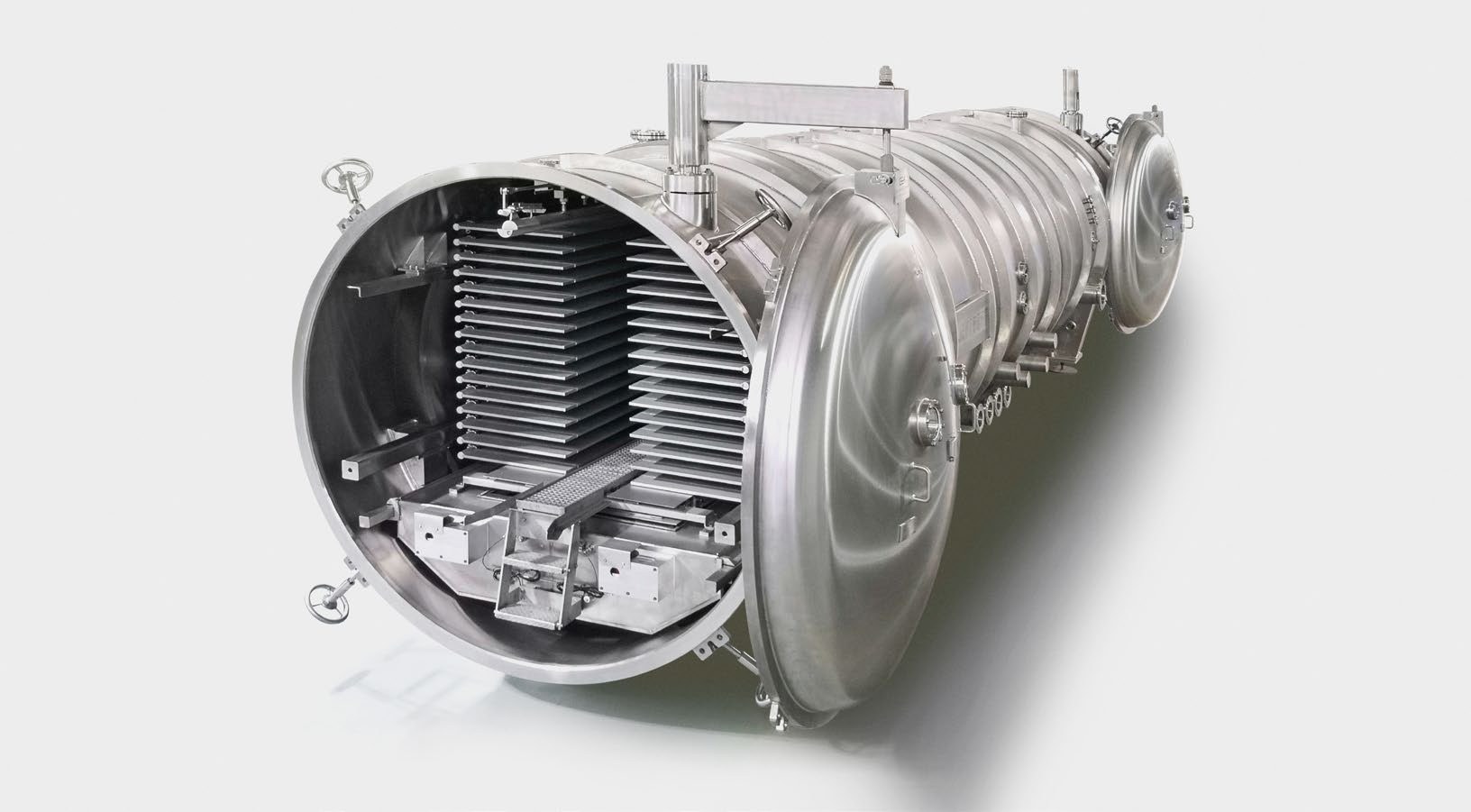
An industrial food freeze dryer is often described by kg per batch, but that number is only a starting point. Real capacity depends on product thickness, tray loading density, initial water content, target residual moisture, freezing method, condenser load, and cycle time.
The FFD series is built as a production platform from FFD-50 to FFD-250. The model number reflects usable shelf area in square meters. A 50 m2 system may be close to 500 kg/batch for some fresh food products, while a 250 m2 system can support roughly 2500 kg/batch when the product and loading pattern allow it.
Step 1: Start with product geometry
Freeze drying is a surface-area and heat-transfer process. Thin strawberry slices, diced vegetables, coffee extract, pet food pieces, and ready-meal components do not load the same way. A product with high fill height may use the tray volume but slow the drying front; a thin product may run faster but require more tray handling.
Step 2: Estimate water to remove
Fresh food may contain 60-95% water. The vacuum system and condenser must handle the ice load created during sublimation. A fruit product and a meat product with the same fresh kg can place different demands on cycle time, condenser load, odor management, and final moisture control.
Step 3: Match shelf area to daily output
| Model | Usable shelf area | Approx. fresh load | Typical role |
|---|---|---|---|
| FFD-50 | 50 m2 | About 500 kg/batch | Entry industrial line, premium snacks, scale-up |
| FFD-100 | 100 m2 | About 1000 kg/batch | Fruit, coffee, pet treats, ingredients |
| FFD-150 | 150 m2 | About 1500 kg/batch | Factory-scale production with output growth |
| FFD-200 | 200 m2 | About 2000 kg/batch | Large-volume pet food, fruit, ready meals |
| FFD-250 | 250 m2 | About 2500 kg/batch | High-capacity multi-shift production |
Step 4: Decide freezing workflow
Some products are frozen inside the chamber. Others are pre-frozen by blast freezer or IQF to reduce chamber occupancy. External pre-freezing can increase production rhythm, but it changes cart handling, room layout, and labor planning. This decision is especially important for large FFD systems.
Step 5: Check packaging and final moisture
Food freeze drying does not end when the cycle ends. The final product must be packed before moisture pickup damages texture or shelf life. For snacks and pet treats, texture and aroma matter. For coffee, beverage ingredients, probiotics, and nutraceuticals, moisture and water activity targets may be tighter.
Practical sizing example
If a producer wants about 1000 kg of fresh fruit per batch, FFD-100 is the starting model to review. If the fruit is loaded thinly and the daily target is high, the project may move toward FFD-130 or FFD-150. If the product is dense, high in water, or requires a conservative cycle, the capacity plan should be checked against condenser load and expected cycle duration.
FAQ
Can I choose an FFD model only by kg per batch?
No. kg/batch is useful for comparison, but final sizing should include product thickness, tray loading, water content, cycle time, condenser load, and daily output.
Which FFD model fits 1000 kg per batch?
FFD-100 is the usual starting point for a 1000 kg/batch discussion, but product behavior and cycle duration may move the final recommendation up or down.
Is FFD suitable for small production?
FFD-50 can serve entry industrial production, but H series or commercial H systems are often better before the project has stable demand and a production room.
Frequently asked questions
Can I choose an FFD model only by kg per batch?
No. Kg per batch is only a rough reference. Real capacity depends on shelf area, tray loading, product thickness, water content, target residual moisture, and cycle time.
Which FFD model fits 1000 kg per batch?
Many projects around 1000 kg per batch evaluate the middle FFD range, but the final model depends on product geometry, loading density, and cycle duration. Shelf-area calculation is required.
Is FFD suitable for small production?
FFD can start from smaller industrial production, but very early recipe trials or small sales batches are usually more economical on H or commercial H systems.