Why Supercooling Can Inhibit Ice Nucleation and How to Improve Freeze-Drying Performance
Why Supercooling Can Inhibit Ice Nucleation and How to Improve Freeze-Drying Performance
General
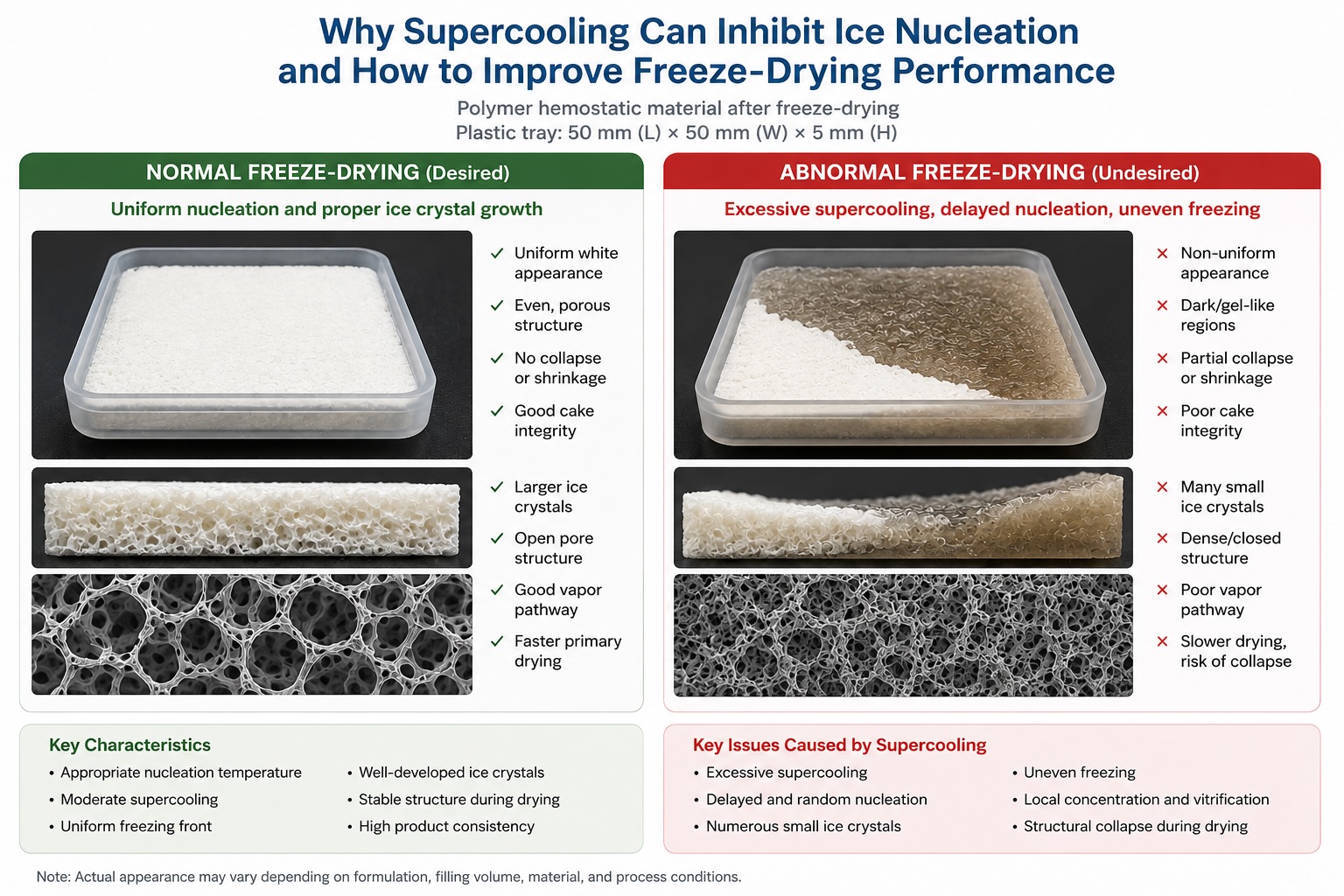
This document is a technical note discussing supercooling, ice nucleation, polymer systems, freeze-drying risks, and process optimization.
Key Conclusions
- Supercooling does not guarantee successful freezing.
- Freezing requires both low temperature and stable ice nucleation.
- Polymer systems often inhibit water molecule organization, making nucleation more difficult.
- Deep supercooling can lead to small ice crystals, poor pore structure, and inconsistent drying.
- Earlier-loaded samples may perform better because they have more time to nucleate.
- Process development should focus on achieving uniform nucleation rather than simply lowering shelf temperature.
Recommended Actions
- Extend hold time at nucleation temperature.
- Deep freeze below -40°C after nucleation is complete.
- Reduce aggressive annealing conditions.
- Consider controlled nucleation technology.
- Compare early-loaded and late-loaded samples.
Frequently asked questions
Should I solve supercooling by lowering the shelf temperature?
Not first. Lower shelf temperature may help after nucleation, but the first check is whether stable and uniform ice nucleation occurs before deep freezing.
How can I tell whether loading time affects nucleation?
Compare early-loaded and late-loaded samples under the same recipe. If early-loaded samples dry better, the process likely needs a longer nucleation hold.
Can annealing make the problem worse?
Yes. Annealing can improve ice structure, but aggressive annealing may soften or damage polymer-rich systems. Test mild and strong annealing separately.