Nutraceutical Freeze Drying: Probiotics, Collagen Peptides, Enzymes, and Supplements
A practical equipment guide for probiotic, enzyme, peptide, extract, and dietary-supplement freeze drying without unsupported health or retention claims.
GMP Freeze Dryer
Short answer: select a nutraceutical freeze dryer from the product and finished dosage form, not from the word “supplement.” Probiotic cultures, enzymes, collagen peptides, botanical extracts, and blended powders have different freezing behavior, heat sensitivity, quality tests, hygiene needs, loading formats, and economics. Define viability or activity where relevant, residual moisture, reconstitution, powder handling, packaging, batch size, and regulatory scope before choosing a lyophilizer.
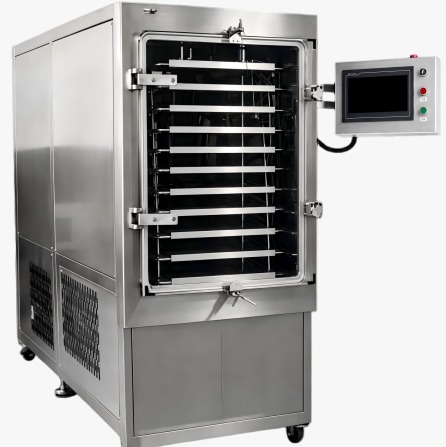
The terms nutraceutical freeze dryer, probiotic lyophilizer, dietary supplement freeze dryer, collagen peptide freeze dryer, and enzyme lyophilizer describe applications, not one universal machine. Freeze drying can support a stability or handling strategy, but the actual retention of viable cells, activity, nutrients, aroma, or other attributes must be measured for the formulation and package. Avoid fixed “retention percentage” claims that have not been demonstrated.
Map the product before mapping the equipment
| Application | Useful quality targets | Equipment questions |
|---|---|---|
| Probiotic cultures | Viable count, strain identity, moisture, storage stability, dispersibility | Freezing control, low product-temperature operation, cleanability, oxygen/moisture exposure |
| Enzymes and functional proteins | Activity, aggregation or degradation where relevant, moisture, reconstitution | Product probes, controlled primary drying, partial loads, endpoint, material compatibility |
| Collagen peptides and peptide ingredients | Identity, purity, moisture, solubility, powder properties, stability | Does freeze drying add value versus spray or other drying? What is the real load and cycle? |
| Botanical and fermentation extracts | Marker compounds, moisture, color, aroma, oxidation, bulk density | Tray depth, solvent review, condenser, cleaning, cross-contamination, powder recovery |
| High-value supplement blends | Uniformity, moisture, activity or assay, flow, package stability | Mixing and fill consistency, tray or vial loading, recipe control, hygienic unloading |
Not every nutraceutical needs a pharmaceutical lyophilizer
Use the risk, format, facility, and records to choose the equipment class. A non-sterile fruit or food ingredient loaded in deep trays may fit an industrial FFD food freeze dryer. A sensitive probiotic, enzyme, clinical nutrition ingredient, sterile vial, or product made under a pharmaceutical-style quality system may justify controlled shelves, pressure, tighter records, stoppering, or a Command configuration.
| Project condition | Likely direction | Confirm before purchase |
|---|---|---|
| Early formulation and small trials | Creator pilot lyophilizer | Temperature, pressure, probe data, partial load, endpoint |
| Controlled high-value small batches | Command SJ-50F(T) or SJ-100F(T) review | Tray or vial, hygiene, data, load, condenser, cycle |
| Flexible vial and tray work | Command F configuration review | Shelf count, clearance, load, stoppering, cleaning |
| Large pharmaceutical-style production | Engineered Command production project | Utilities, CIP/SIP, automation, isolation, documents |
| Ordinary bulk food or pet nutrition | Commercial H or industrial FFD review | Fresh load, tray depth, cycle, sanitation, output, packaging |
Command options for controlled nutraceutical freeze drying
Command systems are most relevant when a nutraceutical project needs controlled shelves and pressure, traceable recipes, sensitive-product handling, vial or tray flexibility, or a pharmaceutical-style documentation path. Ordinary bulk food may fit an FFD food system better.
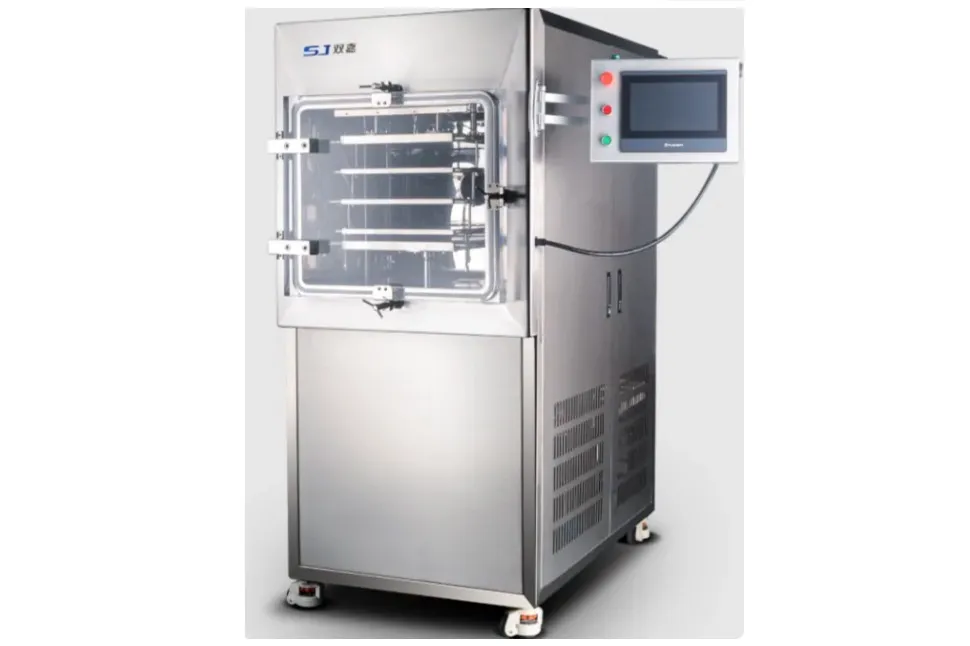
Command SJ-50F(T)
Formulation, probiotic, enzyme, and small GMP-like batches
0.5 m2 shelf area
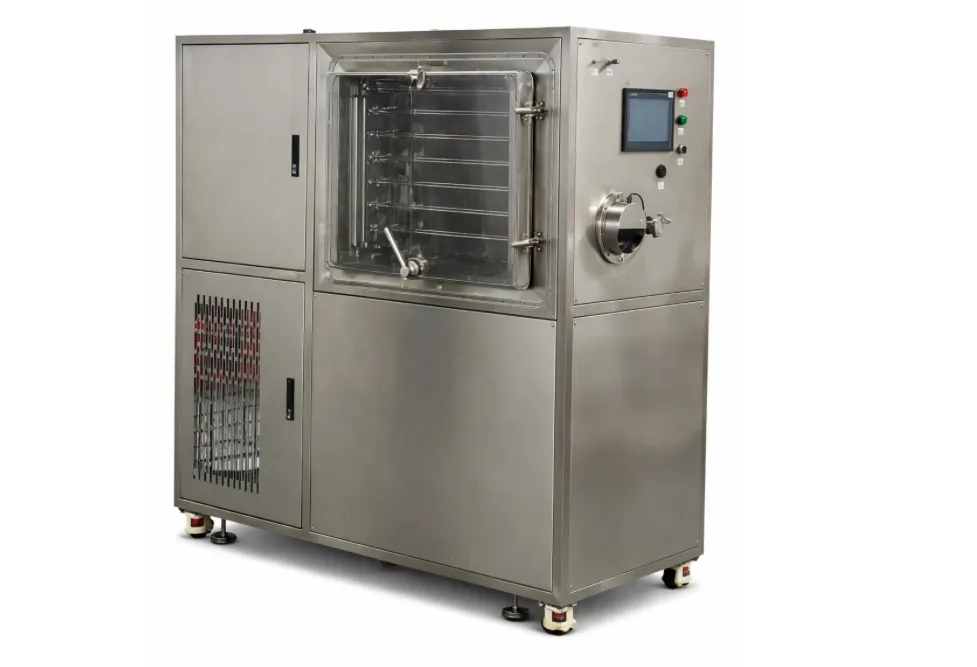
Command SJ-100F(T)
Controlled small-batch supplement production
1.0 m2 shelf area
Command F Flexible Shelf GMP Freeze Dryer
Flexible vial and tray planning for mixed products
1.08-3.51 m2 shelf area

SJ-Command F25M Pharmaceutical Freeze Dryer
Large engineered batches with project-specific configuration
24.48 m2 shelf area
Probiotic freeze drying: protect viability through the whole chain
For probiotics, survival after unloading is only one checkpoint. Strain, fermentation, harvest, concentration, protectants, freezing, primary and secondary drying, oxygen and humidity exposure, milling or blending, packaging, and storage all affect the final viable count. A probiotic lyophilizer should support repeatable freezing and drying, but it cannot repair weak upstream handling or packaging.
- define the viable-count method and report both immediate recovery and stability over the intended shelf life;
- screen protectants and solids with product-specific studies rather than copying another strain;
- monitor product temperature and use a justified process limit during primary drying;
- limit uncontrolled exposure to warm, humid, or oxygen-rich conditions after drying;
- qualify milling, blending, capsule filling, sachet filling, and package moisture barrier where used.
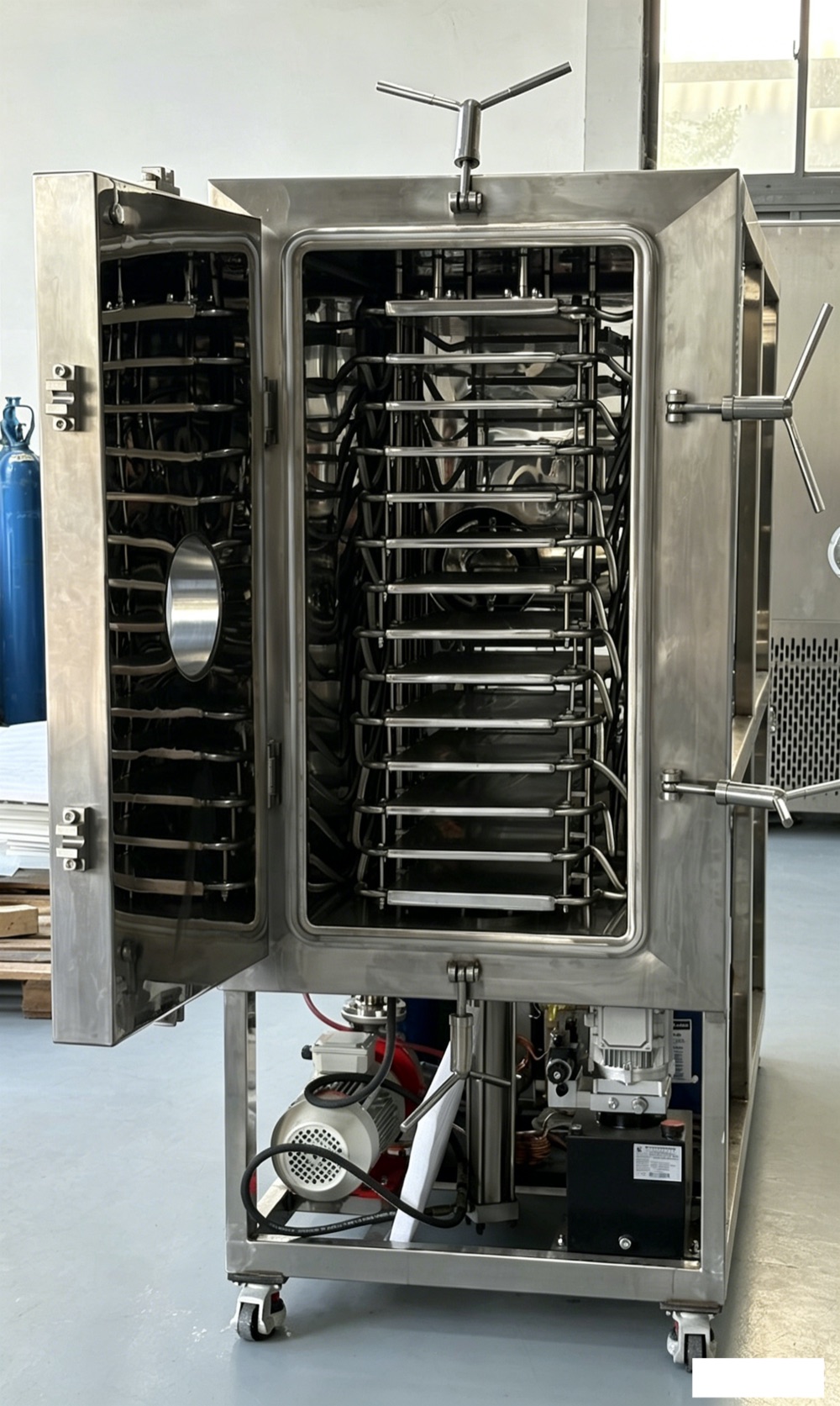
Collagen peptides, enzymes, and extracts need different business cases
Freeze drying may be attractive for high-value, heat-sensitive, porous, rapidly reconstituted, or analytically demanding products. It may be uneconomic for a robust commodity powder that can meet quality targets with spray drying, vacuum drying, or another process. For collagen peptides, prove that the selected drying route improves a required quality or handling attribute enough to justify cycle time and utilities.
Enzymes and functional proteins may require activity assays, aggregation or degradation checks, and controlled reconstitution. Botanical or fermentation extracts may create high solids, sticky matrices, foam, solvent, cleaning, odor, or powder-recovery challenges. Run a representative trial before sizing production equipment from kilograms of wet feed alone.
For peptide and protein fundamentals, continue with the practical peptide lyophilization guide and protein lyophilization guide.
Size from saleable dry output
Record kilograms or liters of wet feed, solids concentration, water or solvent to remove, tray depth or vial fill, usable shelf area, qualified cycle, unloading and cleaning time, good yield, and required batches per day. Then calculate saleable dry output and cost per kilogram or dose. Nominal chamber volume can hide low loading density or a long cycle.
Packaging starts immediately after drying because porous product can regain moisture quickly. Define unloading humidity, hold time, oxygen exposure, container or liner, desiccant where justified, seal integrity, and storage study. A good freeze-drying cycle can be lost in a poorly controlled packaging room.
Information to send for an equipment review
- product class, strain or molecule where appropriate, formulation, solids, pH, solvent, and allergens;
- critical quality targets: viable count, activity, assay, moisture, reconstitution, powder properties, and stability;
- vial, bottle, tray, liner, or bulk format; fill depth; wet load; dry output; minimum and maximum batches;
- freezing route, known critical temperatures, intended cycle, endpoint, packaging and storage;
- food, nutraceutical, pharmaceutical, sterile, GMP-like, containment, and cross-contamination scope;
- cleaning, CIP/SIP, stoppering, backfill, data, automation, qualification, utilities, and installation site.
Compare the Command GMP freeze-dryer range and industrial FFD food systems, or send a nutraceutical process brief so the equipment class is selected before the model.
Technical references
Frequently asked questions
What is a nutraceutical freeze dryer?
It is a lyophilizer selected for a nutraceutical product such as a probiotic, enzyme, peptide ingredient, extract, or supplement blend, with suitable temperature, pressure, vapor handling, hygiene, loading, data, and scale.
Is a probiotic lyophilizer different from a food freeze dryer?
The core process is freeze drying, but probiotic projects may need strain-specific process control, viability testing, protectant studies, controlled unloading, hygiene, records, and packaging that an ordinary bulk-food project does not require.
Does freeze drying preserve all probiotic cells?
No fixed survival rate applies. Strain, protectants, freezing, drying, oxygen and humidity exposure, downstream handling, package, and storage determine recovery and stability.
Should collagen peptides always be freeze dried?
No. Compare freeze drying with spray, vacuum, and other drying routes using the required quality, solubility, powder properties, yield, cycle time, energy, and cost.
When should a nutraceutical project use a Command GMP lyophilizer?
Consider Command when controlled shelves and pressure, sensitive high-value product, vial or tray flexibility, traceable recipes, stoppering, stronger hygiene, qualification, or pharmaceutical-style documentation are required.