How to Evaluate a Freeze Dryer Manufacturer Before You Buy
A practical buyer checklist for comparing freeze dryer manufacturers, quotations, factory capability, FAT scope, documentation, service, and lifecycle risk.
Freeze Dryer Manufacturer
Short answer: do not choose a freeze dryer manufacturer from the lowest chamber temperature or the largest quoted kg/batch. A serious comparison should show who designs and builds the machine, how the proposed model matches your product, what will be tested at FAT, which documents are included, and who will support the system after shipment.
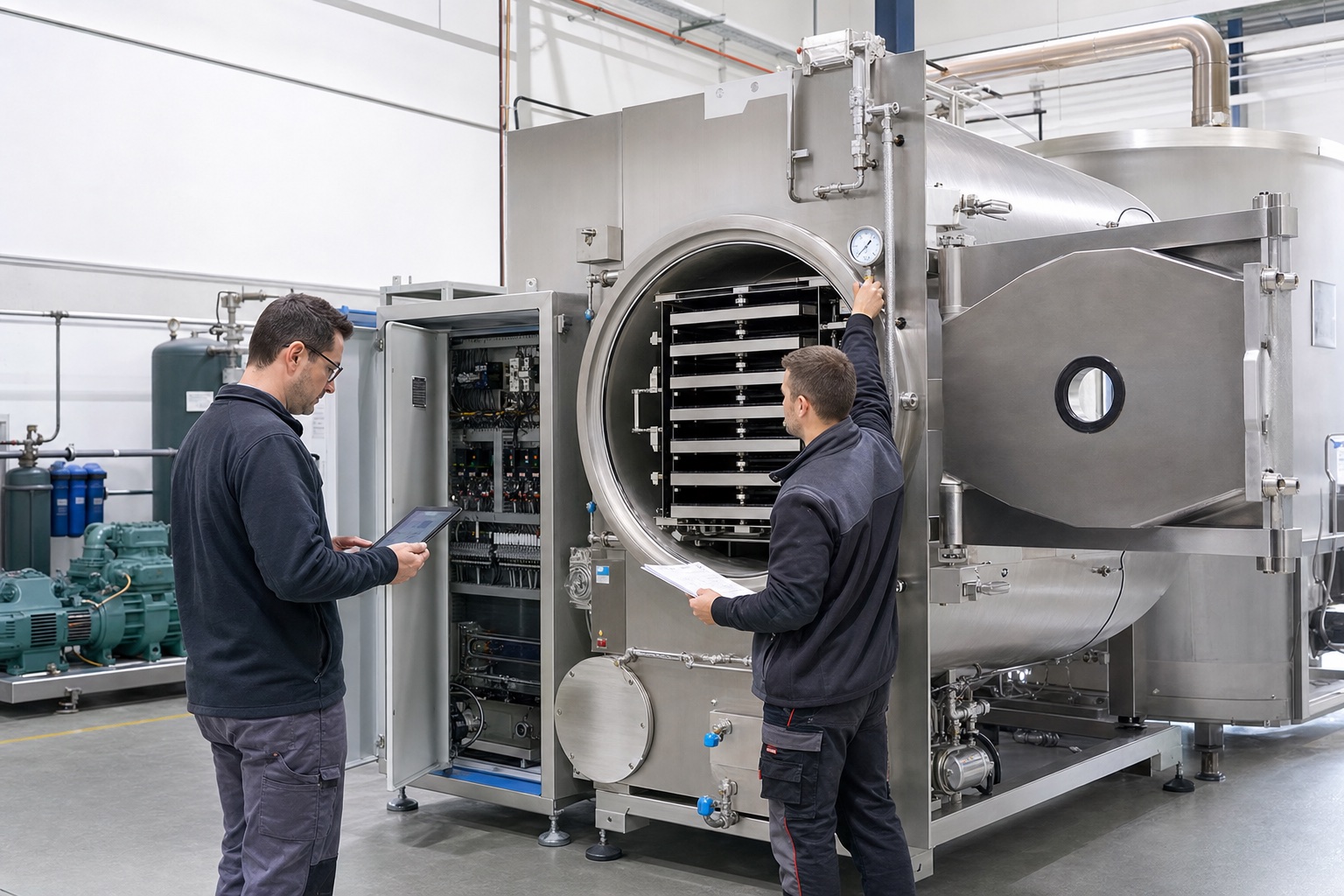
This guide is for buyers comparing a freeze dryer manufacturer for laboratory, food, pilot, peptide, or pharmaceutical work. The same refrigeration and vacuum principles appear across these machines, but the acceptance criteria are very different.
The 15 checks at a glance
| Area | What to ask for | Why it matters |
|---|---|---|
| 1. Legal supplier | Contracting entity, manufacturer, warranty party | Avoids confusion after payment or shipment |
| 2. Application fit | Comparable food, vial, API, or peptide projects | A machine can be cold and still be wrong for the product |
| 3. Sizing basis | Shelf area, product load, water load, cycle assumption | Prevents misleading kg/batch comparisons |
| 4. Shelf performance | Temperature range, ramp rate, uniformity test | Product temperature depends on controlled heat input |
| 5. Condenser | Ice capacity, capture rate, surface and refrigeration margin | Capacity must follow vapor load, not shelf count alone |
| 6. Vacuum control | Control range, sensors, leak test, pressure stability | Ultimate vacuum is not the same as controllability |
| 7. Materials | Contact materials, finish, gaskets, certificates | Supports cleanability and compatibility |
| 8. Controls | Recipes, trends, alarms, roles, data export | Operators and QA need usable records |
| 9. FAT | Approved protocol with measurable acceptance criteria | Defines what “finished” means before shipment |
| 10. Documentation | Manuals, drawings, parts list, certificates, protocols | Reduces installation and validation delay |
| 11. Utilities | Power, cooling water, compressed air, steam, drain | Exposes hidden site costs |
| 12. Service access | Component layout and maintenance clearances | Affects downtime for the life of the unit |
| 13. Spare parts | Commissioning kit and two-year recommended list | Shortens recovery from routine failures |
| 14. Installation | Remote/on-site scope, travel, training, SAT | Clarifies responsibility at handover |
| 15. Change control | Drawing approval and deviation process | Stops custom projects drifting after the PO |
1. Confirm who sells, who manufactures, and who supports
International equipment projects often involve a trading entity, a factory entity, and a brand. That is not automatically a problem, but the relationship should be explicit. Ask which name appears on the contract, invoice, nameplate, manuals, export documents, and warranty. Ask who owns the design files and who can authorize a technical change.
For SJ projects, SJ Scientific Limited in Hong Kong supports international trade and project communication. Ningbo Sjia Instrument Co., Ltd. is the China manufacturing identity associated with SJIALAB equipment and the Alibaba channel. Buyers should see these names as connected operating roles, not unrelated suppliers. The quotation should still identify the exact contracting and warranty entities for each order.
2. Make the manufacturer size the process, not just the chamber
A credible proposal begins with the material. For food, send prepared wet load, product thickness, initial solids, target moisture, freezing method, cycle target, and batches per day. For pharmaceuticals, send vial drawing, fill volume, vial count, critical product temperature, expected ice load, stoppering format, cleanroom interface, and validation requirements.
The proposal should state its assumptions. “500 kg/batch” without product, layer thickness, water content, and cycle time is not a complete capacity statement. “Ten shelves” without shelf dimensions and vial pitch is not a vial-capacity statement.
3. Look for thermal, vapor-flow, and vacuum evidence
Freeze drying is a heat-and-mass-transfer process. The shelf system supplies controlled heat, the product releases vapor, the duct carries it, the condenser captures it, and the vacuum system maintains the selected pressure. These parts must be evaluated together.
- Shelves: ask how temperature uniformity and ramp performance are measured.
- Condenser: ask for ice capacity and the basis for peak capture rate.
- Chamber-to-condenser path: ask whether vapor conductance limits have been considered at the proposed load.
- Vacuum control: ask for control stability in the useful process range, not only final vacuum.
- Full load: ask what changes when every shelf is loaded at the stated depth.
This is especially important when shelf area increases. A manufacturer should not assume that the same condenser is suitable for every shelf configuration without checking water load, sublimation rate, condenser surface, refrigeration duty, and cycle target.
4. Turn the FAT into a decision document
A factory acceptance test should be agreed before the machine is complete. The protocol should identify the test method, instrument, acceptance criterion, record, and response if the result fails. Useful FAT items include visual and drawing checks, I/O verification, alarm and interlock challenges, refrigeration pull-down, shelf control, vacuum pull-down, leak-rate test, pressure control, condenser operation, stoppering where fitted, recipe execution, data export, and document review.
For a GMP lyophilizer, FAT is not IQ/OQ and does not replace site qualification. It should, however, reduce the number of basic design and functional problems discovered after delivery.
5. Compare the document package line by line
“Validation documents included” is too vague. Ask for a document index. A pharmaceutical project may need URS response, design specification, P&ID, electrical drawings, component list, material certificates, instrument list, calibration certificates, software functional description, risk assessment, FAT/SAT protocols, IQ/OQ protocols, traceability matrix, manuals, maintenance plan, and spare-parts list.
A food project may need fewer validation documents but still benefits from layout drawings, utility list, product-contact material declaration, cleaning guidance, operating manual, electrical drawings, and maintenance records.
6. Test the control system from an operator's chair
Ask the supplier to create a recipe, run it, interrupt it, acknowledge an alarm, recover from a permitted stop, export the batch record, and show how permissions work. For regulated projects, review audit trail, electronic signatures, time synchronization, backup, restore, data retention, and recipe version control against the site's own quality system.
A screen that looks modern is not proof that the workflow is practical or compliant.
7. Price service and lifecycle risk
The purchase price is only one part of ownership. Ask which refrigeration components, vacuum pumps, valves, seals, sensors, PLC and HMI parts are locally available. Request a commissioning spare kit and a recommended two-year list. Clarify remote support hours, on-site rates, travel responsibility, software backup, warranty exclusions, and expected response time.
Also inspect maintenance access. A low-cost component can create expensive downtime if it cannot be reached without removing half the system.
Red flags in a freeze dryer quotation
- Capacity is stated only as chamber volume or kg/batch.
- Shelf dimensions, usable area, or shelf spacing are missing.
- Condenser capacity has no water-load or time basis.
- The supplier will not show a proposed P&ID or utility list.
- “GMP” appears as a label without a document and qualification scope.
- FAT means only power-on and visual inspection.
- The contract does not identify who provides installation and warranty service.
- Every application is offered the same configuration with no stated assumptions.
What to send with your RFQ
Send a one-page process brief before asking for a final price: product or formulation type, container, batch size, water load, shelf area or vial count, temperature and pressure needs, cycle target, utilities, room constraints, controls, documents, market, and installation location. Then compare suppliers against the same brief.
For the next step, review SJ Scientific's GMP freeze dryer range, H series food freeze dryers, FFD industrial food systems, or send the process brief through the engineering inquiry form.
Frequently asked questions
How do I verify a freeze dryer manufacturer?
Verify the legal and manufacturing entities, inspect comparable equipment, review drawings and the document index, and witness a FAT with measurable acceptance criteria.
What should a freeze dryer FAT include?
A useful FAT covers I/O, alarms, refrigeration, shelf control, vacuum, leak rate, pressure control, condenser operation, recipes, data export, documentation, and stoppering where fitted.
Is the lowest freeze dryer price usually the lowest project cost?
No. Missing utilities, documentation, commissioning, spares, validation work, or service access can cost more than the initial purchase-price difference.