Laboratory Freeze Dryer Selection: Machine, Price, and Supplier Questions
A practical laboratory lyophilizer buying guide for matching samples, flasks, trays, condenser duty, vacuum, controls, accessories, and quotation scope.
Laboratory Freeze Dryer
Short answer: choose a laboratory freeze dryer from the sample and workflow outward. Define what is being dried, the solvent, total liquid per run, container or flask arrangement, pre-freezing method, required condenser margin, vacuum-pump compatibility, and whether the task is simple sample drying or controlled cycle development. A low advertised temperature and a large collector number do not by themselves identify the correct laboratory lyophilizer.
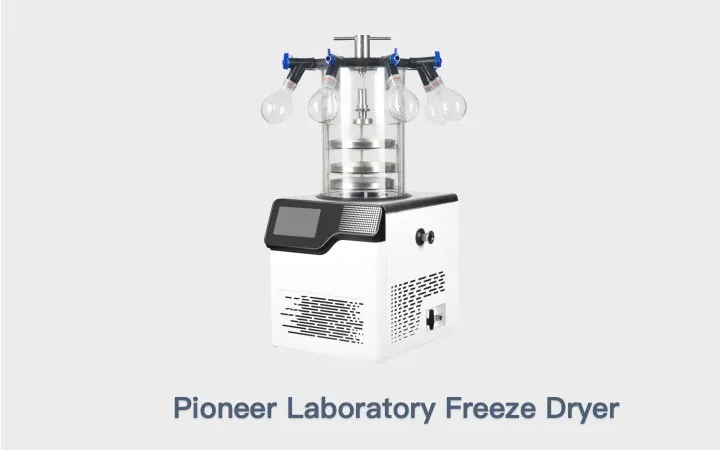
This guide is written for searches such as laboratory freeze dryer machine, lab lyophilizer, laboratory freeze dryer price, and laboratory freeze dryer supplier. It supports the protected Pioneer laboratory freeze dryer series without changing that series page or its indexed product pages.
First decide what the laboratory is trying to do
Laboratory freeze drying covers several workflows that should not be treated as one machine class:
| Workflow | Typical containers | Equipment features that matter |
|---|---|---|
| Routine sample preservation | Small bottles, ampoules, tubes, trays | Collector duty, vacuum stability, practical loading, repeatable operation |
| Flask or manifold drying | Round-bottom flasks, serum bottles, external vessels | Manifold ports, adapters, valves, pre-freezing method, vapor path |
| Bulk material in trays | Shallow trays or dishes | Usable tray area, layer depth, temperature exposure, loading access |
| Formulation or vial cycle development | Partially stoppered vials | Temperature-controlled shelves, pressure control, product probes, recipes, trends, optional stoppering |
A basic collector with manifold accessories can be suitable for endpoint sample drying, but it does not reproduce a shelf-temperature recipe. When the objective is to develop a transferable vial cycle, compare a Creator pilot freeze dryer rather than selecting a larger collector-only unit.
Calculate the liquid and ice load honestly
State the total liquid entering the run, not only the dry solids. Then identify how much of that solvent must be captured before defrost. Collector ice-holding capacity, capture rate, and recommended working load are different quantities. A collector may physically hold a stated amount of ice, but that does not prove it can accept the same amount in one run at the required vapor rate while maintaining temperature and pressure.
Ask the supplier to state the basis of its rating: water or another solvent, pre-frozen geometry, ambient condition, test duration, condenser temperature, and vacuum-pump arrangement. Leave operational margin for uneven loading, warmer samples, door openings, defrost state, and future work.
Choose the condenser from the solvent and process pressure
The condenser must remain cold enough to capture vapor under the intended pressure and load. Water-based samples, low-freezing formulations, mixed solvents, and high-vapor-pressure solvents can require different equipment, materials, traps, pumps, and safety controls. Do not assume that a colder collector automatically makes every solvent safe or compatible.
The Pioneer family offers application-dependent condenser temperature choices, including configurations down to -105°C. The correct choice depends on the formulation and must be confirmed with the supplier. Read the dedicated laboratory freeze dryer condenser-temperature guide before specifying a low-temperature option.
Match the sample format and accessories
A laboratory lyophilizer is often a system assembled from a collector, drying chamber, manifolds, shelves or racks, valves, flasks, adapters, vacuum pump, tubing, mist control, and sometimes solvent traps. Ask what is included in the quotation and what must be ordered separately.
- For flasks, provide flask type, volume, neck size, quantity, adapters, and whether shell freezing is planned.
- For trays, provide usable tray dimensions, product depth, total area, loading quantity, and pre-freezing method.
- For vials, provide vial and stopper drawings, fill volume, quantity, half-stoppered height, and whether in-chamber stoppering is required.
- For tubes or unusual vessels, confirm vacuum compatibility, closure, heat transfer, and a supported loading rack.
Specify the vacuum pump as part of the process
The pump must reach and sustain the required pressure with the expected vapor and solvent. Review pumping speed, ultimate pressure, gas ballast, oil or dry configuration, chemical compatibility, inlet protection, exhaust, oil-mist control, isolation, anti-suckback behavior, noise, and maintenance.
An oil-sealed rotary-vane pump is common and can be economical, but oil condition and vapor management matter. A dry pump can reduce oil-related maintenance but still needs compatibility and performance checks. The pump quoted for a water-based application may not be appropriate for aggressive or organic solvent work.
Separate collector temperature from product control
The collector removes vapor; it does not directly define the thermal history of every sample. For endpoint drying in flasks, controlled shelves may not be necessary. For formulations, peptides, proteins, diagnostics, or vial cycles, shelf temperature, product temperature, ramp rate, pressure control, and data become central.
The existing article Product Temperature Is Often More Critical Than the Condenser explains this distinction. If the project requires programmable shelves and a reproducible pressure setpoint, move from Pioneer sample-drying equipment to the Creator process-development class.
Compare the current Pioneer laboratory range
| Model | Best starting point | Product page |
|---|---|---|
| SJ-Pioneer 3L | Compact benchtop work, flask drying, and small sample loads | View Pioneer 3L |
| SJ-Pioneer 4L | Routine laboratory work needing additional collector margin or configuration choice | View Pioneer 4L |
| SJ-Pioneer 6L | Regular R&D throughput and broader sample-preparation workflows | View Pioneer 6L |
| SJ-Pioneer 12L | Larger laboratory loads and higher sample throughput | View Pioneer 12L |
These collector sizes are model identifiers and comparison starting points. Final working load depends on the sample, solvent, container geometry, pre-freezing, accessory arrangement, vapor rate, condenser option, and pump.
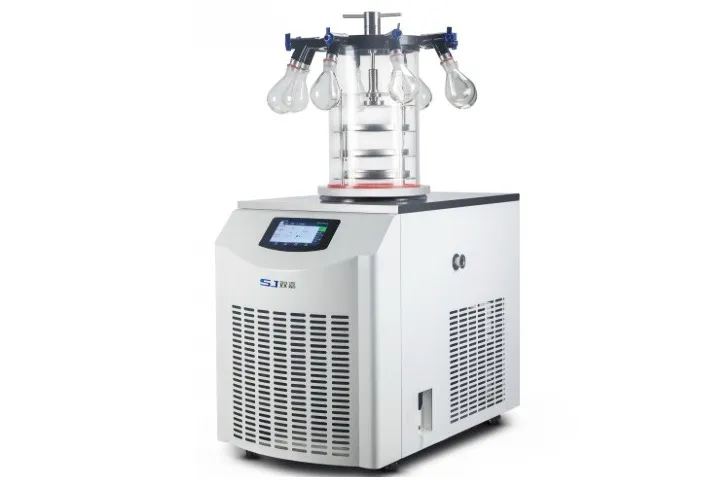
What changes laboratory freeze dryer price?
A useful laboratory lyophilizer quotation identifies the exact collector, condenser temperature, chamber or manifold, number and type of ports, shelves or trays, vacuum pump, valves, adapters, flasks, probes, control functions, data export, corrosion-resistant options, defrost method, voltage, freight, commissioning, warranty, and spares.
Price usually changes with collector size and temperature, refrigeration architecture, vacuum pump, drying accessories, solvent compatibility, controls, monitoring, materials, electrical standard, and service scope. A low machine-only price may exclude the pump and the accessories needed to run the first batch.
Questions for a laboratory freeze dryer supplier
- Which sample, solvent, container, and pre-freezing assumptions support the proposed configuration?
- What are the collector ice capacity, recommended working load, and demonstrated vapor rate?
- Which vacuum pump and protection components are included, and why are they compatible?
- Which accessories are included and which are optional?
- How are collector temperature and vacuum sensors calibrated or checked?
- What maintenance is required for gaskets, valves, defrost, pump oil, filters, and refrigeration?
- Which manuals, test records, warranty terms, remote support, and spare parts are provided?
Send this information through the laboratory freeze dryer inquiry form to receive a configuration-based quotation rather than a generic price.
Useful external references
Frequently asked questions
How do I choose a laboratory freeze dryer?
Define the sample, solvent, total liquid, container, pre-freezing method, desired workflow, condenser margin, vacuum-pump compatibility, accessories, controls, and data needs before selecting collector size.
How much does a laboratory freeze dryer cost?
Price depends on collector size and temperature, refrigeration, vacuum pump, chamber or manifold, ports, shelves and trays, solvent compatibility, controls, accessories, electrical standard, freight, warranty, and service.
Is collector ice capacity the same as sample capacity per batch?
No. Ice-holding capacity, capture rate, and recommended working load are different. Batch capacity depends on solvent, pre-freezing, geometry, vapor rate, condenser performance, vacuum, and operating margin.
When does a laboratory need controlled shelves?
Controlled shelves are important for formulation and vial cycle development where product temperature, shelf ramps, chamber pressure, and repeatable process data matter. Basic flask drying may not require them.
What should a laboratory freeze dryer supplier include in a quotation?
The quote should identify the collector, temperature option, drying accessory, vacuum pump, valves, adapters, containers, probes, controls, electrical supply, documentation, freight, warranty, service, and exclusions.