Peptide Freeze Dryer Selection Guide: Lab, Pilot, and GMP Lyophilizer Requirements
How to choose a peptide freeze dryer or peptide lyophilizer for R&D, pilot, clinical, and GMP production, with practical checks for shelf uniformity, vacuum control, condenser load, stoppering, cleanability, and data integrity.
Peptide Freeze Dryer Selection
Short answer: choose a peptide freeze dryer around process control first, capacity second. For early peptide R&D, the useful machine is the one that lets your team see product temperature, change recipes without friction, and run partial loads without pressure hunting. For clinical or GMP peptide production, the same decision expands into stoppering, cleanability, validation documents, audit trails, and data integrity.
This guide is written for teams comparing a peptide freeze dryer or peptide lyophilizer before a project is fully locked. It assumes you may still be changing formulation, vial size, fill volume, or batch quantity, which is exactly when equipment choices are easiest to get wrong. Read the companion peptide lyophilization cycle development guide for process work, and the GMP peptide lyophilizer validation checklist when the project moves toward regulated production.
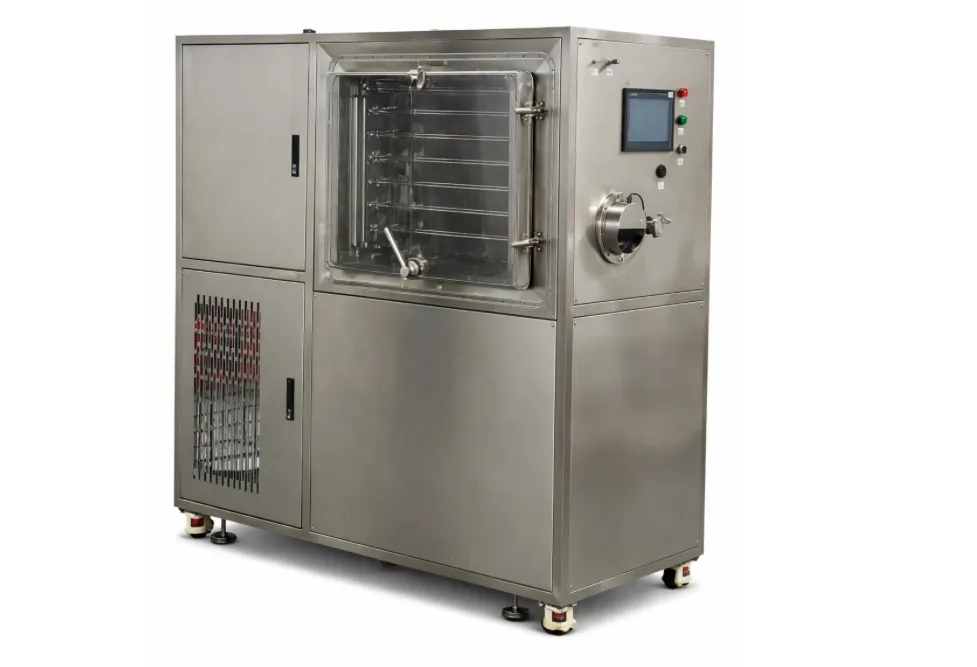
Peptide Freeze Dryer Options by Project Stage
Use the project stage as a starting point, then confirm vial format, fill volume, solvent system, ice load, stoppering, cleanability, and validation requirements with the engineering team.
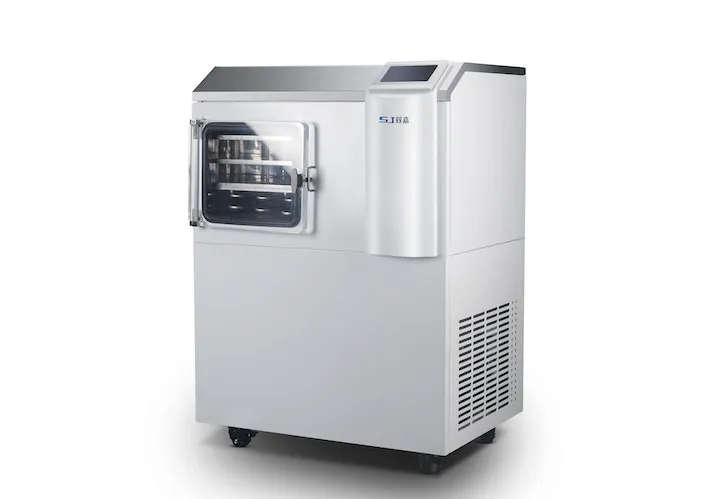
Creator 2S Research FD
R&D and cycle development
0.24 m² shelf area
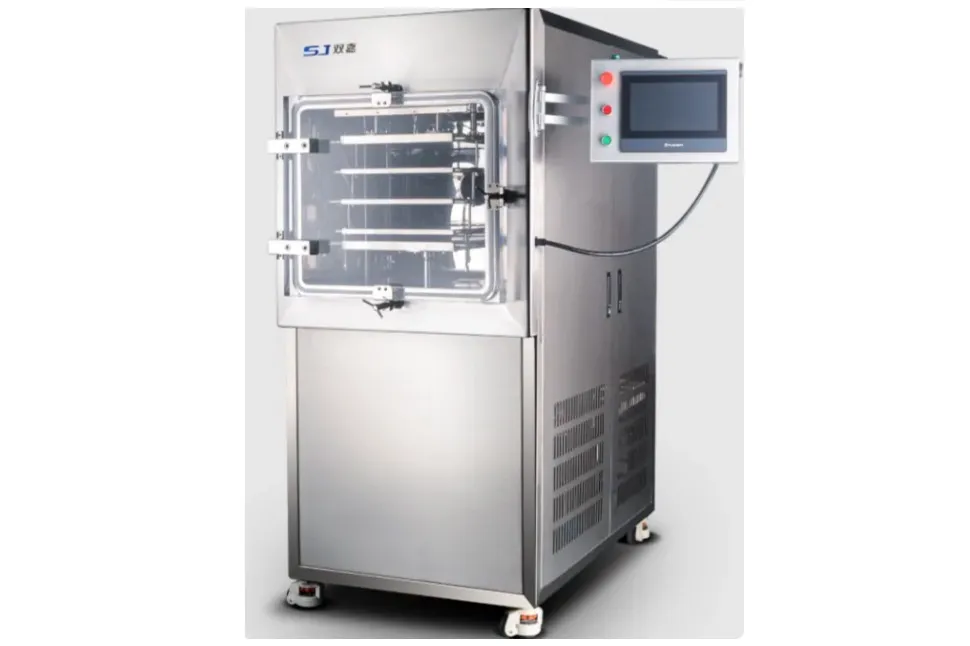
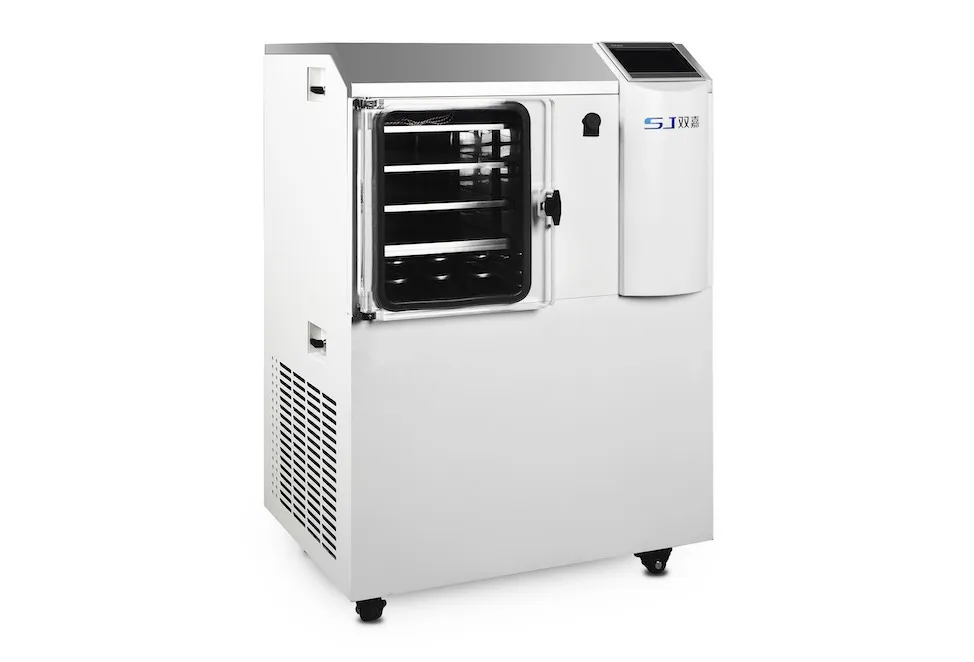
Command SJ-50F(T)
Clinical and compact GMP vial batches
0.5 m² shelf area
Command SJ-100F(T)
Small-batch GMP peptide production
1.0 m² shelf area
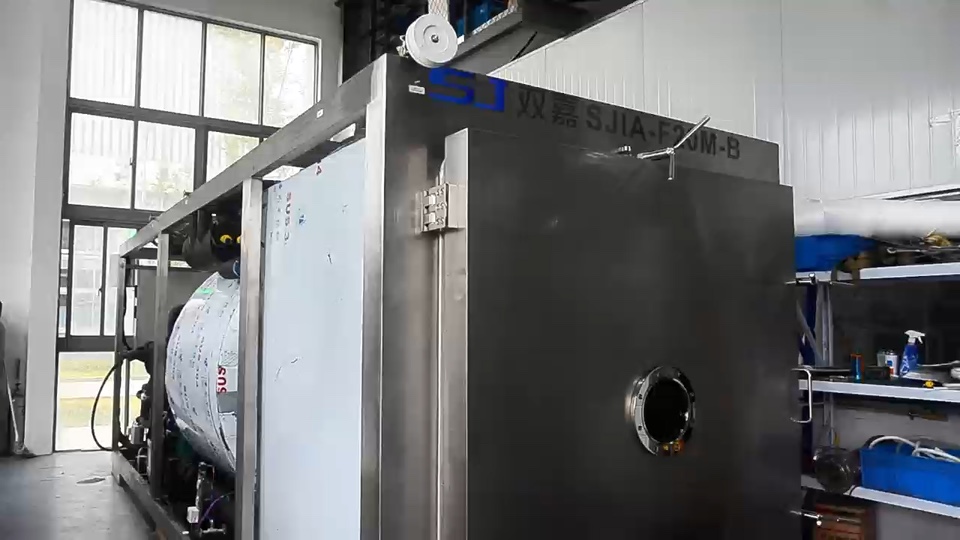
SJ-Command F25M Pharmaceutical Freeze Dryer
Production-scale peptide API or vial projects
24.48 m² shelf area
Start with the stage of the peptide program
In real projects, the first useful question is not "How many liters can the chamber hold?" It is "What evidence do we need from this batch?" A formulation screening run, an IND-enabling batch, and a commercial vial campaign use the same physics, but they do not need the same equipment package.
| Project stage | Equipment direction | What matters most | Where projects usually fail |
|---|---|---|---|
| Formulation screening | Lab or small pilot lyophilizer | Recipe flexibility, product probes, quick loading | A recipe that only works in one vial format |
| Cycle development | Pilot freeze dryer | Shelf mapping, pressure stability, condenser margin | Long cycles with weak endpoint evidence |
| Clinical or small GMP batches | Compact GMP lyophilizer | Repeatable records, stoppering, controlled recipes | Good cake appearance but incomplete QA evidence |
| Commercial peptide manufacturing | GMP production lyophilizer | CIP/SIP strategy, validation package, data integrity | Cleaning or audit-trail issues discovered too late |
| CDMO peptide work | Flexible GMP platform | Recipe management, changeover, material compatibility | One client product fits, another creates solvent or residue risk |
Five specification checks that actually change the outcome
1. Shelf uniformity under the load you will run
Peptide cycles are often product-temperature limited. A shelf map at steady state is useful, but it does not tell the whole story. Ask how the shelf pack behaves during ramping, during partial loads, and at the low temperatures used in primary drying. If the formulation has a narrow collapse window, a small temperature spread can become a batch-quality issue.
2. Pressure control at small vapor loads
Many peptide batches are not full-load production batches. Early programs may run a few trays or a small vial count. Some lyophilizers can pull deep vacuum on an empty chamber but still drift when the vapor load is light. For peptide work, controlled pressure during sublimation is more important than the lowest ultimate vacuum number on a brochure.
3. Condenser behavior, not just condenser capacity
Small peptide batches can still stress the condenser when the cycle is long, the fill volume is high, or turnaround time matters. Review condenser pull-down, temperature under load, ice capacity, isolation, defrost, and vacuum-pump protection. If acetonitrile, TFA, tert-butanol, HFIP, or other solvent traces may be present, treat that as an engineering review, not a footnote.
4. Stoppering and container fit
For injectable peptide formulations, stoppering is part of the process. Check shelf clearance, stopper travel, stoppering force, inert-gas or vacuum stoppering requirements, and loading tools. A clean cake is not enough if the final closure does not protect the product after drying.
5. Cleanability and documentation
Peptide residues, salts, buffers, and solvent traces can make cleaning harder than expected. For non-GMP research, manual cleaning access may be enough. For GMP peptide production, review product-contact surface finish, drainability, gasket compatibility, CIP/SIP options, cleaning validation support, material certificates, and the batch-record workflow before ordering.
Information to prepare before asking for a quote
- Peptide API, sterile intermediate, injectable vial, or research sample
- Vial, tray, flask, or bulk format
- Vial size, fill volume, and expected vial count
- Batch frequency and desired turnaround time
- Expected water load per batch
- Target residual moisture range
- Known collapse temperature, eutectic temperature, or conservative product-temperature limit
- Organic solvent or aggressive buffer presence
- Need for stoppering, inert gas, CIP, SIP, or cleanroom integration
- Documentation level: R&D, pilot, clinical, or GMP
Shelf area should be calculated from real loading geometry, not only from total liquid volume. Many small vials can consume more shelf area than the team expects, while a larger chamber can be awkward if the real work is mostly partial-load development.
Common mistakes when buying a peptide lyophilizer
Buying the largest chamber too early
Oversizing can make low-load pressure control harder and can slow development. A staged path often works better: develop the cycle on a capable pilot machine, then move to a GMP unit after the vial format, fill depth, and product-temperature limit are understood.
Choosing by ultimate vacuum
Ultimate vacuum is a service number. Peptide lyophilization needs a stable chamber pressure during sublimation. Ask for the pressure instrument type, control method, calibration range, and how the system behaves during light loads.
Ignoring residual-moisture distribution
A visually good cake can still have uneven moisture. Edge vials and center vials may dry differently. Development batches should collect enough data to understand location effects before the recipe becomes a fixed GMP cycle.
Leaving GMP documentation until later
If a peptide program might move into clinical or commercial manufacturing, involve QA early. Audit trail, recipe approval, electronic signatures, alarm review, FAT/SAT, and IQ/OQ/PQ expectations are cheaper to define before the system is built.
Practical supplier questions
- What shelf mapping data can you provide for the proposed model?
- How does pressure control behave during partial-load peptide batches?
- Which pressure instruments are used for process control and endpoint review?
- How is condenser load calculated for long peptide cycles?
- Can the system stopper vials under vacuum or inert gas?
- What cleaning approach is recommended for peptide residues?
- What changes if organic solvent traces are present?
- Which batch record, audit trail, recipe-control, and electronic-signature functions are available?
- What is included in FAT, SAT, IQ, OQ, and PQ support?
- How do you support transfer from pilot cycle development to GMP production?
Bottom line
A peptide freeze dryer is not just a cold chamber with a vacuum pump. It is the process-control platform that decides whether a high-value, moisture-sensitive product can be dried repeatably and documented clearly. The best purchase decision connects the equipment to the current program stage and leaves a practical route to GMP scale-up.
FAQ
What is a peptide freeze dryer?
It is a lyophilizer selected for peptide formulations, peptide API, or peptide research samples. The selection focus is shelf uniformity, vacuum control, condenser behavior, cleanability, stoppering, and documentation support.
Is a peptide lyophilizer different from a standard freeze dryer?
The machine platform may be similar, but peptide projects usually need closer attention to partial-load pressure control, residual moisture, shelf mapping, material compatibility, and GMP records.
Should I choose lab, pilot, or GMP equipment?
Use lab or pilot equipment for formulation and cycle development. Use a GMP lyophilizer when the batch must support clinical, sterile, or commercial production with validation documentation.
For a vial-count, fill-volume, condenser-load, and URS calculation, use the pharmaceutical freeze dryer sizing guide.
Frequently asked questions
What is a peptide freeze dryer?
A peptide freeze dryer is a lyophilizer selected for peptide formulations, peptide API, or peptide research samples, with attention to shelf uniformity, vacuum control, condenser behavior, stoppering, cleanability, and documentation.
Is a peptide lyophilizer different from a standard freeze dryer?
The mechanical platform may be similar, but peptide projects usually need tighter review of partial-load pressure control, residual moisture distribution, shelf mapping, material compatibility, and GMP records.
Should peptide R&D use lab, pilot, or GMP equipment?
Use lab or pilot equipment for formulation and cycle development. Use a GMP peptide lyophilizer when the batch supports clinical, sterile, or commercial production.