SJ Freeze Dryer Factory & Workshop Tour
Factory overview video showing SJ freeze dryer manufacturing, assembly, and workshop operations for laboratory, pilot, food, and GMP systems.
For US Biotech, CDMOs, and Process Development Labs
0.5 to 2.16 m² shelf area · 21 CFR Part 11 compliant · 316L contact parts · Validation packages adaptable to lean QA teams · Installed at US biotech sites in Boston, Bay Area, and RTP
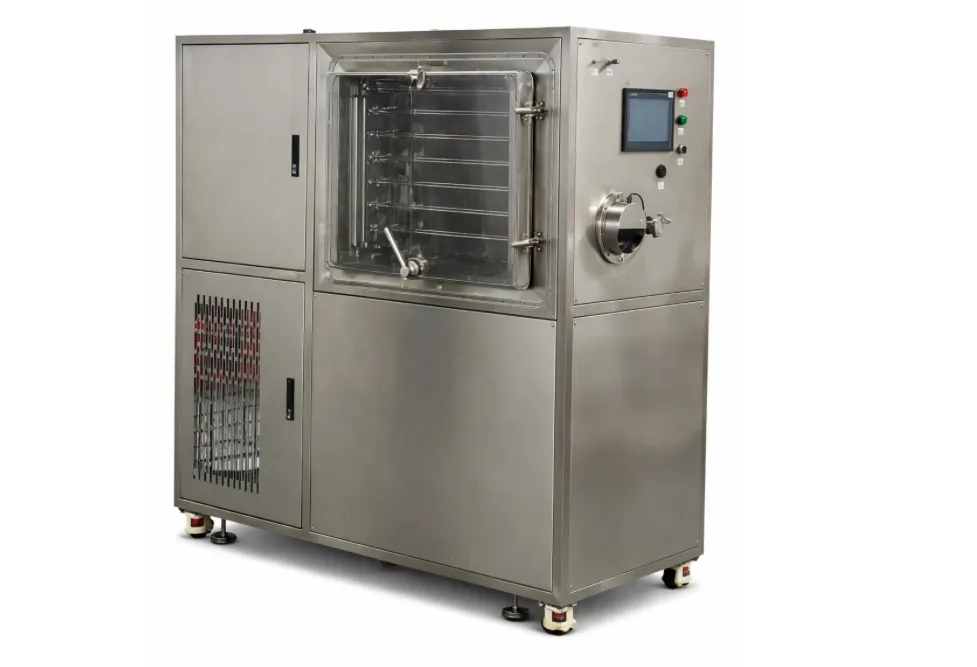
If your IND filing is 12 months away and you're choosing between a $400K system from a major brand or our pilot-scale GMP unit, here's what's actually different. We don't try to compete on legacy. We compete on fit, speed, and price.
| What you usually get from major brands | What we offer |
|---|---|
| $300K – $700K typical pilot system pricing | $60K – $120K range, transparent on our website |
| 4–8 week sales cycle before getting a quote | Budgetary number in 48 hours · No NDA required |
| 6–12 month lead time after PO | 90–150 days from PO to delivery |
| Documentation tailored to large pharma SOPs | Validation packages adaptable to lean QA teams or single CMC consultants |
| Dedicated sales rep, slow technical answers | Direct email access to our process engineers |
| Service contracts starting at $30K/year | À la carte service · Remote SCADA diagnostics standard |
| NDA before sharing technical specs | All technical content available without registration |
Product walkaround, SCADA validation, and process highlights — picked from our video library. Admin chooses which clips appear here.
Factory overview video showing SJ freeze dryer manufacturing, assembly, and workshop operations for laboratory, pilot, food, and GMP systems.
Command 50FT GMP freeze dryer video showing shelf loading capacity, chamber layout, and equipment configuration for pilot and production applications.
SJFreeze Dryer ,F20M Bulk type Freeze dryer
Our pilot-scale GMP systems are currently operating at biotech and CDMO facilities across the major US life science clusters:
Client names and detailed case studies are available under NDA after an initial technical call.
Many vendors say “21 CFR Part 11 ready.” When your QA team or a regulatory consultant actually opens the SCADA, here's what they'll find on our systems.
Your QA consultant can review the full SCADA via screen-share before purchase. We don't expect you to take our word for it.
Your QA team can request a live SCADA screen-share — every audit trail, electronic signature, and access control feature listed here is operational on systems in use today.
All systems include 21 CFR Part 11 SCADA, 316L product contact parts, and standard validation package. Configurations below are typical; custom requirements (CIP/SIP, stoppering, redundant vacuum, custom shelf temperature range) are quoted separately.
| Model | Shelf Area | Shelf Temp | Condenser | Vacuum |
|---|---|---|---|---|
| Command SJ-50F(T) | 0.5 m² (5.4 ft²) | -65°C to 65°C | ≤-85°C | ≤7.5 mTorr |
| Command SJ-100F(T) | 1.0 m² (10.8 ft²) | -65°C to 65°C | ≤-85°C | ≤7.5 mTorr |
| Command SJ-200F(T) | 2.16 m² (23.2 ft²) | -65°C to 65°C | ≤-85°C | ≤7.5 mTorr |
| Command SJ-300F(T) | 3.2 m² (34.4 ft²) | -65°C to 65°C | ≤-85°C | ≤7.5 mTorr |
| Command SJ-500F(T) | 5.4 m² (58.1 ft²) | -65°C to 65°C | ≤-85°C | ≤7.5 mTorr |
Ultimate chamber vacuum ≤7.5 mTorr (≤1 Pa / 0.0075 Torr) — measured empty, post pull-down, with chamber sealed.
Standard configurations: 480V / 60Hz / 3-phase (North America), 400V / 50Hz / 3-phase (EU / Asia), 220V / 60Hz / 3-phase (regional / smaller sites). Other regional voltages available — specify on inquiry.
Every Command-series GMP system ships with a complete validation documentation set. Below is the standard package. Custom additions (FAT/SAT extensions, PAI rehearsal support, custom URS gap analysis) are available on request.
Most pilot-scale GMP lyophilizers in North America are quoted between $300K and $700K, with 4–8 week sales cycles before you even see a number. We do this differently.
| Model | Typical Range (USD, FOB Ningbo) | Standard Lead Time |
|---|---|---|
| Command SJ-50F(T) — 0.5 m² | $60K – $70K | 90–150 days |
| Command SJ-100F(T) — 1.0 m² | $75K – $90K | 90–150 days |
| Command SJ-200F(T) — 2.16 m² | $90K – $120K | 90–150 days |
Final pricing depends on configuration: stoppering, CIP/SIP, redundant vacuum, custom shelf temperature range, or non-standard chamber dimensions. Validation package included in all base prices.
Get a budgetary number within 48 hours. No NDA. No 30-minute discovery call. Just a number for your CFO.
Request Budgetary QuoteNo. We've worked with biotech clients who have a single CMC consultant handling all validation work. Our IQ/OQ/PQ protocols are written to be followed by a small team, with optional remote support during execution. Many clients have a CMC contractor execute the validation against our protocols.
Three layers of support are in place: 1. Remote SCADA diagnostics — included with every system, standard. For ~80% of issues (alarms, parameter tuning, recipe troubleshooting, sensor calibration questions), we resolve remotely within one business day. 2. Regular US travel rotation — our engineering team visits US clients every 2–3 months. Non-urgent onsite work is scheduled around these trips. 3. US-based service partners — for urgent onsite needs that can't wait for our next visit, we coordinate with US-based service technicians on a case-by-case basis. We are actively expanding this network as our US installed base grows. We're transparent that we are not a US-headquartered company with 50 field service engineers. But for emerging biotech teams who value direct access to the actual process engineers who designed their system — rather than navigating a tiered support call center — the model works well. Several of our US clients have specifically cited this as a reason they chose us.
Yes, with reasonable timing. Standard lead time is 90–150 days from purchase order to delivery, plus 2–4 weeks for onsite installation and IQ/OQ. Total: roughly 4–6 months. If you place the order in the next 30–45 days, you still have 3–5 months for engineering runs and PQ before your IND date.
We work with biotech clients on this realistically. Standard payment schedule is 30% deposit, 60% before shipment, 10% after acceptance. We've accommodated payment delays for clients between funding rounds. Talk to us early if there's a concern.
Our process engineers are accessible directly by email and scheduled video calls — not gated by a sales rep. Remote SCADA diagnostics is standard. For onsite issues, we coordinate with US-based service providers for hands-on support, with response timelines arranged before installation.
Our GMP design follows 21 CFR Part 11, FDA cGMP for pharmaceutical manufacturing, and PDA Technical Report 39 for lyophilization validation. Our equipment is currently used in IND-enabling studies in the US. We support clients with mock-PAI rehearsals and have resources to assist with FDA Form 483 responses if questions arise.
Honest answer: if budget is unlimited and timeline is flexible, the major brands have decades of FDA inspection history and we don't. If you need GMP-ready equipment that fits an emerging biotech budget and timeline, and you can afford to spend 30 minutes evaluating a newer supplier, we're a serious option. We'd rather have you ask tough questions upfront than be surprised later.
Yes, for serious prospective buyers (typically after a technical scoping call). We facilitate introductions to current US clients in similar applications, subject to their consent. Most current US clients are willing to take a 15-minute reference call.
Standard delivery is FOB Ningbo or CIF US port. We work with experienced freight forwarders who handle the customs process for pharmaceutical equipment regularly. Typical sea freight transit is 25–35 days from departure. We provide all required documentation (commercial invoice, packing list, certificate of origin, technical specifications) for HS code classification and FDA import filing.
Two ways to start. Pick whichever fits your timeline.
Talk directly to one of our process engineers. We'll review your application, suggest the right system size, and answer technical questions. No sales pitch.
Book a CallFill out a brief form with your application details. You'll receive a budgetary quote and recommended system configuration within 24–48 business hours.
Open Inquiry Form