Microbial screening and media development
Start with 5 L total volume for small-volume trials, culture observation and operator training.
Match the working volume and control package to your organism and development stage.
Start with 5 L total volume for small-volume trials, culture observation and operator training.
Select 10 L for laboratory trials involving feeding, pH correction and oxygen-demand assessment.
Use 15 L to study a larger working volume before moving to a pilot system. Scale-up requires process-specific engineering.
All capacities are total vessel volume. Working ranges are planning values; final values depend on organism, mixing, aeration and foam. Contact us to configure the system for your process.
| Model | Total / working volume | Control platform | Application | |
|---|---|---|---|---|
| SJ-FS-DJ-5L | 5 L / 1.5-3.5 L | 10-inch HMI + PLC | Small-volume microbial screening, media development and training | View configuration |
| SJ-FS-DJ-10L | 10 L / 3-7 L | 10-inch HMI + PLC | Microbial process development, batch and fed-batch laboratory trials | View configuration |
| SJ-FS-DJ-15L | 15 L / 4.5-10.5 L | 10-inch HMI + PLC | Intermediate process development and scale-transition studies | View configuration |
Core functions in the proposed base package; agreed engineering and acceptance criteria govern final supply.
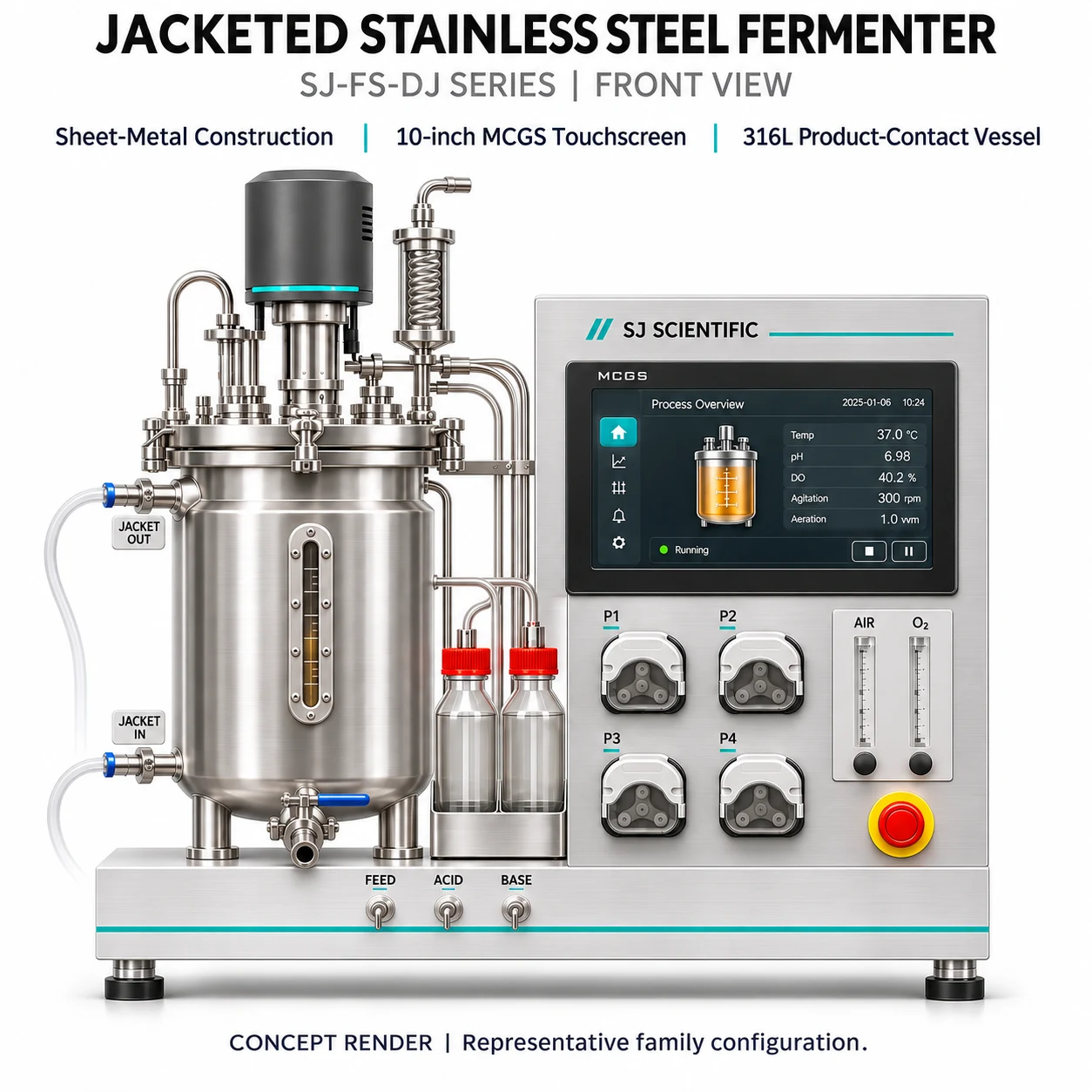
Centralizes process values, settings and operating commands. Check the process from one interface and organize routine operation.
Circulates a heating/cooling medium around the culture vessel. Adjust culture temperature without a cooling coil occupying culture space.
Adjusts stirring within the selected drive and impeller range. Tune mixing to culture volume, viscosity and oxygen-transfer needs.
Measures pH and uses acid/base pump channels under agreed control logic. Correct pH changes with less repeated manual addition.
Measures oxygen availability; agitation response is configured to the process. Identify oxygen limitation and guide the control strategy.
Provides acid, base, nutrient feed and antifoam channels. Keeps addition duties separate and supports planned feeding.
Detects foam at a chosen height and triggers limited antifoam pulses. Respond to foam without relying only on visual checks.
Indicates flow through manually adjusted rotameters. Set the gas supply for each trial; automatic flow requires an MFC upgrade.
Condenses part of the moisture in outgoing gas. Helps reduce evaporation and moisture carry-over; sterile filtration is separate.
Places cabinet fasteners at the rear with clean front and side panels. Provides an uncluttered operator-facing surface and an organized service layout.
Make utilities, sterilization and software scope explicit before ordering.
Manual SIP engineering package proposed, requiring agreed pressure design and steam utility; automated SIP optional
Multi-stage recipes, MFC gas control, data export, access roles and SCADA are quoted to your requirements.
Chiller, air compressor and sterilization utilities are separate unless quoted. Final packing dimensions and gross weight follow approved design and crating.
Open a model for specifications, benefits, applications, related products and downloadable English catalogues.
No. Capacity identifies total vessel volume. The planning working ranges are 1.5-3.5 L, 3-7 L and 4.5-10.5 L for the 5 L, 10 L and 15 L models.
Cooling water circulates through the jacket. An external chiller may be needed when available water is too warm or the culture heat load is high.
It helps condense moisture in the exhaust and reduce evaporation and carry-over. It does not replace the sterile exhaust filter.
No. The conductive probe detects contact at a chosen height. The PLC can apply limited antifoam pulses; this is a point-detection system.
No. Sterilization depends on the agreed vessel, pressure design, seals, valves, steam conditions and drainage. Automated SIP is a separate option.
Do not assume this. The proposed glass route is off-line autoclaving of approved components within their permitted cycle and pressure/temperature limits.
Only if separately listed in the quotation. The base equipment and external utilities are itemized so the quotation matches your site.
Send your URS, organism and documentation needs. Qualification support and data-integrity functions are agreed separately; no blanket GMP or electronic-record compliance is claimed.
Send your product type, target daily output, tray size preference, and utility limits. We will help select the model and outline the production workflow.